In my previous post, below, I argued that Sunzi would oppose torture, especially the kind of systematic torture regime of the latter Bush administration. But the more I think about it, the more a certain question hangs in the air: why? What are the reasons for Sunzi's aversion to torture? Thus far, I have suggested only one, but, the more I think about it, the more I realize there is a second as well.
The first, and most obvious, reason is instrumental. The most direct statement by Sunzi on the topic in 2.19, "Treat captives well and care for them," is preceded by this passage (2.18):
Therefore, when in chariot fighting more than ten chariots are captured, reward those who take the first. Replace the enemy's flags and banners with your own, mix the captured chariots with yours, and mount them.
This suggests that prisoners are a kind of materiel, similar to chariots, that can potentially be turned to serve against their previous army. If we treat them well, we are more likely to be able to put them to our own use. If we abuse them, they will hate us and not want to work for us. The next passage in the text, 2.20, clinches this idea: "This is called 'winning a battle and becoming stronger'."
This, to my mind, is rather weak as a moral argument. The only restriction on torture is the self-interest of the party who holds the captive. If we do not need prisoners to work for us, what then? If our victory is assured, is there really no constraint on how we treat captives? Without further theorizing, Sunzi's thought might be impotent to prevent torture.
But there is further theorizing, at least I think there is. And it lies in Sunzi's notions of a good ruler and commander. Although I would hesitate to call him a "Confucian," since war-making is not central to the Confucian moral project, he does draw upon Confucian notions of leadership. In chapter one, he describes the "five fundamental factors" for success in war: "moral influence" (this is how Griffith translates "Dao," which could be problematic), weather, terrain, command, and doctrine. He goes on to provide more specific definitions of each, and when he gets to "command" he writes (Griffith, 1.7):
By command I mean the general's qualities of wisdom, sincerity, humanity, courage and strictness.
將者,智,信,仁,勇,嚴也
And a commentator adds:
If humane, he loves mankind, sympathizes with others, and appreciates industry and toil.
Lots of Confucian resonances there. You can almost hear Mencius saying that we all have hearts that cannot bear to see others suffer. Interestingly, when discussing the use of spies, which as we mentioned in the last post might sometimes require the killing of an agent who prematurely divulges important intelligence, Sunzi points out (13.13):
He who is not sage and wise, humane and just, cannot use secret agents. And he who is not delicate and subtle cannot get the truth out of them.
非聖智不能用間,非仁義不能使間,非微妙不能得間之實
It is the occurrence of "humane/humanity" – 仁 – that suggests a deeper moral theory at work. Sunzi is clearly suggesting that a commander should be humane, he should be engaged constantly in the cultivation of a virtuous character and should attend to doing the right thing, in terms of humaneness, in everything that he does. Obviously, a military commander is in a tough position, having to give orders to kill and die. And those orders should not be taken lightly. Killing should happen, presumably, only when it must, to secure victory and preserve the state.
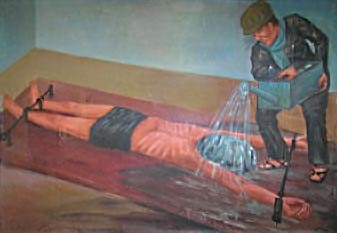
As such, a commander should not want to engage in toruture, or be responsible for torturing, because it obviously inflicts pain and suffering on another person in an inhumane manner. And gentlemen just don't do that. To do so lessens the humanity of the torturer as well as the victim.
We might ask if, in a "ticking time bomb," situation Sunzi's intrumentalism might overwhelm his humanity. There is nothing in the text to suggest that it would. And that tells me that Sunzi would reject a policy of torture. He would have torn up John Yoo's infamous memos.


 The Useless Tree
Leave a reply to Khatzumoto Cancel reply