I was traveling last week, to Seoul and Hong Kong. My primary purpose was to give a couple of talks, though I found some time to meet up with many former students and friends.
First, last Monday in Seoul, I did a lunch time talk at the Asan Institute of Policy Studies, a further development of a paper I wrote a few years ago on the relationship between the re-emergence of Confucianism and the possibilities that it might provide some sort of "soft power" for the PRC. I added to the analytical framework – comparing how liberalism and Marxism moved into China as a point of departure for how Confucianism might move into the US – but my conclusion is the same, as demonstrated by the title: "The Revival of Confucianism: Not a Source of Soft Power for the PRC." It was an interesting group of about twenty five people and some good questions afterward. Some action photos here.
I expanded upon my argument last Friday in a more abstract manner in a talk with the Philosophy Department of Hong Kong University. For that presentation I drew on Pierre Bourdieu's analysis of Martin Heidegger's political ontology, which I used as a method for constructing a sociology of Confucianism in America. I'm still thinking through that project. But before that, on Thursday, I did a talk on Life, Liberty, and the Pursuit of Dao at the Foreign Correspondent's Club in Hong Kong. It was great fun.
But my short time in Seoul got me thinking about Korean Confucianism, in both its historical and contemporary expressions.
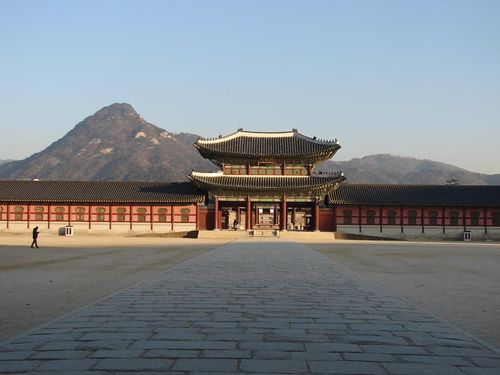
As for history, I visited the Gyeongbokgung Palace, where the rulers of the Joseon Dynasty lived and held court from about the 15th century onwards. Those rulers relied upon Confucianism as a basis for state legitimation. And they built their palace with an eye toward Chinese architecture and feng shui, which physically embodied their expression of Confucian virtue. In the National Folk Museum of Korea there were various exhibits that demonstrated just how deeply Confucian ideals and concepts were inscribed into the society and culture. The assertion that you hear all the time – that Korea is the most "Confucian" society in the world – seems ever more plausible when engaging with these sorts of historical materials.
But that assertion about Korean Confucianism is often stated in the present tense; that is, for all of the turbulence of the 20th century, Korea has been able to preserve more of its Confucian legacy than China or Japan or Vietnam. That statement is hard to verify (how do we measure the depth of "Confucianism" in a particular society?). But there is certainly a self-conscious sense of its centrality and also its attenuation in recent decades.
I chatted briefly with Hahm Chaibong, President of the Asan Institute, who has thought and written deeply about Confucianism in East Asia. He mentioned the continuing, living tradition in Korea, most notably the Confucian academies that seek to preserve values and practices. These places, and the people who center their lives around them, are a tangible example of the presence of Confucianism in contemporary Korea.
But even with such outstaniding historical sites, the question remains: to what extent do the efforts of self-identified modern Confucians influence behavior in the braoder society of Korea? Alhougth it might be true that expectations about family duties may still be strong there now, and that may be a continuing expression of Confucian culture, we are regularly confronted with stories like this:
The country’s elderly spent their lives assuming their children would care for them in old age and did little to prepare for retirement. But their children don’t appear to be fulfilling their end of the bargain — and now the elderly are not faring well economically. The relative poverty rate among senior citizens in South Korea is 49.3 percent, the highest of the industrialized countries. Public pensions tend to be small. And the suicide rate for senior citizens, surely an indicator of economic strain, is the highest among the industrialized countries, at about 80 for every 100,000 people.
Reading that, it is hard to conclude that South Korea is now a "Confucian society," because the actual behavior of many people seems to fall rather far short of Confucian standards. Confucianism might still be a kind of aspirational social goal – people may recognize filiality, for example, as a worthy value – but the pressures of modernity thwart its realization.
I don't mean this as a knock against Korea. It's a great place with wonderful people. But it is not now a "Confucian society." It's not clear to me that any place that has experienced as extensive a process of modernization as Korea – and at this point that would include China and Taiwan and Japan – can meaningfully realize Confucianism on a societal scale. There may be individual Koreans who live by Confucian principles, but, taken as a whole, Korean society it too materialist and competitive and individualized to allow for a fuller social expression of Confucianism.
So, perhaps we should state it in the past tense: Korea was the most Confucian society in the world.


Leave a Reply