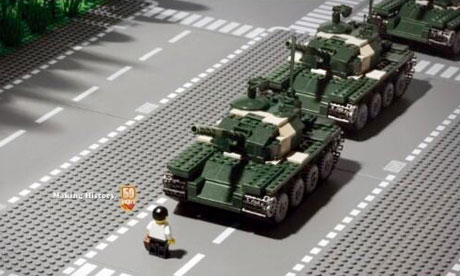
It's a sad day, a day of remembrance of the hundreds and hundreds of people (we still do not have a definitive count) killed by the PRC military in Beijing. I was in Nanjing back on that black day twenty four years ago, watching as the regime sought to repress and distort the reality of what had transpired. The regime continues to repress and distort but, ultimately, it cannot escape from the responsibility it bears for those horrible events.
This is a political problem. It is evident that maintaining economic growth in China requires further structural economic reform: the regime has to allow for an expansion of the "private sector," an enlivening of the entrepreneurial dynamism of social forces unattached to the state. But that "private sector" is not simply an economic space. It is also a political arena, one that, if granted more freedom of economic choice will gain in political power. And even a relatively modest yielding of power from state to society will open up more fissures where those who remember, and demand that that the regime be held accountable for its historical failings, can express themselves and pressure the regime. I don't think the threat here is revolutionary: the CCP is simply too powerful to expect any sort of change of regime from within. Rather, it is a matter of credibility and faith. Even at this remove – 24 years – the evasion of the truth of June 4th is a political problem for the regime, as evidenced in how hard it has to work to continue to repress and distort.
Confucius helps us understand the problem the CCP faces. Here is Analects 13.6 (Hinton):
The Master said: "A ruler who has rectified himself never gives orders, and all goes well. A ruler who has not rectified himself gives orders, and the people never follow them."
子曰:「其身正,不令而行;其身不正,雖令不從。」
Translators in the crowd will immediately notice that Hinton's version is more focused than the original Chinese, which seems to be describing people in general, not only "rulers". Also, who is precisely doing what is open to interpretation here. For example, Watson has this passage as: "The Master said, if the person himself is correct, then although you do not order him to do so, he will act. But if the person himself is not correct, then although you order him, he will not obey."
One reason I like Hinton's take is that he uses "rectify" for 正, which resonates with the notion of the "rectification of names:" 正名, from Analects 13.3.
That notion of "rectification" is important. Confucianism tells us that our actions and our words ("names") must be consistent. We cannot simply assert that we are morally good without actually performing moral goodness in our daily activities. And we cannot use rhetorical evasions to prettify our moral failings. Actions and words must match; and actions speak louder than words.
Thus, Analects 13.3 is both a general statement and a specific admonition to rulers. In our personal lives, we must work to make sure our words match our deeds. For anyone in a position of political leadership, if he or she allows words and deeds to diverge, credibility is undermined and people will simply not believe in or follow his or her pronouncements. Repression and distortion of the truth destroys exemplary leadership.
And that is the problem PRC leaders have faced since 1989. They have repressed and distorted the truth of June 4th. Although they have kept themselves in power, they have failed to rectify themselves and, as Confucius would predict, that failure has sown cynicism and disobedience in Chinese society, making their professed goal of the realization of the rule of law all that more difficult to attain.
But those in the PRC who want to know what happened in 1989, can know. The political leadership cannot hide the truth. It will out. A Confucian might say – and Confucians are generally optimistic in this manner – Rectification, of one sort or another, is inevitable.


 The Useless Tree
Leave a reply to Ngok Ming Cheung Cancel reply