Happy New Year!
2012 ended, as far as blogging was concerned, in a rather desultory manner: only two posts in all of December! So, here's a resolution: more and better blogging in the new year (which would seem to contradict my Daoist leanings, which would tend toward less and murkier…). In any event, we'll start things off in style with a question for the Yi Jing (I have be get back into practice since I will be teaching this text next month): what is the general outlook for the year ahead?
The coin toss yield Hexagram 10, Treading, with no moving lines:

The first thing to notice is the absence of moving lines. What might that suggest? Perhaps the year will be relatively stable, with little in the way of dramatic changes. Or maybe it is meant to call greater attention to the basic Image and Judgment of the hexagram. The latter might well be the better interpretation, since the course of twelve months is certain to produce at least a few significant changes.
The Judgment here points to the possibility of difficult times and the necessity of facing them with caution and decorum:
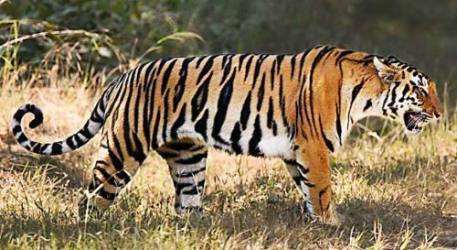
Treading. Treading upon the tail of the tiger. It does not bite the man. Success.
履虎尾,不咥人,亨。
Always like to see "success" (or "prosperity") in the text. That seems good. But that tiger tail: watch out. Wilhelm comments:
In terms of a human situation, one is handling wild, intractable people. In such a case one's purpose will be achieved if one behaves with decorum. Pleasant manners succeed even with irritable people.
There is something to keep in mind in the coming year. We will all – in our work, in our personal lives, wherever – encounter people who are acting unreasonably, or worse. And our challenge is to find the best way to interact with them. The Yi is telling us not be get drawn into petty quarrels but to keep things respectful. That can be hard at times (I am thinking of some "wild, intractable people" in my professional life just now…) but it will pay off in the end.
The Judgment notes, in a rather Confucian tone, that if we can keep interpersonal relationships proper and constructive, broader social and political goods will follow:
Heaven above, the lake below: The image of Treading. Thus the superior man discriminates between high and low, and thereby fortifies the thinking of the people.
The appeal to hierarchy here – high and low – might best be understood in Confucian terms, not as a hereditary privilege but as an earned moral status. We should treat good people – those who are conscientiously working to do the right thing in the world – with the respect they are due; while treating bad people with caution and circumspection. Those bad people, like tigers, can hurt you. But you can't fight them on their own terms; to do so is to both debase your own moral action and to engage with the strength of the adversary, as opposed to exploiting weaknesses (yes, I'm reading Sunzi just now…). If the goal is to come out of the encounter with the best possible result we have to be willing to challenge the bad (step on the tiger's tail) but to do so with care and foresight.
So, the first two questions for the new year are: who are the tigers I will like be facing in the near future; and how, specifically, should I go about engaging them?


 The Useless Tree
Leave a reply to Steve Barru Cancel reply