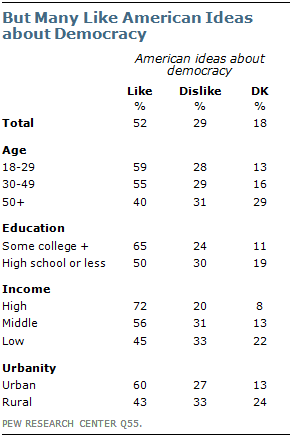
Party ideologists in the PRC, and their apologists, argue that something like "Western-style" or"American-style" democracy cannot and should not happen in China because of the lack of historical and social and cultural grounding.  That sort of democracy is simply alien to Chinese experience.  Odd, then, how, when asked, a majority of Chinese say that they like "American-Style" democracy.  That, at least, is the result of a new survey by the Pew Research Center.

Interestingly, many PRC citizens have rather negative views about the current US-China relationship – but, to my mind, that makes the finding about democracy all the more pertinent: respondents are able to separate the particular issues of American policy and politics from their more general understanding, and desire, for democracy.

Here are some findings:

Chinademocracy

Unsurprisingly, the more urban and educated and youthful, the more positive about democracy, which could suggest that the demand for democracy will grow with time.  

I guess these folks did not get the memo that "American-style" democracy is not really culturally appropriate….

More seriously, these sorts of findings point to the transformation of "Chinese culture" over time.  The idea of "democracy" has been around for a long time in Chinese society and politics.  It is a promise made by the Communist Party and, thus, a standard that people use to assess their concrete realities.  And, apparently, enough Chinese people are sufficiently dissatisfied with actually existing "democracy with Chinese characteristics" that they are open to other democratic possibilities.  Culture, or some ossified definition of "culture," is not an obstacle to the absorbtion of "foreign" ideas. "Democracy," and even forms of that concept that are more common in "Western" cultural contexts, are not really "foreign" to China.  The logic of everyday political life, the experience of highly centralized authoritarian power and extensive corruption, lead people quite naturally to see electoral competition as a potentially positive countervailing force.  

"Democracy," in other words, can translate into Chinese culture with all of its connotations, including its "American" or "Western" meanings.

Wukanelection

Sam Crane Avatar

Published by

Categories:

7 responses to “Chinese Like Democracy”

  1. Ngok Ming Cheung Avatar
    Ngok Ming Cheung

    I do not doubt that majority of Chinese want more democracy. The question is whether “American-Styled Democracy” as you referred is what Chinese really meant. Chinese wanted more freedom to criticize their government, to speak up against corruption, to find justice against venal and corrupt officials. I do not need a survey to confirm common sense. In the internet age some of those freedom are gradually come to realization despite censorship and suppression. I am maybe one of those apologists you referred or an elitist, but Does “American-Styled Democracy” really good for Chinese or for that matter really good for average American? Does voting for Obama or Romney will change the vector and direction of American Empire? The result of “American-Stled Democracy” is resulting an Oligarchy of 1% or is it 0.1% controlling our destiny and increasing poverty. Some of the problems of income ineqality in China are the result of following the American model. Do the average Chinese surveyed understand the difference between democracy as they perceived and the American model?

    Like

  2. melektaus Avatar
    melektaus

    The problem with “American style democracy” is that it isn’t any kind of democracy. The fact that many Chinese people hold naive views of democracy much like many Americans shouldn’t surprise anyone.
    It would be more informative if there was a poll comparing different styles of governing without labels. I’m sure Chinese people see good things in aspects of American style government and some more generally other aspects much as they see good things in their own government (Pew also has surveys showing that the Chinese overwelmingly approve of their central government, in fact more so than the citizens of any country on earth). However, that doesn’t mean American style governence is the only game in town nor that it ought to be. If you ask for American style “democracy,” you just might be unlucky enough to get it. The Chinese people shouldn’t be satisfied with ersatz, titular democracy. They should ask for and demand the real thing.
    They deserve no less.

    Like

  3. melektaus Avatar
    melektaus

    Also, as I’m sure you are aware, the PRC is very dedicated (at least in words) to building democracy. I also happen to think they have done many things in that direction.
    However, the problem is with many people is that they hold incredibly silly views of democracy. They think that democracy is simply a property of formal political institutions. Once you institute these institutions you magically get “democracy”. That’s incredibly silly. Formal political institutions have little to do with actual democracy.
    Real democracy is a property of the population. It has to do mainly with the education (broadly construed) and sensibilities of the people themselves. In that way it’s much like the rule of law.
    The institutions mean very little to nothing if the people don’t trust, correctly apply, and monitor/maintain the practices constitutive of it.

    Like

  4. Ngok Ming Cheung Avatar
    Ngok Ming Cheung

    As a self admitted apologist for China I would like to explore more on the question of democracy. When I visited China earlier this year I found some nostalgia for Mao era despite the horrors of the Cultural Revolution. Some people remember those times as cheap living cost for rent and foods, less pressure for money, and more idealistic strives and egalitarianism even though they have less freedom as defined by West. We in the West put down China when Eastern Europe opened up and hope China would collapse as Societ Union did. Then it was the comparison with India and the scrutiny of various problems with India put that off. Then the Arab Spring springed the hope the jasmine revolution will touch China and that also faded as Libya unraveled and Egypt elected a Muslim government. Everyday we read some new book on the unsustainability of Chinese economy and coming hard landing. Yet despite those misgivings China forges ahead with their own path with their own definition and pace of modernization and yes democracy.

    Like

  5. melektaus Avatar
    melektaus

    China is a huge pluralistic country. Just because some people have nostalgia for Mao’s era and even admire Mao himself doesn’t mean that there aren’t criticisms of Mao in China.

    Like

  6. Ngok Ming Cheung Avatar
    Ngok Ming Cheung

    melektaus,
    My point on the existence of nostalgia for Mao is not just itself, but the existence of a pushback against capitalist American model, whether you call it American-Styled Democracy or Capitalism. The downfall for Bo in no way detracts but reinforces it. There already are experimentation in various locals on basic medical insurance coverage and social security for old people. I suspect the new leadership coming in November will push reforms farther in the direction of more safety net.

    Like

  7. melektaus Avatar
    melektaus

    I don’t know why you are telling me this. This has nothing to do with the original post nor anything I’ve said…
    Perhaps you are just the type that loves reading your own posts.

    Like

Leave a reply to Ngok Ming Cheung Cancel reply