China Heritage Quarterly, a marvelous publication from Australian National University, has a special double issue on an early 20th century Chinese publication, The China Critic. There's a lot of great stuff there. But one piece has gotten some play on my twitter feed, and deservedly so: Lin Yutang's "Confucius as I Know Him," a satirical little essay on the foibles and flaws of the great sage. It is a fun read – fun, at least, for those who have read a little Confucius.
Lin references The Analects and Shiji to draw a rather unflattering portrait of Confucius. The sage could be spiteful, as here:
Let us begin with some examples of his practical sense in the Confucian Analects.
Even if not everything recorded therein was true, it was at least what
Confucius' own disciples said of him. The Third Chapter tells us that
once Ju Pei went to call on Confucius. Confucius disliked the fellow and
told him that he was ill, which is the oriental equivalent of your 'not
at home'. A Western gentleman would stop there. But Confucius went one
better. When Ju Pei was just outside the door, he purposely took a
mandolin, and not only played on it but also san[g] in order to make the
visitor realize that he was in the house after all. When we read the
empty praise by his disciples that Confucius was always polite and
well-poised' we must, therefore, take it with a grain of salt.
It continues in that vein. Lin makes many humorous flourishes, as we might expect from a writer who worked to introduce western notions of "humor" into Chinese texts and contexts (he actually coined the standard Chinese translation for "humor" –
幽默). Confucius, it seems, was rather particular in his eating habits, causing Lin to remark:
Think of a German wife trying to serve a German supper without the help
of the delicatessen! Is it any wonder then that Confucius' wife, who was
married to him at below the age of nineteen, found it hard to submit to
this family discipline?
And, yes, Lin reminds us of Confucius's marital failings:
According to Li-ki [Liji, Classic of Rites], a series of chapters or books compiled by
the Confucian followers, and recognized as one of the Confucian
classics, the Confucian family held a record of three divorces in three
successive generations: Confucius, his son and his grandson. In the case
of Confucius' daughter-in-law, she ran away to marry someone else, but
this does not alter the question that his son's marriage was a failure.
Confucius himself, as I have said, was a man of fine feeling and
extremely good taste. His love of music was well known: when he heard
the old music of Shun, he was spiritually so upset that he forgot the
taste of meat for three months. No one who was not sensually something
of an epicurean or who was not capable of surrendering to the music with
all the force of his emotions, could speak of music in the ecstatic
fashion that he did. But he was an epicurean not only in music, in his
love of curios, his passion for the antique, but also even in the
personal matters of eating and clothing. My suspicion is that it was his
over-refinement in the matter of food that caused his divorce.
And there's more; read the whole thing.
It's important to recognize that Confucius was not perfect. He may not have lived up to the standards of behavior that he preached. And that is instructive. As I say to my students regularly: it's hard out here for a Confucian (yes, that is a popular cultural allusion). But that doesn't mean we shouldn't take the philosophy and ethics seriously. We should. We just shouldn't expect most people to be perfect Confucians all the time.
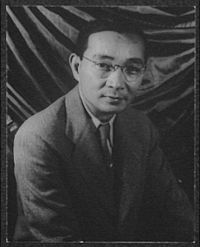
The piece is also interesting in what it shows us about Lin Yutang. He's a fascinating guy. An early-to-mid-twentieth century modern bicultural interpreter and translator. By that I mean, an intellect positioned between China and America who worked to bring ideas and cultural practices from each to the other. Confucius, thus, poses something of a problem for him. "Confucianism,' in its sprawling historical presence, is at once both a source of inspiration and an obstacle to cultural modernization. Thus, Lin pokes fun at the outmoded foppishness of Confucius, but tries to preserve something of the tradition:
But with all his shortcomings, inconsistencies and often unscrupulous
conduct, Confucius remained a very charming character. The charm lies in
his evident sincerity of purpose. When a man is sincere, we can excuse
many of his evident faults.
I suspect Lin tried to hold on to that view in relation to his acquaintances in his own time.


 The Useless Tree
Leave a comment