Daniel A. Bell has a piece today in the CSM, arguing that the PRC political system is, basically, a meritocracy that holds lessons that might correct the flaws of US democracy. Bell is a philosopher and he tends to operate in normative terms (i.e. what a meritocracy ought to be; what a democracy ought to be; how the ideal of meritocracy might improve democracy). I do not want to engage with the normative questions because there is a rather glaring empirical problem: the current Chinese political system is not a meritocracy by the definition Bell puts forth. And I think we could push a bit further to say that, in fact, the imperial Chinese system was not a meritocracy either, if we consider a somewhat broader definition of that term.
Bell gives us his definition of meritocracy right up front:
Political meritocracy is the idea that a political system is designed with the aim of selecting political leaders with above-average ability to make morally informed political judgments. That is, political meritocracy has two key components: 1) The political leaders have above-average ability and virtue; and 2) the selection mechanism is designed to choose such leaders.
He goes on to report that various methods of rigorous recruitment into the Chinese Communist Party have moved the Chinese political system toward this ideal. But there is much evidence that leads to the opposite conclusion: that the very nature and structure of the CCP vitiates the possibility of realizing meritocracy.
I should point out here that various writers and scholars have delved deep into the study of CCP, and their work demonstrates that personal gain and loyalty to the existing power structure are the animating features of the contemporary CCP. It is not about "morally-informed political choices;" it is about gaining power and advantage. Richard McGregor's book, The Party, and Minxin Pei's work on the "trapped transitions" are good starting points for understanding how the PRC polticial system actually operates.
To return to Bell, notice that his definition of meritocracy focuses on "morally-informed political choices," which is to be expected, given his normative focus. We might also define merit more in terms of technical competence (i.e. promoting people who have the technological and scientific skills necessary to answer complex modern questions). For now, we will just focus on Bell's normative definition; but we will have reason to return to the other definition later, when considering some broader, historical aspects of the issue.
Contrary to Bell's normative aspirations, the CCP is currently not an organization that recruits and promotes and rewards people for making the best "morally-informed political choices." We can see this at both the top and the bottom of the political heirarchy.
The case of Bo Xilai, whom some will want to mimimize as exceptional, is quite instructive. Bo rose to the top fo the political system, the Politburo, and was aiming for the very, very top, the Standing Committee. He got there by building a personal empire of connections and payments and coercion. He was quite willing to distort the law to his own purposes of personal power:
Bo’s enormous power as the top Communist official in Dalian manifested in other more sinister incidents. After Dalian-based journalist Jiang Weiping wrote three anonymous articles in a Hong Kong publication that criticised Bo for his role in a corruption scandal, he was sentenced to eight years in prison on charges of subversion and stealing state secrets. He served nearly six years before he was freed and fled to Canada.
Persecuting journalists who are trying to tell the truth about corruption is not a "morally-informed political choice."
And things got worse, much worse, when Bo took power in Chongqing and initiated an anti-crime campaignto burnish his political image:
"The anti-mafia campaign in Chongqing wasn't based on the rule of law," says lawyer Li Zhuang, who represented an alleged gang member. "It was an anti-mafia campaign for political purposes. It overrode the law, it ignored basic legal procedure and it even violated basic human morality."
When Li first met client Gong Gangmo, Gong told him Chongqing police had tortured him sporadically over a period of eight days and nights.
"They hung him from the ceiling, so he could touch a table with his toes, but he couldn't put his heels down," Li recalls being told. "He was hanging for a long time, so he soiled himself. An interrogator took him down, and ordered him to clean up the mess with his hands, and wipe the floor with his shorts. Then they hung him up again naked."
It should be noted that Bo's trangressions were illegal and immoral by the standards publicly espoused by the CCP in it's efforts to develop the "rule of law" in China:
“Even by Chinese Communist Party standards, this is unacceptable,” said Cheng Li, an analyst of the Chinese leadership at the Brookings Institution. “This is red terror.”
If Bo's police chief had not desperately run to the US Consulate in Chengdu to get out from under the scandal, Bo might still be in power, moving toward the highest office. The internal workings of the Party had been impotent in the face of his actions. It was only when the story broke internationally, and the eyes of the world were able to see the truth of Chongqing, that the Party removed Bo.
Bo is unusual only in the scale of his abuse of power. He got away with a lot because he had a lot of power. But at lower levels of the vast Party machine, the interests of power regularly contravene morality. Again, when I say "morality" here I do not need "Western" standards, but standards articulated by the Party itself. This is what we see in the Chen Guangcheng case.
It was local Shandong party authorities who held Chen without charge, beat him and punished his family. They did so to isolate and silence him so they could preserve their local power and, they thought, their reputations. Obviously, these were not "morally-informed political choices."
We could go on to adduce other cases. Suffice it to say, if the PRC political system were truly a meritocracy it would not have to routinely lie and distort in its efforts to maximize its power, as it did in the 2003 SARs outbreak, and the 2005 Songhua River spill, the 2008 Siquan earthquake school collapse scandal, or what now appears to be dissembling and evasion in reporting the truth about the Beijing flood. None of these are indicative of "morally-informed political choices."
Now, it must be said that there are, no doubt, many well meaning and ethically upstanding people working in the PRC's vast bureaucracy. But the system, with its powerful material incentives for corruption and self-interest, does not live up to Bell's ideal of meritocracy. It makes me think of Gandhi's response when asked about western civilization: "it could be a good idea."
Finally, if we think in more technocratic terms, a meritocracy that centers on promoting people with the best technical and scientific credentials, we might also find the current Chinese political system lacking. We could debate that. But thinking in these terms leads us to a conclusion about imperial China: when confronted with the challenges of Western technology in the 19th century it proved to be incapable of systemic adaptation and, thus, was lacking a certain technical meritocracy. Mandarins and gentry were too wed to the old order, they benefited materially and politically too much, to concern themselves with change. There were, of course, some Chinese leaders – Kang Youwei, Liang Qiqiao, countless entrepreneurs and activists – who tried to change. But they were thwarted by a system that did not promote people with the technical expertise required to understand and manage the transformations that the times required. Political and personal interest reigned supreme…. Come to think of it, that sounds rather like 2012 as well….
Bottom line: US democracy is flawed. There may well be some aspects of China's experience that could be useful in thinking about how to improve US politics and society. But CCP meritocray is not one of them because it does not actually exist.
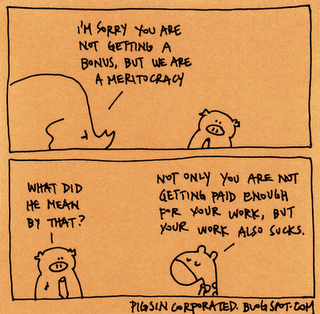
(illustration from Pigs Incorprated)


 The Useless Tree
Leave a reply to FOARP Cancel reply