Daniel Bell and Jiang Qing have a short op-ed in today's NYT outlining what a Confucian political system for China might look like. This is a large and complex topic, and the brevity of the piece really cannot do it justice, so any critique must be limited: I'm sure Bell and Jiang have much, much more to say by way of elaboration of this topic. But even in this roughtest of outlines, there seems to be something essential missing, at least to my mind: the notion of popular sovereignty.
Bell and Jiang suggest that regime legitimacy is not simply a matter of the "sovereignty of the people." They then invoke a tripartite definition of legitimacy, drawn from a particular reading of certain Chinese classics, and arrive at a suggestion for a tri-cameral political system:
In modern China, Humane Authority should be exercised by a tricameral legislature: a House of Exemplary Persons that represents sacred legitimacy; a House of the Nation that represents historical and cultural legitimacy; and a House of the People that represents popular legitimacy.
The leader of the House of Exemplary Persons should be a great scholar. Candidates for membership should be nominated by scholars and examined on their knowledge of the Confucian classics and then assessed through trial periods of progressively greater administrative responsibilities — similar to the examination and recommendation systems used to select scholar-officials in the imperial past. The leader of the House of the Nation should be a direct descendant of Confucius; other members would be selected from descendants of great sages and rulers, along with representatives of China’s major religions. Finally, members of the House of the People should be elected either by popular vote or as heads of occupational groups.
At base this scheme rejects the centrality of popular sovereignty, by giving the "people" only one house, which could be blocked and legislatively defeated by the other two, more narrowly drawn elitist, houses. It also conflates the ideas of legitimacy and sovereignty, which are not necessarily the same.
My sense is that this is wholly unrealistic in light of twentieth century Chinese history.
When the Qing dynasty finally fell in 1911, China embraced the notion of popular sovereignty, and it has never relinquished that position. Of course, historically, that ideal has been violated, sometimes with horrible irony, as in Mao's notion of the "people's democratic dictatorship." But the key issue for the constitution of Chinese politics is not whether the people ultimately are the source of sovereign rule, but how the people's interests are best expressed: through either democratic or authoritarian representation.
A limitation of popular sovereignty in a new constitution would be experienced by many Chinese people as a give back of sorts. They, the people, have been recognized as the rulers of their own country for a hundred years now. Moreover, the vast majority of countries in the world today accept, at varying levels of abstraction, the notion of popular sovereignty. Even constitutional monarchies, like the UK, where a hereditary queen symbolizes the nation, generally constrain the monarch's power in the interest of popular sovereignty.
For most of the world, China included, popular sovereignty is one of those facts of modern life that seem now inescapable. We can complain about the inefficiencies of this or that particular arrangement of democratic politics (and, we must remember, there are many, many particular formations that democracy can assume), but it seems too much of a throw-back to a by-gone era to assert the idea that sovereignty somehow should reside in a specific group of individuals based simply on their hereditary status (descendants of Confucius?) or, even, there performance on some sort of exam.
The problem here is how we adapt traditional texts and ideas to modern contexts. In China, there is a certain desire to construct a distinct modernity, one that includes aspects of Chinese tradition. This is true for most places on earth. But, of course, there is great tension and debate regarding just what aspects of tradition are worthy or useful to bring forward and preserve or refashion. Virtually no one argues that foot-binding should be brought back. Nor has the notion that Chinese culture and society are essentially agrarian been invoked to impede what has been, in the past three decades, perhaps the most extensive and intensive urbanization in world history. Marxism, famously, has been used to define and structure the politics of the PRC: a non-Chinese ideology that is somehow culturally appropriate. We could go on…
The point is: there is nothing definitive about any aspect of "tradition," a hopeless large and fuzzy concept. A rejection of popular sovereignty is no more culturally necessary than is the return of footbinding.
Bell and Jiang's argument is, then, simply political. They are skeptical about how a "Western multi-party democracy" might fit contemporary Chinese circumstances, and likely believe that authoritarianism has suited China just fine. They may also, I suspect, not like what China has become: a socially and culturally pluralistic and dynamic society that has moved away from tradition and toward various possibilities of modern politics and economics.
But at this point China is simply what it is. It is now, and has been for a hundred years, a political system founded – imperfectly to be sure – on the principle of popular sovereignty. That political foundation is not un-Chinese. It has been accepted and adapted into Chinese life. To reject it now, if favor of an inchoate reinvention of supposed "tradition," would not be a return to an ideal Chinese past. It would more likely spark a popular revolution, one is which the Chinese people would demand, again, to stand up.
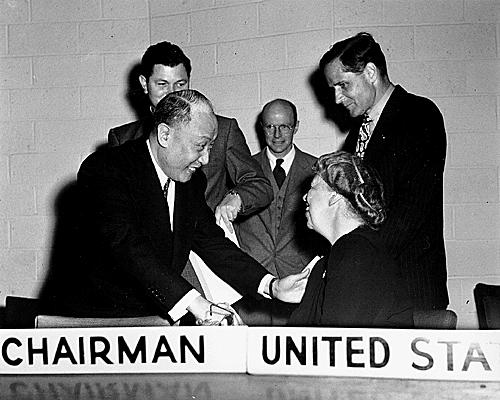
(photo of P.C. Chang, Chinese representative to the UN Commission on Human Rights)


 The Useless Tree
Leave a reply to buy from china Cancel reply