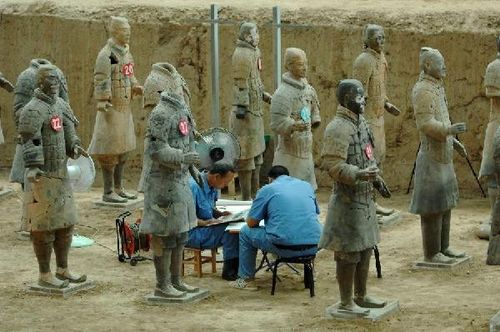
Word comes of a new excavation of even more terracotta warriors and figures at the massive burial site of the first Qin Emperor. But whenever I think of Qin and his subterranean army, Mencius comes to mind. And Mencius gives us reason to resist the hoopla and see Qin's megalomaniacal effort to militarily dominate the after-life for what it truly is: inhumane.
In the first chapter (1A4) of the book that bears his name, Mencius gives us this insight:
Mencius said, "In your kitchen, there is fat meat, and in your stables fat horses. Yes the people have a hungry look, and out beyond, in the more wild regions, lie the bodies of those who have died of starvation. This is to lead animals to devour people. Now, animal devour one another, and people hate this about them. If one governs as father and mother of the people and yet is not deterred from leading animals to devour people, in what sense is he father and mother of the people? Confucius said: 'the one who first made grave figures – was he not without posterity? This was because he made human images for such a use. How then should it be with one who causes his people to die of starvation?'"
曰:「庖有肥肉,廐有肥馬,民有飢色,野有餓莩,此率獸而食人也。獸相食,且人惡之。為民父母,行政不免於率獸而食人。惡在其為民父母也?仲尼曰:『始作俑者,其無後乎!』為其象人而用之也。如之何其使斯民飢而死也?」
First, the image of animals devouring people is powerful. It is directed at King Hui of Liang, and it underscores the inhumane effects of his rule. He maintains a lavish stable of animals, and eats only the best meat, while people in the countryside starve. His animals eat better than some people; thus, in effect he is feeding people to animals. Disturbing…
But I want to highlight the last few sentences about grave figures – 俑者. In Menicus's day, such figures were made of wood and they symbolized servants and others who would provide for the deceased when he or she passed into the after-life. In some ways, wooden or, later, terracotta or ceramic tomb figures were an improvement over the earlier Shang practice of burying servants alive with a master. But, even without that horror, Mencius is not down with tomb figures.
Making the comment (in the form of a rhetorical question) that those who invented (and by extension, continue to use) tomb figures are without posterity, Mencius is, in effect, saying that the practice is a self-indulgent distraction. One who worries about who will serve him in the next life is not paying sufficient attention to performing Humanity toward others in this life. Remember Confucius tells us (Analects 11.12) that attending to our responsibilities in this life should take precedence over thinking about what happens upon death:
When Adept Lu asked about serving ghosts and spirits, the Master said: "You haven't learned to serve the living, so how could you serve ghosts?"
"Might I ask about death?"
"You don't understand life," the Master replied, "so how could you understand death?"
季路問事鬼神。子曰:「未能事人,焉能事鬼?」敢問死。曰:「未知生,焉知死?」
Much the same could be said about Qin Shihuangdi. He forced society to serve his desire for immortality, and his repression became the horrible standard of inhumanity for Confucians ever since. And he took the production of tomb figures to an entirely different, insanely obsessive, level. In effect, he led the terracotta figures to devour people.
Whenever we see Qin's vast fields of terracotta figures, we should understand it as a supreme example of un-Confucian and inhuame behavior.


 The Useless Tree
Leave a reply to skc Cancel reply