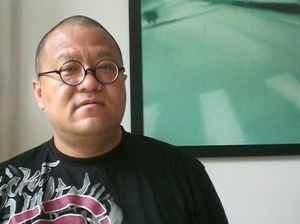
Louisa Lim has a report on NPR this morning that reminds us that Chinese intellectuals and artists continue to press for freedom of expression, speech, and thought. She presents the work of artist Yang Weidong:
A deceptively simple question has become an obsession for Chinese artist Yang Weidong.
"What do you need?"
For the last four years, Yang has posed the question to more than 300 Chinese intellectuals, and the results illustrate a startling level of discontent among China's thinkers.
As for the answer, one word pops up time and time again.
"I need freedom," says writer Chang Ping.
"I need freedom of speech," says economist Mao Yushi.
"I need freedom of expression," says poet Ye Kuangzheng.
John Garnaut reported on Yang's work last year, when he had interviewed about 150 people and was coming up with the same responses. Seems like the results have held over time…
When I heard Lim's report this morning, I immediately thought of this passage from Zhuangzi, 3.4 (Watson translation):
The swamp pheasant has to walk ten paces for one peck and a hundred paces for one drink, but it doesn't want to be kept in a cage. Though you treat it like a king, it's spirit won't be content.
澤雉十步一啄,百步一飲,不蘄畜乎樊中。神雖王,不善也。
That last line is pretty much the legitimation strategy of the PRC party-state: we will give you material comfort, but you have to accept limitations on your freedom. And this is central to maintaining the support of thinkers and writers, who traditionally in Chinese history have been an important political constituency. This strategy has worked for the past twenty years or so, at least insofar as diffusing intellectual leadership for mass style protest in the manner of May 4th or June 4th. But, as Zhuangzi suggests, this may not be effective in the longer term. The pheasant will resist the cage…


 The Useless Tree
Leave a reply to skc Cancel reply