Rick Santorum, who somehow is being taken seriously by Republican primary voters, rejects the idea that global warming is a real phenomenon and that it is connected to human activity on the planet. He castigated President Obama for having a "phony theology" that unscientifically accepts as dogma (I guess) that climate change is happening….
Where to start… Actually, the best place to begin a response might be a nice little blog post over at the National Catholic Reporter. That's right, people who take Catholicism seriously - not just certain selective points about abortion and contraception while ignoring the other stuff like torture – come to a very different conclusion on environmental issues:
But Santorum is a Catholic. Maybe he has never gotten further in his reading than Humanae Vitae. So I wonder if he is even remotely aware of Catholic statements on the environment. As recently as May 2011, a Vatican-appointed panel of scientists affirmed that the earth is indeed getting warmer, and urgent measures are needed to reverse the trend through a reduction in carbon dioxide emissions, methane and other pollutants…
The writer then gets a bit cheeky: "Rick Santorum needs some basic environmental catechism." To which one can only say: Amen!
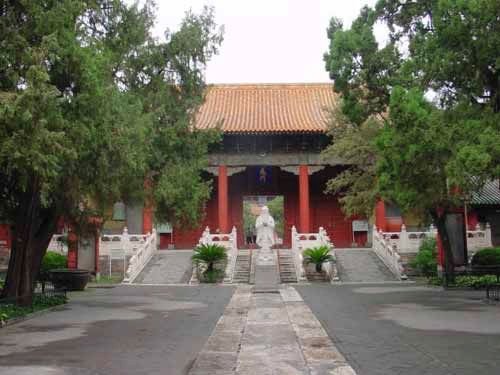
I think Confucius, too, would find fault with Santorum's environmental denialism.
Confucius would agree, in a conditional and limited manner, to at least one aspect of Santorum's position on climate change. While not a "dominionist" orientation, which Santorum seems to be embracing, Confucianism would agree that humans have an elevated moral status in relation to nature. For example, Confucius sees people as being more important than animals, as suggested in Analects 10.12 (which is sometimes numbered 10.11 or 10.17):
One day the stables burned down. When he returned from court, The Master asked: "Was anyone hurt?" He didn't ask about the horses.
Animals matter less than people, morally, so there is no need to inquire about the horses. We might expand this suggestion to argue that, if it serves the purposes of Humanity, then using natural resources is justified. If there is a conflict between human moral good and the environment, the former could take precedence in many, though not all, cases. Confucianism would thus countenance a more thoroughgoing human presence over nature than, say, would Daoists.
But that presence must be counterbalanced by a certain respect for the environment. Humans should not wantonly abuse nature. Indeed, Humanity requires a certain limitation of human action in nature, as suggested by Analects 7.27:
The Master fished with hooks, not nets, and he never shot roosting birds.
He calibrated his actions in accordance to what was required for the nature reproduction of the natural world. If we add in here the Confucian ideal of material simplicity, symbolized by Yan Hui, then we can see that the pursuit of Humanity can accomplished in a manner that is respectful of natural processes.
Fast forward to the globalized capitalism of the 21st century, driven by conspicuous consumption and rapacious destruction of nature. A modern Confucian would look on the scene and say that our relationship to the environment is out of balance. We are fishing with nets, not hooks, and shooting roosting birds. The fact of global warming is well established, and it is "very likely" connected to human activity. Contemporary Confucians would, I believe, accept these points of view, and they would see the link between environmental degradation more generally and materially extravagant human behavior. There is, as I have argued before, a certain greenness at the heart of Confucianism.
To do full justice to Confucian environmentalism requires a lot more work than I can do here. But I think it is safe to say that the kind of anti-scientific, dogmatic, ideological environmental denialism demonstrated by Santorum as he panders for right-wing votes, would be frowned upon by a modern Confucian.


 The Useless Tree
Leave a reply to Carl Cancel reply