Yes, I fell off the end of the earth for a while. My daughter has been auditioning for BFA acting programs and we've been on the road a fair amount the last couple of weeks – at the precise time that a new semester was starting. Yikes! Things have settled down a bit and, perhaps, blogging can resume at something like a normal level. Here we go…
I noticed this piece in the NYT last week: To Combat Modern Ills, Korea Looks to the Past. It is a familiar post-modern story: increased social mobility, economic dynamism and cultural change spark a search for supposedly settled and unchanging traditional "truths." We see it in China; we see it in the US (in the anxieties of conservatives). And we see it in South Korea. As in China, one expression of neo-traditionalism is a Confucian revival of sorts.
The article tells us:
In South Korea, where the word “Confucian” has long been synonymous with “old-fashioned,” people like Mr. Park have recently gained modest ground with their campaign to reawaken interest in Confucian teachings that stress communal harmony, respect for seniority and loyalty to the state — principles that many older Koreans believe have lost their grip on the young.
It's always the kids' fault… they just don't understand how to be traditionally virtuous… (I resist this and believe that, in fact, the kids are alright…)
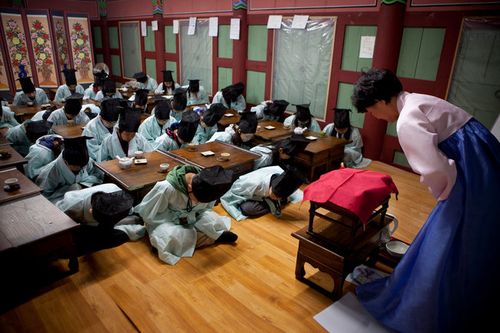
I think the specific efforts discussed in the article – creating "traditional" Confucian schools, where kids don "traditional" costumes, memorize by rote passages from the old books, and learn how to bow correctly – are ultimately self-defeating. If the goal is to bring some aspects of Confucianism into modern life, then, it seems to me, creating little Disney-fied simulacra of "traditional" Confucianism will not really get the job done. Such places will remain isolated and out of the mainstream of modern society, and thus generally ineffective in making Confucianism real for new generations. The article recognizes the problem:
Much of the seowon [Confucian academy] stay program actually takes place in an adjacent replica village where aspects of an older lifestyle — weaving rice-straw mats, riding in ox carts, reciting Confucian texts — are re-enacted for tourists.
Mr. Park, the chief curator, can go on for hours about what he thinks is wrong with the “trash education” of today — an overemphasis on English and mathematics at the expense of ethics and history. But even he concedes that preaching Confucianism in South Korea today may have its limits.
Over the past two decades, he has seized every opportunity to promote Confucian learning — to everyone from government officials to visiting tourists. “They accept one-tenth of what I say,” he said. “They look at me as if I were crazy, ultraconservative, out of fashion. I feel like an outcast.”
If he wants to be taken more seriously, perhaps he should stop the tourist gig, which highlights the exoticism of the exercise, forget about the silly hats, and find a way to connect with those fashionable Korean youth…


 The Useless Tree
Leave a reply to Justice&Mercy Cancel reply