Not sure what to make of Zhang Huan's new exhiibtion at the Rockbund Art Museum in Shanghai, entitled, "Q Confucius." All I know is what I can see on the intertubes. From that limited perspective, however, it does not appear that the artist in engaging in a facile revival of tradition. The big animatronic Confucius bust ("Q Confucius no. 2") is speechless: the Sage is not offering us his wise words. Rather, he just looms there, quietly inhaling and exhaling, in a shallow pool of water, a hulking presence:
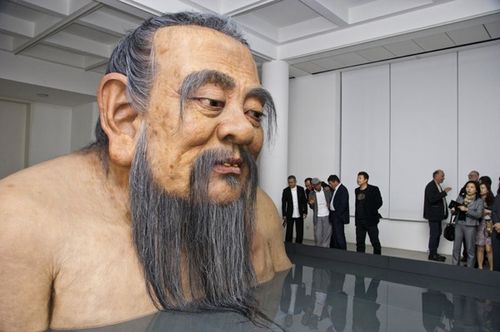
It looks a bit ugly to me. But maybe that's the point: to make the myth more concrete, more imperfect in its embodiment. Or perhaps Zhang is simply saying that, whatever we think of the cultural ideal, some aspects of Confucianism are always already present in Chinese reality. He is inescapable. Whether we engage seriously with his words or not, we have to confront his eternal recurrence. On a more mundane level, one observer quips:
— the overall effect is like you’re intruding on Confucius’s spa time.
Equally unusual is "Q Confucius no. 6," a robotic Confucius that lurches about within a steel cage. Apparently, on the day it opened, the robot was joined in the cage by nine live monkeys (not clear if they make any additional appearances). The monkeys are said to have symbolized, "…the primitive desire in human civilization. Are we to assume then, since they disappeared after the first day, that Confucius is a civilizing force? I don't think Zhang is going for that kind of didaticism. Just look at the piece:
This is not a representation of a smooth and lyrical process of civilization. It is a jerky, almost violent, performance, suggesting difficulty and pain. Maybe this interpretation gets at it:
Zhang's show reveals the impending struggles of China's people through the acknowledgment of a forgotten way of life. Definitive answers may still be unclear, but Zhang's show asks if the solution may lie in a reclaiming of the past. Zhang's work applies to more than just a specific people, but the entire planet as we strive to find meaning in a world that feels more and more disjointed every day.
But reclaiming the past may not be a "solution." Confucius in the cage (one wonders if Zhang is alluding to Weber's iron cage) is not settled and comfortable. He thrashes about, armless (unable to hold on to anything), wordless, uncertain. To me, this does not suggest Confucianism as solution but, rather, Confucianism as another site of struggle and confusion and unrest. A supposed cultural golden age of the past cannot be reclaimed in the modern/postmodern present.


Leave a Reply