A nice little piece by Didi Kirsten Tatlow on "Mao's Spell and the need to Break It" in yesterday's NYT. She focuses on Robert Bellah, the venerable sociologist of religion (see review of most recent book here), and his thoughts on the revival of religion and the prospsects for Confucianism in contemporary China. Bellah sees Mao as obstructing the return of Confucius:
But according to Robert N. Bellah, one of the world’s foremost sociologists of religion, to establish true freedom through a societywide, ethical framework that is connected to Chinese traditions, the country first must break the tyrannical spell cast by Mao Zedong, who led the Communists to victory in the civil war in 1949 and ruled with an iron fist until his death in 1976.
This strikes me as a key issue in determining the extent to which Confucianism can come to have a significant cultural impact in China today. To be clear: I am of the mind that China is not now a Confucian society. It is too deeply ensconced in modernizing projects for something like a genuine Confucian ethic to have more than a marginal effect. Clearly, there has been a certain social tendency to revive some aspects of the Confucian tradition to supply a deeper cultural meaning for contemporary life. But that effort is limited by the powerful material interests and incentives that work to undermine a fuller expression and practice of Confucian ethics.
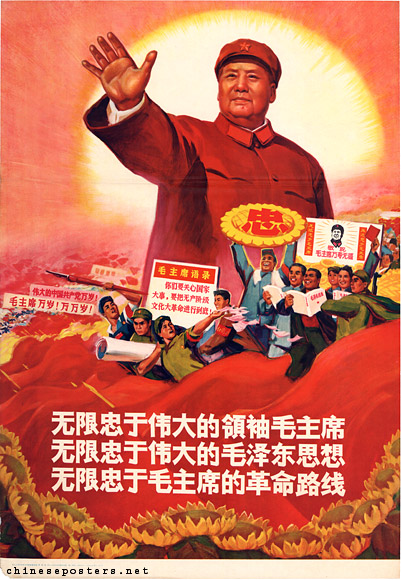
Bellah's point thus highlights another aspect of the problem, the political aspect. It is rather simple: Mao was not a Confucian, indeed he was a resolute anti-Confucian, and his continuing symbolic presence at the center of political life – right there over the main gate of Tiananmen – is a major obstacle to the renaissance of Confucian philosophy-as-a-way-of-life in China. Bellah doesn't pull any punches:
“I think China has to face the fact that Mao was a monster, one of the worst people in human history,” said Mr. Bellah.
He compared China’s situation today to that of Germany and Japan after World War II.
“In a curious way, it’s like the war guilt of Germany or Japan. I think in Germany they’ve come to terms with it, whereas in Japan there’s almost a dramatic lack of any sense of responsibility,” said Mr. Bellah, who is also a Japan scholar.
“There is so much self-pity in China about the Western powers and the 150 years of imperialism, and about the Japanese aggression” of World War II, said Mr. Bellah. “And it’s justified in a way.”
“But God knows what Mao did can’t be blamed on the Westerners or the Japanese,” he said. “The Chinese have their own guilt, and it requires a complex symbolic, ideological and psychological change, and that’s hard.”
This is where Chinese nationalism runs up against Chinese tradition. To be true to the revived tradition, it is necessary to destroy an icon of modern nationalism. My sense is that Mao will continue to win because he, and his historical legacy, is more important to the CCP than is Confucius.
The depth of the problem can be discerned in a China Daily op-ed from earlier this month. Zhang Zhouxiang reports on Bellah's recent lecture in Beijing and reflects upon the revival of tradition. He starts to wander into dangerous political territory (dangerous, that is, when confronting CCP censors) when he writes:
While many scholars claim Western traditions to be the source of the modern concept of rights and obligations, Bellah says that similar themes exist in Confucianism. "Confucius urged the exercise of power through li, not through punishments, which will only encourage the people to be devious."
An essential element in Confucius' social design, li is emphasized by Bellah as a rights pattern, a mutual obligation between rulers and subjects. While justifying the ruler's right to rule, li also requires him to do good to and take care of the ruled. The ruled are asked to maintain order, but they also have the right to choose another ruler if the covenant is broken.
The allusion here is to Mencius, who does not really put forth a generalized "right to rebel" but does offer an idea that the elite (ministers from royal families) have an obligation to remove a tyrannical leader. But the way Zhang expresses it here – "the right to choose another ruler…" – is inching in the direction of democracy. That's a fairly common move for certain readers of Menicus (I'm looking at you Kim Dae-Jung), and with a little interpretive help Mencius can be made consistent with liberal democratic principles (even if he was not a liberal democrat himself). There is no one necessary political form that Mencian Confucianism must take, and an electoral system need not be contradictory to the spirit of the text. But this is not the direction the Party wants to move. Indeed, the Party continues to limit the protection of legal and civil rights.
In the end, the Party is really not interested in li – 礼; propriety, ritual. Rather, it is more interested in li – 力; power, force, strength – and li – 利; interest, profit . And these lis are not at all what Confucius and Mencius value.


 The Useless Tree
Leave a comment