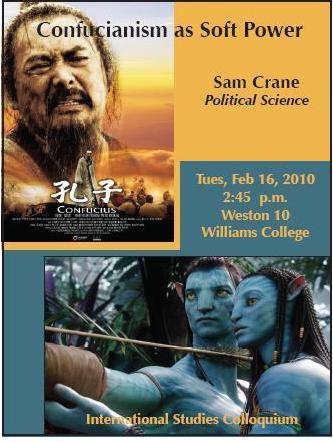
Last year I wrote a paper, and presented it at a couple of think tanks in China, entitled, "Confucianism as Soft Power." The text has been sitting in my computer ever since; so I have decided to post it here for public consideration. Here is an abstract:
In recent years, the PRC government has explicitly invoked Confucianism as an element in its global soft power strategy. From the establishment of Confucius Institutes in various countries around the world to the rhetoric of “harmonious society,” Confucian themes are regularly on display in official PRC statements and activities. Although, on first consideration, it would appear that the Confucian tradition, with its historical depth and intellectual breadth, might provide soft power resources for China, upon further analysis it is evident that there are serious limitations to this facet of PRC foreign policy.
This paper examines the foreign policy utility of Confucianism by first delving briefly into the concept of “soft power” and its analytic shortcomings. Then, several key normative concepts of Confucianism are explicated. A third section analyzes how these concepts press against the effectiveness of Confucianism as soft power. The paper concludes that Confucianism is ill-suited to the purposes of foreign policy soft power.
It is a bit long and, at parts, theoretical, but, hey, what do you expect from an academic. I take Confucianism seriously, as a rigorous moral theory. The basic argument stands up pretty well, I think, and might be best summarized by the final paragraph:
In sum, the PRC does not have a Confucian state; its political ideology continues to be officially derived from Marxist-Leninism-Mao Zedong Thought. The Communist, not the Confucian, Party is firmly in power. Contemporary Chinese society is not a Confucian society; its economy is not a Confucian economy. Quite the contrary, China today resembles the marketplace society described by John Agnew. The “China model,” if one can be said to exist, is a combination of modern political authoritarianism and global capitalist dynamism, which does not rely upon, and can directly contradict, key normative principles of Confucian thought. Thus, without firm grounding and expression in actually existing Chinese social and economic and political practices, Confucianism is not likely to serve as a source of Chinese soft power, either oppositional or apologetic. As the PRC continues to grow economically and transform socially and culturally, and perhaps even change politically, opportunities will arise for an expansion of its soft power. But that soft power will be a modern Chinese soft power, it will not be Confucian soft power.
I welcome comments and critiques. The whole paper is here:
Download Confucianism as Soft Power


Leave a Reply