Perhaps the idea most associated with Confucius and Confucianism is filial piety. Our most basic moral imperative is to care for our parents and, by extension, the elderly more generally. Respect your elders: it is the "root of humanity" – 仁之本 - as Analects 1.2 tells us:
Master Yu said: "It's honoring parents and the elderly that makes people human. Then they rarely turn against authority. And if people don't turn against authority, they never rise up and pitch the country into chaos.
"The noble-minded cultivate roots. When roots are secure, the Way is born. To honor parents and elders – isn't that the root of Humanity?"
No wonder, then, that many people in China are dismayed by the kinds of stories recounted by Adam Minter in this article: "In China, Don't Dare Help the Elderly." The problem is, at base ,the rampant materialism of contemporary Chinese society that has led some people, elderly included, to extort "good Samaritans." Here is an infamous case:
This phenomenon essentially began Nov. 20, 2006, when Xu Shuolan, a 65-year-old woman, fell and broke her hip while attempting to board a bus in Nanjing. Peng Yu, a 26-year-old, was the first to help her. He gave her 200 reminbi and escorted her to the hospital, staying with her until her family arrived. In thanks, Xu sued Peng for 136,419 reminbi, or $18,000, claiming that he was the one who knocked her down.
In one of the best-known, most important Chinese judicial rulings of the last decade, a court decided that Peng owed Xu 45,000 reminbi, or $6,076. The court didn't have any evidence that Peng committed the crime of which he was accused by Xu. But the court, controversially, used the “daily life experience to analyze things” standard and claimed that the aid Peng gave to Xu was sufficient evidence of guilt. It wasn't, as many outraged Chinese at the time felt, a simple act of decency.
That court case has proved to be morally corrosive, creating an incentive for fraud. The judge's presumption, essentially, is that only a guilty person would "help" someone in trouble; aid is an indication of guilt. Thus, if a fraudster can induce a person to come to his or her aid, there is a chance for a payoff. Perverse, to say the least.
But the problem is not simply a matter of legal and economic incentives. A much deeper analysis is offered by Yunxiang Yan: "The Good Samaritan's new trouble: A study of the changing moral landscape of contemporary China," which is behind a pay wall but might be available to people with library or institutional affiliations. Yan provides many examples of the "Good Samaritans trouble" in China. And he thinks about causes:
….I would like to emphasise three more specific factors that are directly related to the cases of extraordinary extortion, namely, the legal loopholes that allow an extortion attempt to be almost cost-free, feelings of deprivation that motivate an extortion attempt, and the relationally-based morality that justifies hostility toward strangers.
He thus recognizes the legal and economic motivations of the extorters, but adds that third element: relationally-based morality. He expands on this idea:
The notion of a stranger has different meanings for the elderly and the young. According to Fei Xiaotong, traditional Chinese society is organised through a differentiated mode of association in which individuals are positioned in a hierarchy of various relations, such as that between parents and children, husband and wife, and between friends. Moral rights and duties are defined and fulfilled differently in accordance with one’s position in a given relationship. Many of the behavioural norms and moral values do not apply to people who are outside one’s network of social relationships. ‘A society with a differential mode of association is composed of webs woven out of countless personal relationships. To each node in thesewebs is attached a specific ethical principle’ (Fei 1992 [1947]: 78).With greater social distance, suspicion and hostility increase, even becoming dominant when dealing with strangers (Chen 2006: 118–155).
Nowhere in this article does Yan use the term "Confucian" or "Confucius," but, clearly, the relationships he mentions, and their importance in defining ethical behavior, are associated with Confucianism, which puts forth a particularistic morality.
It would seem then that the "Confucian" idea that our closest family obligations should take priority over other social relationships has created a kind of ethical particularism which, in the context of hyper-modernization, produces a perverse incentive to take advantage of strangers. Old people in economic need have little compunction exploiting young Good Samaritins.
I would resist blaming "Confucianism," however (which is likely why Yan does not bring it up). While it is true that Confucian ethics would put emphasis on caring for family first, it would not condone the exploitation of strangers. Confucius himself, as recounted in the Analects, was always respectful of people he did not know. I think it would be safe to say that if he encountered a person in distress he would help. The only limitation would be if an immediate family duty at that very moment had to take precedence. For example, if there were a bus accident and his parents were among the injured, he would likely see it as proper to attend to them first before aiding others. But short of such an immediate demand, he would encourage us to help others.
In Analects 12.5, a man bemoans the fact that he has no brothers, and a follower of Confucius replies:
…I have heard that life and death are matters of destiny, that wealth and renown are matters of Heaven. If the noble-minded are reverent and leave nothing amiss, if they are humble toward others and observe Ritual – then all within the four seas will be their brothers. So how can you grieve over having no brothers?
For the ethically minded, "all within the four seas will be their brothers," which suggests that strangers should be afforded a certain ethical respect.
Confucius, in other words, would honor the Good Samaritns and reject the extortionists.
The problem, then, is more the materialism and competitiveness of contemporary Chinese society, which create perverse incentives for fraud. Ethical particularism is distorted into immorality in such a context.
And, finally, notice Yan's generational observation. Young Chinese people, who have been subjected more intensively to the impersonalism and universalism of the market economy are more likely to act to help strangers. This suggests that, eventualy, as social and cultural modernization become more extensive, the trouble Good Samaritins face in China could subside. When young Good Samaritins grow old it is not likely that they will try to exploit strangers. Or, at least, the particularlist ethical rationalizations for fraud will weaken; the legal and economic incentives, especially if inquality persists or grows worse, could endure.
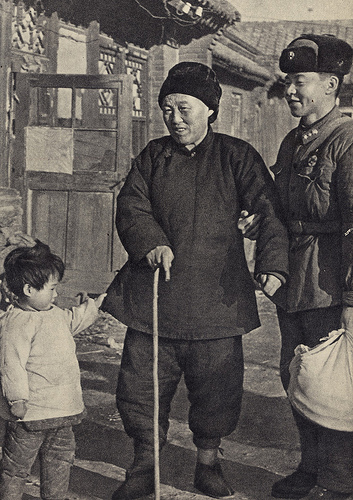
(could we call Lei Feng a "Good Samaritan"?)


Leave a Reply