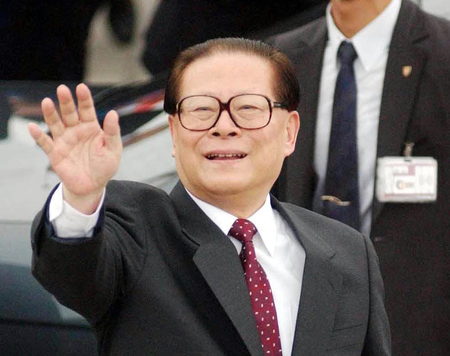
Rumors have been circulating in Beijing the last day or two about the absence of former CCP General Secretary Jiang Zemin from Friday's big 90th anniversary Party. And now the Chinese internet censors have taken fairly assertive action to block searches of "Jiang," and other searches related to his potential death or illness. Something is obviously up – the powers-that-be would not go to the effort of censorship unless there was something they were trying to control or hide. Indeed, on Twitter, NPR correspondent Louisa Lim reports that when she asked a "source close to him" about the possibility of his death, the response was that that information was "temporarily confidential."
I think Jiang Zemin is either dead or gravely ill to the point of being kept alive by respirators, etc.
If that is true – and we should know soon, since keeping such news quiet gets harder and harder with each passing hour – various questions arise.
First, why does the CCP worry so much about such things? Why don't they just let the news break as it will? As this story reports:
The government has long viewed the health of the nation’s top leaders as a state secret, apparently because of concerns that illness might affect the appearance of unity and political stability in the ruling party.
This probably goes back to the old guerrilla revolutionary days: don't let the enemy know our vulnerabilities, etc. But, c'mon guys. It's 2011. You are no longer squatting in caves in Yen'an. You are leaders of a major world power. Allowing for the free flow of information about a retired leader, who now has no formal political position to speak of (though Jiang had significant informal factional influence), is not going to threaten PRC national security. Can't they see that attempting to control this kind of news makes them look paranoid and silly?
What they fear, of course, is 1989, when the Party lost control of the symbolic interpretation of Hu Yaobang's death and all hell broke loose. That seems rather unlikely in the case of Jiang Zemin. He is, after all, the guy who came in and rebuilt state legitimacy after 1989; he had a deep and abiding interest in not allowing a "reversal of the verdict" on that tragic time. Although it is true that there was a period of intellectual liberalization under Jiang, which ultimately did not lead to any substantial political change, this seems a thin reed for dissidents and democrats to grasp if they want to try to make Jiang into a symbol of democracy in the manner of Hu Yaobang. So, a repeat of 1989 seems far fetched, given the political career of Mr. Jiang.
Why then is the Party acting so nervous in the face of Jiang's apparent demise?
I wonder if they worry about a more diffuse Mandate of Heaven effect. That is, to announce such bad news immediately on the heels of the "good" news of the 90th anniversary of the Party might suggest bad times ahead. Heaven is displeased with the staus quo. Indeed, what if Jiang had died the very day, or day after, the Party anniversary? That would really cast a pall on the Party's party. And this is what we will likely never know: when, exactly, did Jiang Zemin die? He may have died on July 1 or 2 but been kept "alive" until a decent interval had passed from the Party anniversary. Or maybe he's not dead yet, just very near it. With the censorship and media control we will never really know…
But, ultimately, I don't think the Party leadership is moved signifciantly by Mandate of Heaven kinds of concerns – except when we are talking about earthquakes and snow storms. It's more likely that old Communist habits simply die hard. Remeber how Andropov and Chernenko in the Soviet Union had "colds"? – rather nasty colds at that…
The Party has always controlled this sort of information and, even though it is much harder to do so now, and by doing so the Party leadership makes themselves look bad, they will continue to try to manage these narratives in this way…
UPDATE: Xinhua, in a single sentence statement, has now denied the reports of Jiang's death, calling them "pure rumor." Most likely, the explosion of coverage in the Hong Kong press forced the Party's hand. The question remains, however: why did they block searches about "Jiang" on certain internet sites? Why did they feel that any discussion of him should be out of bounds?


 The Useless Tree
Leave a reply to Jing Cancel reply