It is generally understood that, following the Qin repression, Confucianism was revived and given government sponsorship under the Han Dynasty. The conventional wisdom goes something like this:
Under the rule of Emperor Wu 漢武帝 (r. 141-87 BCE), Dong Zhongshu 董仲舒, a philosopher who combined cosmologic speculation with the Confucian view on the state, convince the emperor to adopt Confucianism as the sole state doctrine. All other schools were not further considered as worth being sponsored by the state (bachu baijia 罷黜百家 "driving out the hundred schools").
Or this:
By the time of Wu Ti (140-87 BCE) of the Former Han dynasty (206 BCE-24 CE), however, Confucianism had recovered from this blow and the destruction that civil war inflicted on its classics and learning. Confucianism intertwined with the doctrines of the yin-yang and the Five Elements and even with the popularly apocryphal writings, in which Confucianism was interpreted in religious, mystical and prophetic terms, and Confucius himself was taken as the 'uncrowned king'. The syncretic Confucianism was eventually promoted to be the supreme doctrine of the state, acting as the orthodox ideology, at the expense of all other traditions.
Now, both of the sources quoted above recognize certain complexities in the coalescence of Han Confucianism, but I was somewhat surprised in reading a rather new book, Lives of Confucius by Michael Nylan and Thomas Wilson, at how questionable the standard account is. I am not a historian by training, so maybe this is really not all that new, but this passage, among others, caught my eye:
But if from the Analects and the writings ascribed to Mencius and Xunzi, Kongzi's two most important disciples…, we glean a "Confucian" political program, it would have to include the following measures: (1) a host of redistributive mechanisms by which surplus wealth would be transferred from the very richest to the very poorest, based on the understanding that stable government depends upon the provision of economic and educational opportunities to the populace; (2) a general bias against war, unless all diplomatic methods have failed to remove a dictator from office; (3) a combination of sumptuary regulations and penal laws that identify and reward the most virtuous members of society, but punish with corresponding severity the most privileged members of society who engage in self-interested and antisocial conduct; and (4) the general principle that all "others were approached as if treating an important guest"….
No part of the forgoing political program was advanced in the Western Han or Eastern Han. Indeed, the Han founder was famous for having pissed in the hat of a classical scholar spouting pious injunctions at him, and Han Wudi – the emperor most credited in Chinese history with the exaltation of Kongzi – also went down in history as the ruler whose foreign wars of aggression bankrupted the Han house and turned many locals against the idea of a centralized empire. (73-74)
It seems, then, that while the Han may have sponsored Confucianism, or invoked it to shore up state legitimacy, they did not really practice it. And this suggests that we should not use terms like "supreme doctrine of the state" or "sole state doctrine" or, as I have done on various occasions, "state ideology." All of those terms suggest that "Confucian" principles might somehow have guided policy, and Nylan and Wilson are arguing that that is pretty much not the case. Indeed, those authors go further in undermining the notion of a consistent "Confucianism" in early imperial China:
Moreover, no coherent system of thought that may be labeled "Confucianism" existed until a foreign dynasty, the Mongol Yuan, enshrined one conservative strain of Song thought called "True Way Learning"… as the single basis for the civil service exam in 1313, though these same conservatives were already seeking to control the content of the examination questions earlier, in the Southern Song. (71)
"No coherent system of thought"… ouch. Looks like The Master was a useful puppet for powerholders, with little real political impact on statecraft. Rulers used "Confucian" priciples when it served their interests, and ignored them when convenient.
And that brings us to the contemporary revival of Confucianism. The past tells us that powerful centralized states in China have been able to present themselves as "Confucian," without living up to Confucian ideals. They have been "Confucian" only in their words, not their deeds. Of course, this does not mean that there were no individuals who conscientiously enacted Confucian teachings – there were plenty of them. But "Confucianism" (whatever basket of principles and ideas that term might connote) was not the "supreme doctirne of state." I suspect Legalism had more influence on day to day political decision-making…
And that could be a model for the Chinese Communist Party. It can encourage the revival of Confucianism, wrap itself, when useful, in a shroud of Confucian legitimacy (perhaps the robes are available at your local Confucius Institute), but not really adhere to a consistent or coherent Confucian ideology in terms of actual policy and politics. It worked for the Han, maybe it can work for the CCP.
Indeed, by Nylan and Wilson's criteria, it appears that "Confucianism" is remerging in a China that is rather un-Confucian. Let's quickly consider their four aspects of a Confucian political program
1) redistributivism – not so much these days in China, where economic inequality is bad and getting worse.
2) aversion to war – the Vietnamese do not believe the PRC has embraced a Confucian stance here: the memories of 1979 are still too fresh and the current tension in the South China Sea too immediate. It must be said, however, that the PRC is much less belligerent than the US (I just finished Andrew Bacevich's new book), but it's continuing military build-up, in the face of growing domestic inequality, would give a Confucian pause.
3) justice – while severe penalties are handed out to certain high visibility corrupt officials and high living nouveau riches, the legal system remains biased in the direction of powerholders and there are no sumptuary laws to constain the most conspicuous of consumption.
4) general social civility and respect – this is hard to determine: to what extent does this have to apply to fulfill a "Confucian" standard? These kinds of stories suggest some problems here…
In any event, it may be the case that Confucianism sets too high an ethical standard for any society, at any historical time, to meet. And that could raise a problem for political authorities who want to invoke Confucius as a source of state legitimation – the standards that he sets could be turned against rulers who do not live up to them, something that has happened at various times in the long arc of Chinese history (I'm looking at you Hai Rui). But the Han got away with contradicting the Confucian principles they sponsored; indeed, they got away with it for a long time and even emerged historically with a reputation for upholding "Confucianism." Maybe that is what the CCP has in mind as it encourages Confucianism today…
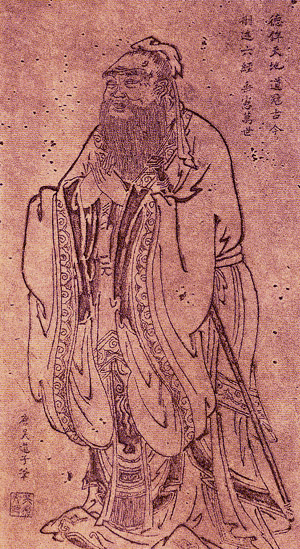
(portrait of Confucius by Wu Daozi, 685-758, Tang Dynasty)


Leave a Reply