My last post below was singularly ill-timed: the day after I pointed out a Taoist facet of Obama's foreign policy he goes and orders the attack on Osama. Oops. Clearly, the careful planning and calculation that went into the raid, to say nothing of the precise use of deadly force, are not in keeping with Taoist sensibilities. So, what's a Taoist to do? Just throw in the towel and admit that the Daodejing and Zhuangzi have little relevance in the modern world. Sure, why not… Taoism is not really concerned with consistency or applicability – it just is. But I want to think about this a bit more…
What can we expect of Taosim in the world today? I think about this a fair amount when I talk with my students about the notion of wuwei – 无为 – which we might crudely translate as "do nothing" or "do nothing coercive" or "do nothing beyond the natural unfolding of things." It suggests a certain virtue in non-action or, at least, less action than might otherwise seem appropriate. My students, most of them, tend to resist this idea. And that is understandable: they are young, active, can-do, academically successful Americans. They believe in the efficacy of carefully planned human action. Instrumental rationality works. It has gotten them to where they are today. Taoist skepticism strikes them as droll or irrelevant, not really useful in the real world.
I push them, arguing that we should not take wuwei too literally. After all, if a Taoist were standing in a road and a bus speeding toward him, he could, while still adhering to wuwei, step out of the way. Wuwei does not tell us to do absolutely nothing. We can eat and clothe ourselves and drink (think of Li Bai!). Rather, wuwei is a cautionary ideal. It is telling us not to attach ourselves too closely with our careful plans and calculations. Be open to unexpected twists and turns of circumstance. Accept variant possibilities. And don't press too hard against what conditions allow.
Admittedly, even with that more modest interpretation, wuwei cannot guide all of our human actions. At times we will have to do more than seems possible in a moment. At times we will need to follow a plan and not just react to immediate circumstances. But wuwei is not irrelevant. It is a reminder that we do not have as much control over our environment as we think. We need to be humble and open. At times we need to follow to lead, while at other times we might need to do more than a stricter wuwei would suggest.
Interesting to note, in any event, that at least one analyst suggested that the now iconic photo of the Situation Room shows Obama in a "lead from behind" pose):
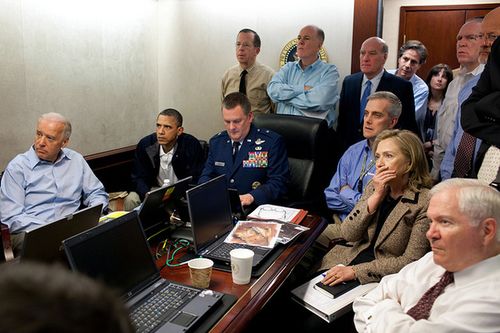
But I won't push that point too hard here…
I will, however, point out that the Daodejing gives us some guidance on how to react to victory in warfare, in this excerpt from passage 31, guidance that could be appropriate now:
To find glory in victory is to savor killing people, and if you savor killing people you'll never guide all beneath heaven.
We honor the left in celebrations and honor the right in lamentations, so captains stand on the left and generals on the right. But use them both as if conducting a funeral:
when so many people are being killed it should be done with tears and mourning. And victory too should be conducted like a funeral.


 The Useless Tree
Leave a reply to Peter Vernezze Cancel reply