Home in Williamstown again, after an intense, if short, China trip. After Lincang, I went up to Shangri-la to visit some new friends, Russ and Kesang and Fei Fei at Black Pottery Coffee. Let me put down some of my impressions of the area – this time with some pictures (my lap top died on the trip, which explains the drop off in posts and the absence of photos)…
Shangri-la, formerly Zhongdian, lies in the Diqing Tibetan Autonomous Prefecture in northern Yunnan province. It was historically a part of Kham (this pdf discusses the Khampa uprising). Interestingly, in the center of town is a cemetery commemorating the Han soldiers who came with the PLA in 1950 and after to occupy and ultimately subdue Kham. I did not see any remembrance of the Tibetan/Kham people on the other side of that fight. In any event, the area is now firmly ensconced in Yunnan province, and the city's Tibetan population is gradually being outweighed by in-migration of Han people, notably from Sichuan.
I was able to talk with some local Tibetans about life in Shangri-la. Kesang is a very interesting person: she grew up in a nearby village, Nixi, moved into Zhongdian as an adolescent, then went on to university in Kunming and lived as far afield as Shanghai and Shenzhen. She has seen much of what modern China has now become and she has chosen to return to Shangri-la to run her business at the coffee shop in Old Town. One of the things she and Russ do is arrange trekking and travel adventures for visitors – Shangri-la is a significant tourist destination for both foreigners and, especially, Chinese. I went with them to Nixi village and met Kesang's family. Indeed, if you are ever in Shangri-la I would very much recommend a trip to Nixi. Go with Kesang, who knows everyone there…
In Nixi I spoke with Kesang's father and came to understand the complexities of the Tibetan situation. His father was an indentured servant in the old Kham Tibet. When the Communist revolution happened in 1949, he joined the fight against the old order. The Party sent him into Zhongdian for training to become a doctor, which he completed. Thus, he moved from the village, and from the farming life, to the city as a result of revolution. He did not make a lot of money as a physician in Maoist China – and his wife's family complained about his poor prospects as a husband (he couldn't get up into the mountains to find the wild mushrooms and greens common in the local cuisine, nor bring down the firewood). But his marriage survived and he and his wife raised four children. He eventually moved back to the village, where he now owns land, a comfortable house (complete with satellite dish), and has several sources of income (pension; crops; pottery; tourism).
With this experience it is unsurprising that he is an ardent supporter of the Communist Party and the current status quo for Tibetans. In his lifetime, his family has gone from indentured servitude to thriving entrepreneurialism. They are Tibetans who have found a way to prosper under Chinese rule, and in Shangri-la they are not alone. Russ and I visited a very nice, up-scale hotel and were told that the owner is Tibetan. Other Tibetans I met are finding niches in the new economy. For many, the sting of Han rule, and especially the loss of control over their own historical narrative, is still felt. But the possibilities of a better material life dissipate overt political opposition.
Of course, there is another side to the story, the one we hear most about when talking about Lhasa: that the fruits of economic reform in Tibet have gone disproportionately to new Han immigrants. And that is true. But is may be less true for Shangri-la. Or, at the very least, there seems to be less tension between the ethnic groups in Yunnan as opposed to the Tibet Automous Region. There could be historical reasons for this (Russ suggested that Han settlers have been around longer in Yunnan, arriving in some numbers in the Ming dynasty and establishing a modus vivendi with the local Tibetans). There could also be economic (more settled agriculture in the narrow valleys of Yunnan, and thus more of an entree into the commercial economy, as compared to the nomads of the TAR) and political (the Yunnan provincial government, which deals with many other ethnic minorities, is not as harsh in its policies toward Tibetans as the government of the TAR) reasons. Whatever the case, the Tibetan experience in Yunnan is different from that of the TAR.
I think its important to be attuned to such complexities. Tibet is a big and complicated place, with historical cross-currents that are not easily reducible to overly simplistic political formulas. That is why I am drawn to the work of Wang Lixiong, who both understands the complexities and strives for more humane outcomes.
There's much more that could be said of Shangri-la, but let's stop for some photos now (with more below the jump):
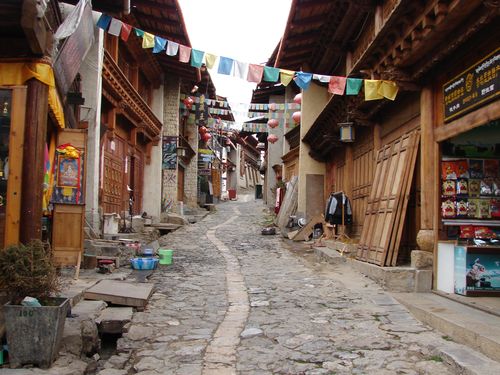
(Old Town, Shangri-la)
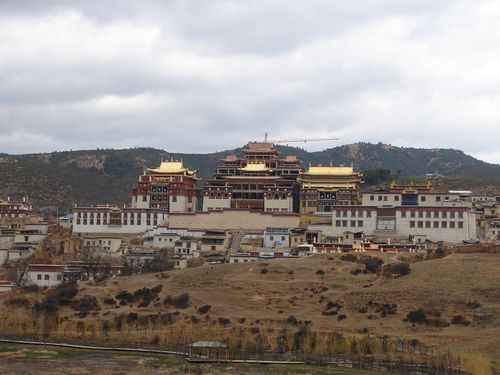
(Songzanlin Monastery)

(Nixi village)
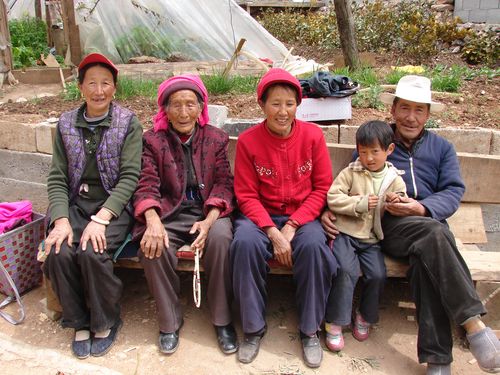
(from right: Kesang's dad, neice, mother, grandmother, friend, in Nixi)
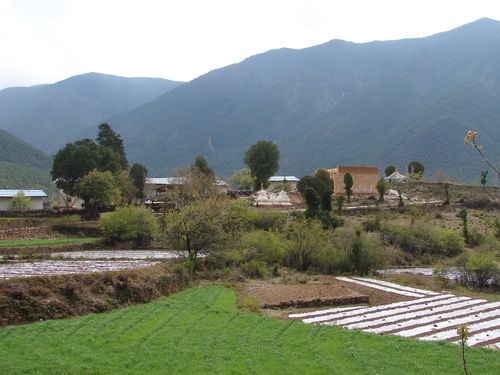
(Nixi)
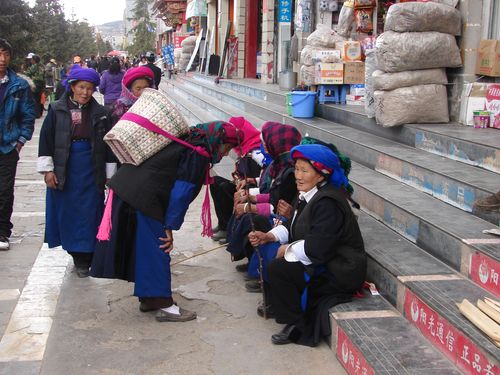
(Street scene, Shangri-la)
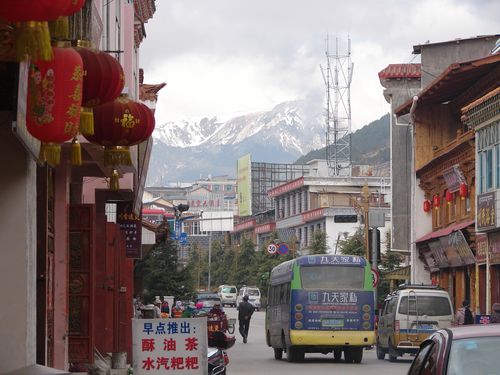
(street scene, Shangri-la; the mountains are always near…)

(prayer flags at Baiji Si, Shangri-la; I hung one for Aidan there)
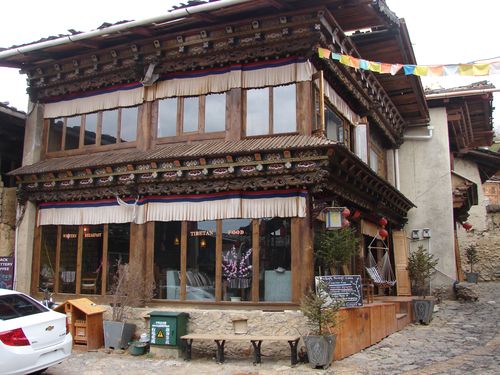
(Black Pottery Coffee, Shangri-la; Russ and Kesang's place)


 The Useless Tree
Leave a reply to Russ Iger Cancel reply