Back from my trip to Cambodia and Vietnam, jet-lag still lingering in my head, I want to jot down some rather rough observations…
One of the first things you will notice when comparing the two places is the relative prosperity of Vietnam. When we crossed the border – on the Mekong River, traveling by ship – the more intensive agricultural productivity of Vietnam was readily apparent. They do three crops of rice, due to both the more reliable water levels of the lower Mekong (as opposed to the cycle of flooding on the Tonle Sap) and the more extensive use of irrigation. It also seemed that more types of crops were grown, most obviously corn, some of which was identified as "American corn," strains that were introduced in the 1960s.
Beyond the countryside, the towns in Vietnam seemed richer. They are, of course, more densely populated – Vietnam has about 86 million people to Cambodia's 14 million. But there was more manufacturing in evidence. Saigon is more built up and wealthy than Phnom Penh.
What to make of the economic differences? Some in my party gravitated toward culturalist explanations, that Vietnamese were some how more hard working than Cambodians. I tend to press against such interpretations and think about broader structural and historical dynamics that might produce varying economic outcomes. "Culture," after all, is not a static thing; rather, it is a reflection of political and structural forces… that is my usual bias, at any rate.
Historically, Vietnam has had a more centralized and powerful political center. At the very least we can trace this back to the Chinese influence. Northern Vietnam was ruled by Chinese for most of the period between the late second century BCE to the tenth century CE. This brought the Legalist-Confucian fusion into Vietnamese political culture: a proto-bureaucratic state legitimized by a quasi-meritocratic Confucian ideology. This combination proved quite successful in centralizing political power and employing the capacity of the state toward public works, such as maintaining flood-control dikes on the Red River. To be clear, Vietnamese built dikes before the Chinese incursion, and they would maintain them afterwards, but the consolidation of a Legalist-Confucian state certainly contributed to the success of this project during and after the period of Chinese domination of the North.
Long story short: Confucianism contributed to the creation of strong political structures in Vietnam, structures of both the state and rural society. When we look at Cambodia we find much less of this historically.
David Chandler, in A History of Cambodia, tells us:
…for Cambodian history at this time [the 1830s] (and perhaps for much of its history, as we have seen), was characterized by a diffusion of power, a shortage or resources, and a negotiability of position that effectively kept anyone from becoming powerful for too long. (150)
In other words, on the eve of French colonization (1863), Cambodia did not have strong, centralized political institutions. And without that political center, those resources that it did have could not be mobilized effectively: from the decline of the great Angkor kings in about the 14th century, public works projects, especially water and irrigation projects, also declined. Without large-scale irrigation projects, agriculture was driven by natural cycles of rain and flood and dry seasons, limiting the extent to which agricultural surpluses could be diverted to other purposes.
Confucianism also provides a kind of structure for social relations: the emphasis on filial piety can reinforce social hierarchies (I don't know if this is inevitable, but it is certainly the case when Confucianism is fused with Legalism as is the case in the Han dynasty…). And this also provides a point of contrast between Vietnam and Cambodia. Here is Ben Kiernan from the opening pages of his The Pol Pot Regime:
[Cambodia's pre-revolutionary] village society was decentralized, its economy unintegrated, dominated by subsistence rice cultivation. Compared to Vietnam's, its villagers participated much less in village-organized activities. They were often described as individualistic; the nuclear family was the social core. May Ebihara, the only American anthropologist to study a Khmer village in Cambodia, wrote: "In village society there are no larger organized kin groups beyond the family or household… The family and household are the only enduring and clearly defined units." The broader kindred did not "crystallize as a group." Most villagers usually did not recall their grandparents' names. Subsistence was usually a personal or a family matter. (5)
One of the things I get out of this is that Cambodia had less in the way of social and political structure than Vietnam. And this might explain the stronger response – in terms of overt resistance and ultimately communist party organization – to French colonialism in Vietnam. And it might also explain, at least in part, the apparently greater capacity of the Vietnamese state to mobilize resources and generate more national growth and wealth than Cambodia.
Of course, we must bear in mind that other events and factors intervene historically. I by no means wish to suggest that we can draw a straight line of influence from the Vietnamese Confucian past to its relatively dynamic economic present. The horrors of the twentieth century, and especially the powerfully destructive Pol Pot period in Cambodia, certainly have shaped contemporary outcomes. But granting all that, the longer history of more centralized political power, which is at least in part explained by the social and governmental structures authorized by Confucian ideas and practices, has contributed to Vietnam's greater prosperity in the present.
I'll put some more photos below the fold:

(fairly typical riverside scene in Cambodia along the Tonle Sap)
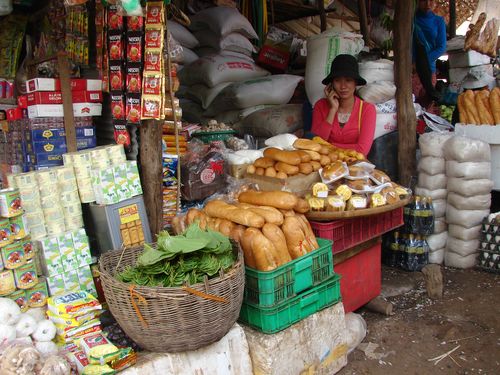
(Market in Kampong Chhnang, Cambodia)
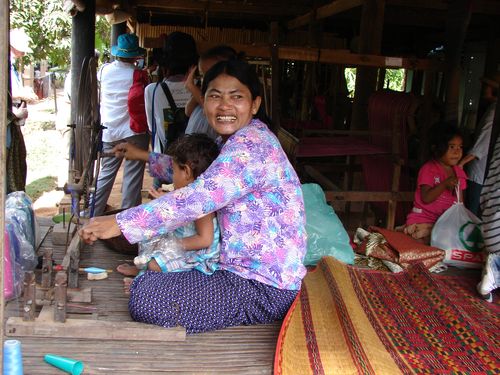
(weaving silk and cotton in Chong Kok, Cambodia)

(corn and sweet potatoes, outside of Tan Chau, Vietnam)
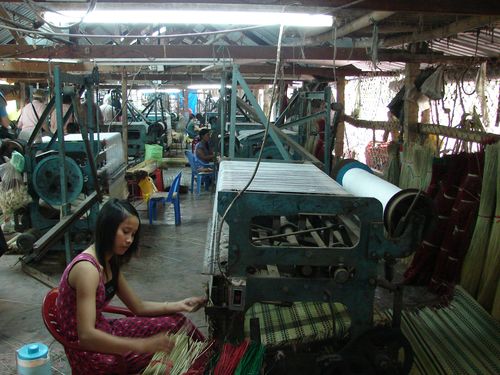
(reed weaving in Cai Be, Vietnam)
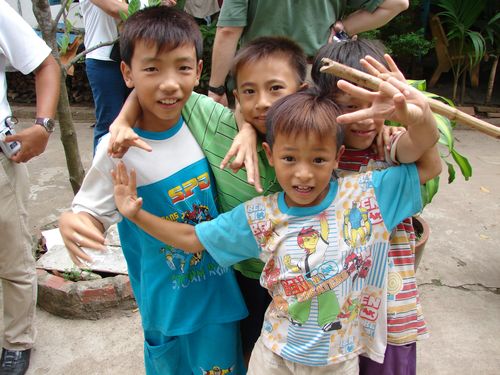
(mugging for the camera, Cai Be, Vietnam)


 The Useless Tree
Leave a reply to TFF Cancel reply