Manyul posted this first, but let me add my own thoughts to the news that a new statue of Confucius just went up on Tiananmen Square:
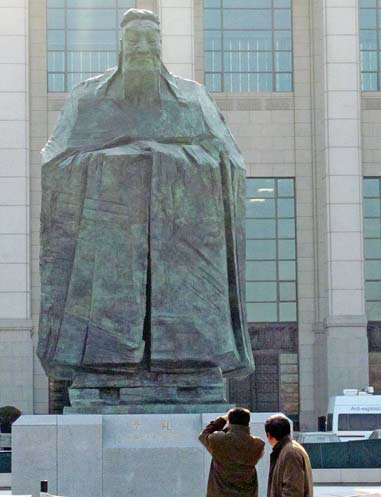
A bronze statue of Confucius has been unveiled near the Tian'anmen Square in central Beijing.
The statue, at the north gate of the China National Museum, which overlooks the Chang' an Avenue, is 9.5 meters tall, including the stone base. The statue shows the scholar, born more than 2,500 years ago, putting his palms together in front of his chest and looking into the distance.
"Confucius was seen as a saint by many dynasties in Chinese history," said Lu Zhangshen, curator of the museum, at a ceremony to unveil the statue on Tuesday.
"He is the symbol of traditional Chinese culture, with a far-reaching impact across the globe," he said.
At first, when I saw the story this morning, I thought: no big deal. The Confucian revival has be going on for some time in China, and the Party has endorsed it in various ways. Another statue in a prominent location is simply more of the same. Now, when the Party changes its name from the Chinese Communist Party to the Chinese Confucian Party, then we can talk about a really significant political extension of the revival. But I'm not holding my breath for that one.
The NYT story had some good observations:
The flip side of economic development is "increased individualism and increased sense of competition and anxiety," said Daniel A. Bell, a philosophy professor at Tsinghua University and author of "China's New Confucianism." ''There's a need for ethics and morals and promoting social responsibility."
For the government, there's appeal in a philosophy that preaches harmony at a time when a yawning rich-poor gap and anger at corruption have fueled instability and when unbridled nationalism has boiled over into raucous protests in recent years.
Top leaders "certainly realize the absence of a value system," said Cheng Li, an expert on Chinese politics at the Brookings Institution. "It's a desperate search for ideology, for a new value system."
Daniel might not agree with me, but I see in his comment a certain irony: it is precisely when China has grown the farthest from its Confucian past, with the rise of culturally individualizing materialist competition, that some people there seek to reconnect with the tradition. In other words, China is not now a Confucian society and the Confucian revival there will not fundamentally redirect Chinese modernization. Whatever "Confucianism" arises there in the next few years and decades will likely be a shallow imitation of the original because the ethical demands of Confucius are too restrictive to modern lifestyles and behavior. While it may be true that certain individuals will find the commitment and fortitude to enact duty according to ritual and progress toward humanity in a manner consistent with Confucius's thought, not enough individuals will do so to justify defining China as a "Confucian" society. The tension between Confucian morality and modern life is just too great.
There is some interesting symbolism here as well. It appears that the statue is facing north. Traditionally, rulers in China would face south when conducting official business. Indeed, facing south is the general orientation of the ruler, which is why the buildings of the Imperial Palace face south. Mao's giant picture on Tiananmen Gate also faces south. I suspect that the placement of the new statue was probably determined pragmatically – the museum could most easily accomodate it at its north entrance, etc. But the symoblic effect is to suggest that Confucian thought does not rule. We could also say that Confucius is being positioned here as a subject or follower, not a ruler or leader. Wonder if that's what the statue builders were thinking here…?
In any event, I must say that I am not all that enamored of the statue as a statue, as statue-esque art. It's ponderous:


 The Useless Tree
Leave a reply to Jim Cancel reply