A story this morning on the NPR radio program, Morning Edition, discussed the political leadership succession now underway in North Korea:
"What has happened [in the] past two days is not the end of succession process," says Moon Chung-in, a professor at Yonsei University. "[It's] barely [the] beginning of [the] succession process. "
Moon says though North Korea is very communist and still very Confucian in its hierarchical approach to politics, the young prince Kim Jong Un has much to prove before he can take over power.
"North Korea is more Confucian than Confucius," he said. "You cannot become leader with legitimacy without making contribution to the people," he said. "But Kim Jong Un has so far … made any significant contribution to the people.
Let me say up front that I have a great deal of respect of Moon Chung-in as an analyst of Korean politics generally. I know him well: have listened to him give talks; have had drinks with him; taught his daughter who attended my college. But I have to rejec
t the statement that North Korea is "more Confucian than Confucius."
Moon seems to be hinting at two things in this characterization: Confucianism is 1) a "hierarchical approach to politics" and 2) "making [a] contribution to the people.
I also suspect he means to imply that the passage of power from father to son, as happened between Kim Il-song and Kim Jong-il, is somehow appropriate in Confucian filial piety terms.
First, it is not at all clear that Confucianism is any more hierarchical than many other political ideologies. The aristocratic codes of early modern European countries were at least as hierarchical as the assumptions about who should rule that surrounded pre-Qin Confucian thinkers. Of course, by the Han dynasty we can no longer judge the political dynamics of Confucianism, in and of itself, by reference to the experience of the Chinese empire, because the statecraft of that empire was very much infused with Legalist ideas and practices. In other words, China, for most of its history, is far from a purely "Confucian" political system.
Moreover, the hierarchy suggested by Confucius and Menicus would not be as rigid as that produced by the Leninist Feudalism (if we can call it that) of the current North Korean state. Confucianism posits an ethical standard – at its core, Humanity – that any and all leaders must adhere to. If a leader did wrong, it was the duty of others in leadership positions to, first, remonstrate, and, then, if the leader persists in doing wrong, to remove the bad leader. None of this has been possible in North Korea. Dissent is clearly repressed. And leadership legitimacy is based not on a transcendent ethical standard, but on personalist criteria. Weber's notion of charismatic authority comes closest. And just as Weber suggested, as one generation passes to another it becomes harder and harder to routinize, or pass on that charisma. Kim Jong-il never had his father's political experience and depth and personality. And it is likely that his son, Kim Jong-un will be even less of a presence.
But the point is: the structures of power and strategies of legitimation of the current North Korean state have nothing to do with Confucianism. Also, hereditary succession, particularly transitions from fathers to sons, is not a Confucian principle. It may have been practiced in China for centuries, but that only demonstrates how Chinese realities diverge from Confucian ideals. Mencius holds up the experience of the legendary sage-kings Yao and Shun as an ideal of finding the most virtuous successor, not necessarily a family member.
Finally, regarding "making a contribution to the people:" this is consistent with Confucian principles. Humane rule is providing people with sufficient sustenance and means to permit them to carry out their family duties with a certain dignity. But, again, this simply does not obtain in the case of North Korea. By no stretch of the imagination does the North Korean system, in its present configuration and practice, provide sufficient sustenance to the people, outside of a narrow military-political elite in Pyongyang. Professor Moon knows this well. And I am sure he means to say that legitimation in NK requires some pretense, at least, of serving the people. But we should call it just that: pretense and fiction. In reality, the NK state is more likely to inspire this sort of response from the people (excerpt of passage 75 of the Daodejing):
The people are starving, and it's only because you leaders feast on taxes that they're starving.
The people are impossible to rule, and it's only because you leaders are masters of extenuation that they're impossible to rule.
The people take death lightly, and it's only because you leaders crave life's lavish pleasures that they take death lightly…
And here's a photo of the likely successor, Kim Jong-un, whose chubby visage reveals a craver of life's lavish pleasures:
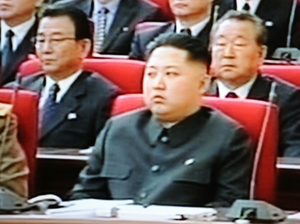


 The Useless Tree
Leave a reply to ZanyHermit Cancel reply