On Saturday the WaPo (hat tip CDT) ran a conventional restatement of the Confucian revival in China story. Not much new reported beyond the usual observations that people, including businessmen, are embracing revised Confucian rituals. Yet when this story is juxtaposed against a recent post at ChinaGeeks, "Education without Heart," (with another hat tip to CDT!) we can see just how limited the Confucian revival really is.
But before I get to the ChinaGeeks translation, let me nitpick the WaPo piece.
First these is this graf:
But a Confucian revival sanctioned and initially steered by the party
has grown into something more vibrant and also more unpredictable. It
has become a quest for alternative ideas that challenge not only
foreign imports such as democracy but also some of the homegrown
results of China's dash to modernity.
My gripe has to do with that "initially steered," which makes the revival seem like it is the brain child of CCP apparatchiks. This is unfortunate, since it is more accurate to say that Confucianism began to revive in the PRC in the 1980s largely due to the efforts of intellectuals both outside and inside China. As John Markham makes clear in his magisterial book, Lost Soul, political authorities had little to do with return of Confucianism after the Cultural Revolution. US-based academics Tu Wei-ming and Yu Yingshi were key players. Now it is true that the Party has found something useful in the Confucian revival, and that certain Party leaders have made public gestures of support. But "initially" the Party had little to do with it.
Substantively, I have to call out this passage:
"If Confucius were alive today, he would probably join the Communist
Party," said the institute's deputy director, Kong Xianglin, a
75th-generation descendant of Confucius and a party member for 30
years.
He said Confucianism will never supplant China's official state
creed of "socialism with Chinese characteristics" but can complement
and reinforce it. Confucius, said Kong, citing an oft-repeated maxim,
"believed in 'harmonious while different.' "
I think this is incorrect. If Confucius were alive today, and if he wanted to be a Party member (and I doubt he would since it has generally transformed into a means for material advancement, not the cultivation of Humanity), he would likely be rejected or expelled. Confucius and Menicus would be too critical to be accepted in the Party. They would not sit silently by as the horrendous errors of the past, especially the deadly Great Leap Forward, are quietly forgotten. They would certainly protest as honest, noble-minded people, like Wan Yanhai, are harassed and hounded from the country. They would not be interested in using their public office for private gain, as so many Party cadres do.
But let's get to the larger question of the limits of the Confucian revival. ChinaGeeks translates an article from Southern Weekend (original Chinese here). The author, Yu Jian, laments the hyper-intrumentalism and lack of empathy characteristic of high school education in China today:
Teaching for the final test seems to have become education’s primary duty.
From
what I understand, all grade three Chinese senior high school students
have already finished their normal studies for the year and entered
into vigorous preparation to battle the Gaokao exam. Now, all schools
only have one class: how to handle the Gaokao. Parents closely
cooperate, and the study of unrelated subjects such as poetry, music,
dance, art, philosophy, aesthetics and ethics have resolutely come to
an end, as if the sky had collapsed in on them. In other words, the
skill of test taking has become education’s highest knowledge, the only
knowledge [worth having].
Yu invokes Confucius briefly:
When the great
Confucius said that we should “teach students according to their
individual abilities”, he certainly did not mean that we should teach
only from some textbook for some test, he meant that we should identify
and cultivate each student’s individual and unique genius[….]
We could go further. Education, for Confucius, was fundamentally moral education. The purpose of learning was understanding how to enact Duty according to Ritual to move toward Humanity in one's life. Education was not a means to power and/or wealth; it was a process of cultivating and expanding upon one's innate ethical sensibilities. While it is true that Confucius hoped that the virtuous and wise would rule, and thereby come to have a kind of privileged position in society. But it was also true that Confucius did not make that possible outcome the explicit goal of education. Indeed, the morally educated person should accept poverty if that is what the moral life required:
The Master said: “The
noble-minded devote themselves to Way, not to earning a living. A farmer may go
hungry, and a scholar may stumble into a good salary. So
it is that the noble-minded worry about the Way, not poverty and hunger.” (15.32)The Master said: “Poor
food and water for dinner, a bent arm for a pillow – that is where joy resides. For me, wealth and renown without honor are
nothing but drifting clouds.”
(7.16)
In other words, it hardly matters that a few Chinese businessmen put on some "traditional" outfits and bow down before a statue of The Sage. If the Chinese education system is producing graduates who focus on the pursuit of individual interest (or "profit" in a general sense), then the soil for the growth of "Confucianism" will be rocky and shallow and inhospitable for many years to come.
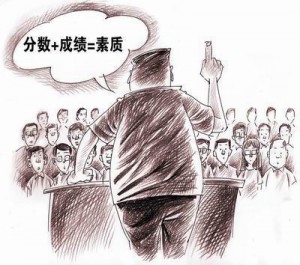
(illustration from Yu Jian's article; caption reads: "score + grades = character").


 The Useless Tree
Leave a reply to Mao Zedong Cancel reply