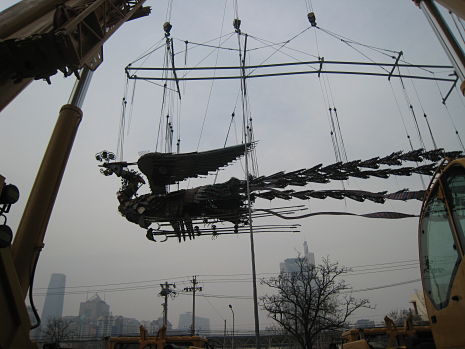
It's a central concept of Chinese aesthetics: the unity of man and nature – 天人合一. And it comes up in a blog post by Evan Osnos over at The New Yorker. He is writing about Xu Bing, an artist, who has made a giant sculpture of a phoenix out of left over construction material. He explains:
I went to a construction site and I was shocked. China has so many
modern buildings, but you can’t imagine how poor the working conditions
and primitive living situations were. I think there is a huge contrast.
That was when I decided to use waste materials. I want to use the waste
materials from the building construction to create a piece of work that
hangs inside the building itself. I thought that could have meaning.
Because this building was very extravagant.
Using waste to highlight extravagance – that has a Daoist resonance to me. Xu doesn't make explicit reference to Daoism, but he does invoke the classic notion of Tianren Heyi – Man and Nature are One:
The Chinese have a sort of respect toward waste, respect to materials.
The Japanese, Chinese, Koreans, because of the Asian tradition, pay
special attention to tian ren he yi: the theory that man is an
integrated part of nature. The rhythm of life should on pace with
nature, including in architecture…. Also, the Chinese have a strong
suit: recycling and frugality. My mother is like that. She hesitates to
throw away even the smallest things.
Again, there is an obvious Daoist sensibility to this idea – the unity and fullness of all things in Way – but it is also infused into the Confucian tradition. Yet, to my mind, Confucianism tends to privilege the human over the natural. Think about Analects 3.17:
As the ceremony had fallen into
neglect, Adept Kung wanted to do away with sacrificing sheep to
announce a new moon to the ancestors. The Master said: "You love
sheep, Kung, but I love Ritual."
Here, if Nature (symbolized by the sacrificial sheep) stands in the way of appropriate human activity (carrying out Ritual), then Nature must yield to human purposes. This little commentary suggests the same, pointing to Xunzi as holding a more human-centered view:
In ancient China, there are three typical kinds of theories concerning
relationships between man and nature: Zhuangzi's
theory of conforming to nature, Xunzi's theory of transforming nature, and the
harmonious relationship between humans and nature advocated in Yijing
. Since the Western notion of "conquering nature"
spread to China, Xunzi's positive theory, by contrast with Zhuangzi's passive
attitude, has been highly valued.
But perhaps that hardly matters now. It seems to me that in contemporary China Tianren Heyi is more often overwhelmed by frenzied development and construction, Xu Bing's mother notwithstanding. And perhaps that is what Xu is getting at by forging art out of waste; he's trying to restore some of the balance…
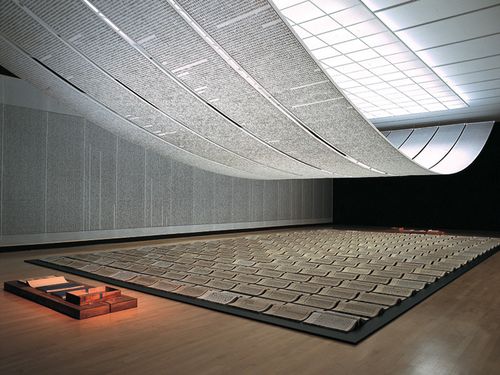
(I will also say that I have always enjoyed Xu Bing's "Book from the sky," which is a series of manuscripts and massive scrolls composed entirely of fake or simulated, but very real-looking, Chinese characters. Brilliant.)


 The Useless Tree
Leave a reply to Eileyah Zen Jenkins Cancel reply