Daniel Bell published a piece last week in the Toronto Globe and Mail, "The Chinese Confucian Party?" For those who know Daniel's work, the argument here is familiar. He points to political reformers within the CCP (which is still the Chinese Communist Party) who have moved away from Marxism and look to tradition and Confucianism for visions of a new political future:
…In the Cultural Revolution, “Confucius” was often just a label used to attack
political enemies. Today, Confucianism serves a more legitimate political
function; it can help to provide a new moral foundation for political rule in
China. Communism has lost the capacity to inspire the Chinese, and there is
growing recognition that its replacement needs to be grounded at least partly in
China's own traditions. As the dominant political tradition in China,
Confucianism is the obvious alternative
As with all of Daniel's work, it is well argued and well written but, ultimately, I find it unpersuasive.
The main problem is that China, at present, is not a Confucian society. Nor is it a Confucian economy or polity. By that I mean the every day social and cultural and economic and political practices and institutions are not fundamentally Confucian. Rather, Chinese society and culture is influenced more by the rise of market forces, which reduce social interactions to transactions based upon calculations of material gain. And that profit motive is basically un-Confucian. Way back in 1997 New Left critic Wang Hui argued:
Through the stepped-up reforms in the systems of
production, trade, and finance, China
has increasingly entered into the competition of the world market, with the result that the restructuring of the
domestic social and production mechanisms has
been undertaken under restrictions imposed by the contemporary market system.
Moreover, commercialization and its attendant consumer culture have thoroughly penetrated every aspect of
social life, thereby demonstrating that the painstaking
creation of markets by the state and by enterprises is not merely an economic phenomenon. Rather, this social process ultimately seeks
to use market rules to regulate all
social life. In this context, not only
have the original social and
professional roles of the intellectuals profoundly changed, but so has the state, particularly the social and
economic roles the government plays at every level
– by daily becoming more intimately related to capital.
Over the past 13 years all of those processes have become more extensive and intensive across China. Conspicuous consumption dominates, not Confucian asceticism and modesty. And the Party has merged with the rising bourgeoisie, in an alliance that suggests a turn toward Confucian virtue is unlikely in the near future.
Bell recognizes all of this. Elsewhere he has recently argued:
But the key obstacle to universalizing Confucianism, perhaps, is the gap
between theory and practice. Yes, the revival of Confucianism over the last few
years is reason for optimism. But there is still a long way to go…A meritocratic political assembly designed to represent the interests of future
generations and foreigners exists only in left Confucian dreams. Confucian-style
education meant to improve social ethics has yet to make any substantial dent in
widespread corruption. There are obvious constraints on religious freedom in
China, and the state does not officially support the Confucian religion. In
short, left Confucianism needs to be translated into practice. Once the Chinese
state acts morally in accordance with Confucian ideas, then it can articulate
and promote its soft power to the rest of world. If it’s just talk, nobody will
listen.
At this point it is just talk. Interesting talk, but just talk all the same. Before any significant Confucian political reformism is possible, Confucian-inspired behavior and practice need to gain traction in Chinese society and economy. And it's hard to see that happening any time soon.
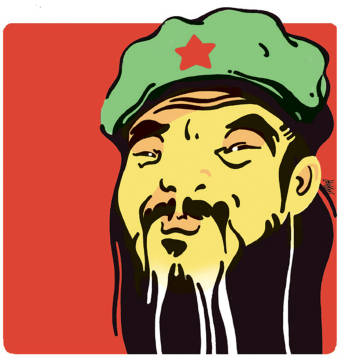
(illustration from Globe and Mail – I guess this is supposed to be Confucius in a Mao cap):


 The Useless Tree
Leave a reply to Daniel Bell and Thorsten Pattberg – too deep into China? Cancel reply