It seems that the movie Confucius has produced an anti-Confucius backlash in China. At least this is what is being reported in the China Daily. Here's Raymond Zhou:
The wave of anti-Confucius sentiment following the
removal of Avatar from 2D screens reveals a backlash against official
maneuvering.In the ongoing holiday movie season, there is an "I-hate-Confucius"
undercurrent. It has boiled to the surface and become a form of
"counter-terrorism". In Chinese, the homonym for Confucius and terrorism are
both "kong".
Zhou notes that displeasure over the movie has sparked criticism of Confucianism itself:
More startling than Confucius, the movie, falling
victim to this act of market tinkering, is Confucius the giant. Amidst the
outpouring of anger and frustration toward movie industry manipulations are the
voices that point to the thoughts of Confucius as a negative force in Chinese
history.It is strikingly reminiscent of the May Fourth
Movement – China's Enlightenment – in the early 20th century. It was at this
time that revolutionaries denounced Confucianism and embraced Western ideals of
science and democracy. And it runs counter to the current trend of promoting
Confucius and his teachings as a quintessentially Chinese alternative, that may
help win hearts and contracts across the world.
Another China Daily piece, by Zhang Xi, today picks up this line of critique:
Essentially, Confucianism was generated to serve feudalism rulers. It advocated
the power-based doctrine, regulated the order of a rank society by indicating
the divine right of emperors. It also orientated human’s social values and set
social behaviors, which required people to be docile. Therefore, Confucianism
began to be framed by subsequent rulers down the centuries to shackle people’s
thoughts. From Emperor Wu in Han dynasty, China started to officially worship
Confucianism alone, which caused Chinese people to follow all orders of
superiors.
While some may argue that certain ethical theories of
Confucianism are good for moral standard enhancement, such as when I walk along
with two others, they may serve me as my teachers. I admit that these phrases
themselves are not bad, otherwise how can they last for thousands of years and
be used to fool people to follow Confucianism? They are simply prettified the
power-based system based on the doctrine of a rank society. So no matter how
nice these certain phrases are, they cannot cover up the core theory they serve
for.
And, just for the record, a third China Daily item, "Confucius' name used to make money," points to the materialist hypocrisy of the Confucian revival.
All of this would be fairly innocuous cultural debate if it wasn't for the official recognition given by the leadership of the CCP for the revival of Confucian ideals. If the Party is really committed to Confucianism as an element of its ideological legitimation, then the critical articles in China Daily raise interesting questions: should we take these articles as direct challenges to the ideological power of the CCP? And, if we do see them in that way, should we interpret their appearance in China Daily as a sign of the Party's weakening hold on power?
I would answer both questions, "no," because my sense is that Confucianism is really not all that important to the Party. Sure, reviving tradition affords the Party a means of shifting its ideological underpinnings away from Marxism. Today, instead of arguing that single-Party rule is legitimate because it is consistent with the theoretical dictates of historical-materialism, Chinese political leaders can assert that Party dictatorship is legitimate because it has revived the nation's power and returned it to a place of global prominence, just like the old empire before Western imperialism. The glories of the past are invoked as a comparisons to the accomplishments of the present. Who needs Marx for that (especially since the Marxian interpretation of the Chinese past emphasized "backwardness" and stagnation)?
Contemporary Confucianism is thus useful for the CCP in only a marginal manner. It is one element of the past that can be remembered. It is not central to state legitimation. What matters on that score is continuing economic growth and a flexible response to social, cultural and, even, political change. Confucianism can be criticized, the the old May 4th style, without significant effect on the CCP's political standing.
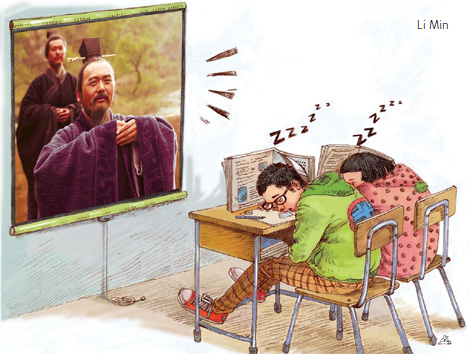
Thus, cartoons like the one below that accompanied the Raymond Zhou article in China Daily are not subversive of CCP power:


 The Useless Tree
Leave a reply to Negil Cancel reply