Let me say right up front that I have not yet seen Confucius, the movie, which opened last weekend in China. Somehow the theaters in my remote northwestern corner of Massachusetts have not yet screened it. I'll likely have to wait until I am in China (in March!)….
But some early reviews are in….and they're not very good. This saddens me, because I really respect and enjoy thinking about and working with Confucian thought. There really ought to be a good movie in his life and times. It seems, however, that the just released film is not it.
First up is Han Han, Chinese cultural bad boy race-car driver and pop icon. This is from his blog (translated by Chinasmack):
Today I went to see Confucius.
Before I went into the theater, I stepped out for a moment to make sure
of where my seat was, so as not to disturb others after entering. Once
I got in, I regretted it. There weren’t even ten people in the theater
and you could practically sit wherever you wanted…
To
tell the truth, I never felt there was much need to make movies on
historical topics. From the perspective of film, it seems as though
from their very birth, movies have been doing something that is very
opposite from [the idea of] film: killing imagination. But it’s not
necessarily true that China’s big historical epics lack in imagination,
because the people who write them often create scenes that are
diametrically opposed to actual history, so it’s really a collaborative
thing [lack of imagination working together with imagination].
We probably should not expect a young rebel like Han Han to give Confucius much of a chance. But his opinion could be important, both as a barometer of youth tastes and as a creator of those same tastes.
Unfortunately, the way Chinese film authorities handled the release of the film has created more of a comparison with Avatar than might otherwise have occurred. American journalist Mary Kay Magistad makes this point over at YaleGlobal:
What do you, as a Chinese film board, do, when the Hollywood science
fiction film Avatar smashes Chinese box office records in its first
three weeks in theaters, when online chatsites are buzzing about the
uncanny parallels between the fictional film plot – of developers
raping the land and forcibly evicting the people – and real life in
China? What if protesters against land grabs in southern China start to
use Avatar as a rallying cry, amidst a dispute with Google and
disagreement between the US and Chinese governments, about whether
information should be allowed to flow freely to the Chinese public?
Apparently, you claim commercial reasons for pulling “Avatar” from
most of the theaters on which it’s showing, and substitute a
Chinese-made film about Confucius that contains a message – respect for
hierarchy – you consider more appropriate for the mass consumption.
Just another example of how heavy-handed CCP control can create precisely the opposite of its desired effect. Brendan O'Kane has some fun turning the tables on SARFT (State Administration of Radio, Film and Television), suggesting how Confucius might respond to the Avatar/Confucius showdown:
Regarding fears that Avatar could overshadow Confucius:
…不患莫己知,求為可知也。(IV.14)“…I do not worry that I will be unappreciated; rather I seek to be worthy of appreciation.”Regarding the China Film Group and SARFT’s motives in yanking Avatar:
子曰:君子喻於義,小人喻於利。(IV.16)The Master said: “The superior man focuses on what is right; the petty man focuses on small gains.”
Regarding the ideal state of SARFT and the China Film Group’s consciences:
子曰:富與貴,是人之所欲也,不以其道得之,不處也。(IV.5)
The Master said: “Wealth and status are what all men desire, but if a
man cannot attain them by acting in accordance with his principles, he
should not hold them.”
If authorities had not jumped in to try to repress sales of Avatar tickets (for whatever reason) and boost Confucius, the latter might have been able to avoid the inapt comparison with the former. But now the competition has been created, and our stolid Sage must battle for the hearts and minds of Chinese viewers against those tall, blue, athletic, Taoist-tinged, righteous indigenous people. Hollywood v. Chinese film, etc. And, if sales are any measure (and Confucius might say that they should not be!), the blue Taoists are winning.
Actually, I don't think we should set these movies up as a straight Confucianism V. Taoism struggle. I'll have to see Confucius before I purse that sort of analysis, but, for now, given all of the external noise – especially the inept interventions of the Chinese film authorities – I will have to assume that Confucius, as a movie narrative, has not yet been given a fair shot.
And Confucius needs some help in his homeland. Commentary surrounding the movie release has also suggested a lack of interest in Confucian philosophy in and of itself. Robert Woo, of Global Voices online, reports on comments left by Chinese young people at a site honoring Confucius. He finds that:
A quick scan through the comments reveals that the overwhelming
majority of the visitors solicited help from Confucius in his role as a
saint-god, for no other reason than the passing of school exams.
Instead of an avatar (can I say that?) of a rigorous moral theory and practice, Confucius has been reduced to a minor deity, a spirit symbol that might magically bring success on school exams. Nothing more, nothing less. And that is so much less than the expanse and subtlety of Confucian thought. It is rather like what happened to Mao Zedong (though his theory and practice turned out to be much less worthy and much more destructive of China): he was devalued to the amulets hanging in taxis, a demi-god of traffic safety and convenience, with no reference to "On Contradiction" or any of his earlier vaunted contributions to Marxist theory. I fear that the current Confucian revival will engender a similar cultural cheapening. Few will take Confucianism seriously; it will languish as a petty commodity, considered only when the gaokao approaches….
It would seem that Yao Ming and Zhang Ziyi really are more potent symbols of contemporary China than is Confucius.
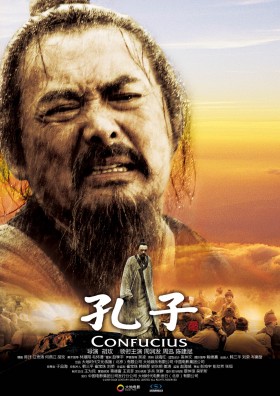
Maybe that is why the Sage looks so uncomfortable in the movie poster:
UPDATE: I just saw this review in People's Daily from last week…man, it's tough when you can't even get a good review from the flagship of the state-controlled media for a movie from the state-controlled film industry:
The two-hour film, reflecting the life of
Confucius from age 51 to his death at 73, is clearly divided into two
parts, each an hour long. The first hour focuses on his political life
and achievements, during which he led several "big-scene" wars. The
second half of the film starts with his dismissal and emphasizes his
travelling life and spreading his philosophy among the people.
According
to many film critics attending the pre-screening, the first half of
Confucius is dramatic with exciting scenes and complicated character
relationships, while the second is comparatively boring.


 The Useless Tree
Leave a reply to isha Cancel reply