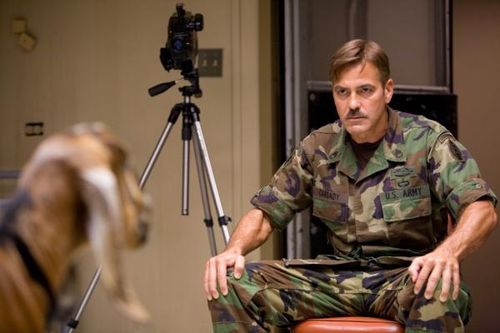
Went to see the movie, "The Men Who Stare at Goats." It is a satire, a goof, on the psychological operations – psy-ops – used by the US military; and in that satire is a critique of those methods, especially as they have been utilized in Iraq. The movie shies away from developing the critique directly, it remains largely in the realm of humor. Not earth-shattering or ground-breaking, but I think the NYT review captures it fairly well: "…this likable, lightweight, absurdist comedy".
Apparently, there is some truth behind the satire, as the book that inspired the movie is said to be a nonfiction account of early psy-ops efforts in the American military.
Psy-ops is made to look stupid and ineffective (though still dangerous and hurtful) in its origins: the movie portrays a group of Vietnam War era US military men latching on to hippie-like, proto-New Age ideas to reverse the thinking about war. How to turn weakness into strength so that war can ultimately be prevented. And, yes, Lao Tzu is mentioned at one point (if I am remembering correctly, when the Ewan McGregor character is reading the "New Earth Army" handbook, Lao Tzu is mentioned as one of its inspirations).
So, for me, the movie represents a popular cultural invocation of Taoism for, in this case, humorous purposes. As someone who takes Taoism seriously, I don't really see any problem in this. If anyone should be able to laugh at themselves, it is Taoists. Indeed, Taoist humor makes me think of the beginning of passage 41 of the Tao Te Ching:
When the lofty hear of Way they devote themselves.
When the the common hear of Way they wonder if it's real or not.
When the lowly hear of Way they laugh out loud.
Without that laughter, it wouldn't be Way.
This passage holds several meanings. First, it would seem that laughter is a part of Way – "without that laughter, it wouldn't be Way." But what does the laughter signify here? Are the lowly simply dismissive of Way, neither trying to devote themselves to it or question whether Way is real or not? And is that dismissiveness a more natural response to hearing of Way – a more Way-like attitude so to speak – than the responses of either the lofty or the common? Who here has a more open and direct and genuine connection to Way: the lofty, the common or the lowly? Perhaps the passage is telling us that if we want to follow Way, we need not "devote" ourselves to it – in the sense that devotion is a purposive, intellectual exercise – but just open ourselves to it, marvel at what Way presents to us, and laugh.
That is what this movie is doing, essentially. It is not carefully constructing an analytic critique of American abuses of psy-ops. It is laughing at the absurdity of the pursuit of power by any means, and it is asking us to join in that laughter as a means of critique.
I don't want to end here without mentioning the Taoist ideas that are being invoked. That is, the notion that the weak can overcome the strong. Passage 43 of the Tao Te Ching comes immediately to mind:
The weakest in all beneath heaven gallops through the strongest, and the vacant absence slips inside the solid presence.
I know by this the value of nothing's own doing.
The teaching without words, the value of nothing's own doing: few indeed master such things.
And, of course, the strong anti-war theme of Taoism comes through in passage 69, as well as in other places in the text:
There once was a saying among those who wielded armies: I'd much rather be a guest than a host, much rather retreat a foot than advance an inch.
This is called marching without marching, rolling up sleeves without baring arms, raising swords without brandishing weapons, entering battle without facing an enemy.
There's no greater calamity than dishonoring an enemy. Dishonor an enemy and you'll lose those treasures of mine.
When armies face one another in battle, it's always the tender-hearted one that prevails.
And, yes, there is some similarity between Taoist notions of war and Sun Tzu. It is the latter writer who made famous the idea of "winning without fighting." But, it must be said, that last sentiment in passage 69 about the tender-hearted, is definitely not something Sun Tzu shared…..


 The Useless Tree
Leave a reply to TwangGuru Cancel reply