I didn't see this the other day in the NYT: sculptor Li Chen has a major show in Singapore. He is inspired by Buddhism and Taoism:
“Li Chen is regarded as one of the leading Asian sculptors today,”
said Tan Boon Hui, the recently appointed director of the Singapore Art
Museum. “His works stem from a fusion of philosophies and spiritual
beliefs and contemplate values that are lost or forgotten in our modern
lifestyle. I find his contemporary expression of traditional Chinese
iconography both interesting and unique.”
Tan Hwee Koon, the
curator of the exhibition, said that Mr. Li’s sculptures are
predominantly based on the artist’s study of Buddhism and Taoist
philosophies, which he combines by injecting the Buddhist concept of
emptiness and the Taoist concept of chi, or energy. “The inflated
figures are actually a reflection of the chi, the energy inside,” she
said. “He’s injecting the life force into the sculpture.”
Of course, emptiness is not only a Buddhist concept; it is also a Taoist notion, though we shouldn't demand too rigorous a distinction between the two since they merge into one another in the religious realm. But philosophical Taoism embraces an ideal of emptiness as well. It is sometimes tied to meditative practice, or it can be associated with the Taoist sensibility of eschewing formal "knowledge" in favor of a more direct and open experience of Way. We need to empty our minds of all preconceived expectations and desires if we are to come to apprehend the fullness of Way. Yes, Qi (ch'i) would be relevant here, too. When we empty our minds we open ourselves to the flow and flood of qi. (the "qi flood" image is from Mencius, perhaps a Taoist element of Confucianism).
I like the way he gets at emptiness through large, billowy forms. Here are a couple of photos from a site with his name on it, lichensculpture.org:
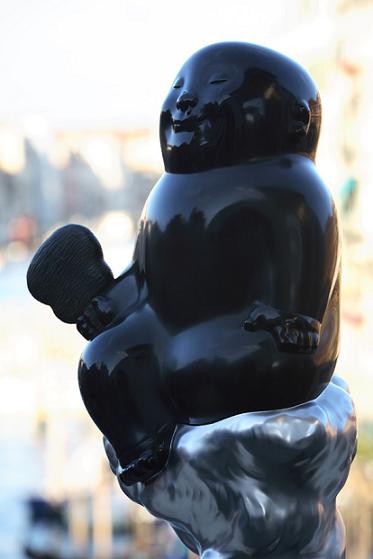
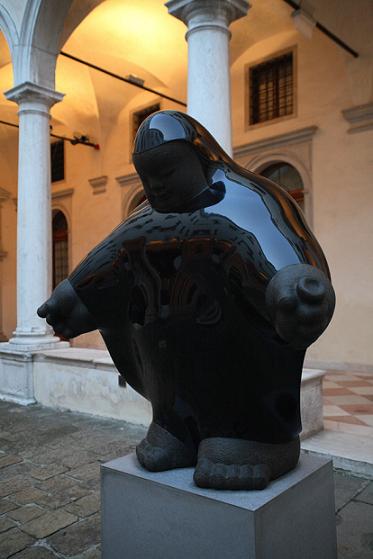
It looks like these figures have opened themselves to the qi flood.


 The Useless Tree
Leave a reply to badgercat Cancel reply