Went to see Whatever Works the other night. I was ready to not like it, since I have never really embraced Woody Allen's comedy (too much upper-middle class angst for my taste). But I was pleasantly surprised! Perhaps because it had been written in the 1970's, and thus reflected his earlier wit. Whatever the case, I found it amusing.
So, I disagree with A.O. Scott. True, it was not a great movie, and the main female character was rather unbelievable, but, for all its faults, I found it more refreshing than he did (maybe because I live so far away from Manhattan). I suspect the Taoist resonance had something to do with it.
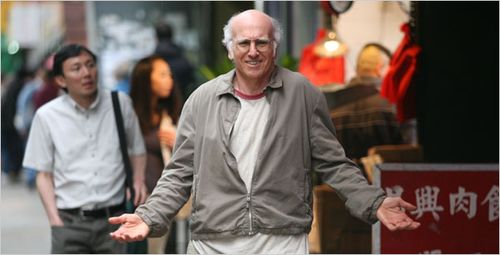
The main character, Boris, is cynical and pessimistic, as we might expect from an Allen creation. The title, as critic Scott points out, sums up some of his philosophy of life:
But “whatever works” — by which he means, basically, do your own thing,
“filch what happiness you can” in the absence of metaphysical order —
could also be the slogan of pragmatism, a more optimistic philosophical
disposition, and one that would deny Boris both his self-pity and his
puffed-up sense of intellectual superiority.
There is no transcendent meaning to be found, there is no grand metaphysical order, thus just follow the natural unfolding of Way before you. A Taoist, especially a Chuang Tzu-inspired Taoist, would not find in this a reason for nihilism or defeat. Rather, why not just "filch what happiness you can" and have a good time. As I watched the movie, I thought of this passage from the Inner Chapters:
We're cast into this human form, and it's such happiness. This human form knows change, but the ten thousand changes are utterly boundless. Who could calculate the joys they promise?
And so the sage wanders where nothing is hidden and everything is preserved. The sage calls dying young a blessing and living long a blessing, calls beginnings a blessing and endings a blessing. We might take such a person as our teacher, but there's something the ten thousand things belong to, something all change depends upon – imagine making that your teacher. (87)
Woody Allen, ultimately, is not a Taoist. He complains and kvetches too much. His hypocondria gets in the way. But he comes close. He just misreads what randomness and fate and meaninglessness offer. Maybe he read too much existentialism and not enough Taoism when young…


 The Useless Tree
Leave a reply to Chris Cancel reply