The folks over at the New Legalist web site are after me again. They have posted "Part II" of their critique, "Who is 'Distorting Chinese History and Chinese Philosophy': The New Legalists or Prof. Sam Crane." (Guess which one they think is at fault…). So, I suppose I have to respond again. It is getting a bit tedious, however. I do not expect to sway any opinions over there: they are clearly devoted nationalists who will forever adhere to a historically dubious primordialist view of China. And they seem to have an overblown sense of their own importance, suggesting that this exchange will: “elicit new light to illuminate the future of mankind” I have no such expectations myself. It's just a blog debate.
But let me make a couple of points. (It gets a bit long, so I will drop it under the jump)
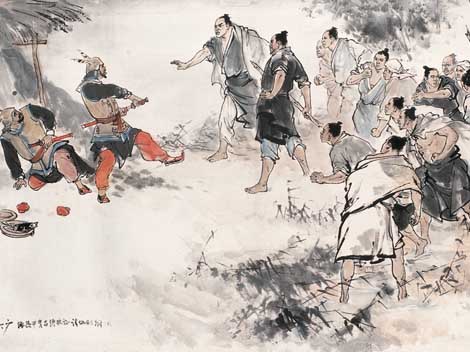
(painting of Chen Sheng and Wu Guang leading the uprising against Qin)
1. Qin Legalism killed hundreds of thousands of Chinese people.
Notice how the New Legalists elide the brutality of Qin. They note several well recognized reforms (some of which actually originated elsewhere) and then simply mention: "And after that, the reformatory measures of the Qin state were extended throughout the empire…" How nice. "Extended throughout the empire." But precisely how did that happen?
What the New Legalists do not want to discuss is the vicious and inhumane warfare that Qin brought down on neighboring states. Qin policies were not simply "extended throughout the empire." They were imposed by unprecedentedly harsh violence. Let's look at the numbers.
…In 268 BC, a strategist, Fan Sui, proposed to Qin's King Zhao the policy of "attacking not only territory but also people." He argued that Qin should aim at the destruction of armies on such a scale that rival states would lose their capacity to fight. Before Fan Sui articulated this policy, however, Qin's commanders had already begun mass slaughters of defeated armies. According to classical texts, one talented commander, Bo Qi, along killed 240,000 Han-Wei allied troops in 293 BC, drowned several hundreds of thousands of Chu soliders and civilians in 279 BC, killed 150,000 Zhao-Wei allied troops in 273 BC, and buried 400,000 Zhao forces in 260 BC. On the whole, Qin is recorded to have killed more than 1.5 million soldiers of other states between 356 and 236. While these numbers are likely to be exaggerated and should be treated as reflecting the magnitude of battle deaths rather than absolute figures, they nevertheless reflect Qin's ruthless brutality in its pursuit of domination.
Victoria Tin-bor Hui, War and Statecraft in Ancient China and Early Modern Europe (Cambridge, 2005), pp. 86-87. (I have not included Hui's footnotes).
These are all instances of battles before the final wars of unification, which we can assume followed Qin's established style of brutality. Of course, as Hui suggests above, we cannot take these numbers as exact. They do not include Qin military deaths, which must have also been considerable. And they do not account for the many, many civilians caught up in the Qin war machine. Hui reviews the debate over the historical data in footnote 168 on p.152 of her book, noting other scholars, Chinese and Western, who find that the general magnitude of the killing, though not the precise numbers, is likely accurate. Her ultimate description is, thus, one we should keep in mind when thinking about Qin: "ruthless brutality in its pursuit of domination." Is this what the New Legalists wish to revive?
Qin inhumanity is to be expected. It is simply an outgrowth of the Legalist dictum: "agriculture and war." Mark Edward Lewis remarks on the book of Shang Yang, an early policy guide for the Qin:
The overarching principle is the identity of the army with the peasant populace, which enables the entire state to be mobilize for war: "The means by which a ruler encourages his people are offices and rank; the means by which a state arises are agriculture and war." This vision figures throughout the book, which constantly discusses how to encourage people to devote themselves to agriculture and warfare – the rewards that will result from doing so and the disasters that would flow from failure to do so.
Qin was a violent, inhumane, military dictatorship that ultimately failed on its own terms. That failure is described by Derek Bodde in the Cambridge History of China, vol 1. , in an otherwise sympathetic account of Qin:
The large mass of convicts used for military and labor purposes, and for the colonization of new territories, apparently consisted of a mixed assortment of unfortunates. Among them were common criminals, persons forced by economic circumstances to become fugitives, and persons belonging to disfavored groups; also some merchants and, on on occasion, even "functionaries who had not been upright in handling court cases." These and others must have formed a large reservoir of resentful and desperate people ready to participate in rebellion when the central government fell into rapid decay following the death of the First Emperor. (p. 88).
I'm sure the New Legalists will try to spin this in a manner that suggests a conspiracy theory among elites of some sort. But there is a larger story here: Qin's hyper-repressive politics alienated large numbers of people, their own people, subjects of Qin, many of whom were common people, peasants, and these people became so desperate that they were willing to stand up against the power of the state. As Bodde demonstrates (pp. 89-90), the up-swelling of popular resistance against Qin repression began before the First Emperor's death, so we cannot simply absolve him of responsibility for the systemic failure of the state he constructed, as the New Legalists would like to do. Bodde specifically mentions increasing food prices under Qinshi Huangdi as a factor they may have led peasants to revolt.
Chen Sheng and Wu Guang were not simply inventions of corrupt elites. They signified popular rejection of the extreme brutality of the Qin state.
There is much we can never know about Qin, since historical records are so scarce. But we must continue to ask: how many people died as a result Qin's domination? How many died at the hands of the Qin army? How many died in conscripted labor, making walls or useless terra-cotta statues that the megalomaniacal Qinshi Huandi hope to use to dominate the after life? How many died in desperate circumstan
ces? We will never know exact numbers, but it is obvious that Qin killed many, many innocent people, hundreds of thousands at least, possible millions. And as Mencius says:
Prince T'ien asked: "What is the task of a worthy official?"
"To cultivate the highest of purposes," replied Mencius.
"What do you mean by the highest of purposes?"
"It's
simple: Humanity and Duty. You defy Humanity if you cause the death of
a single innocent person, and you defy Duty if you take what is not
yours. What is our dwelling place if not Humanity? And what is our
road if not Duty? To dwell in Humanity and follow Duty – that is the
perfection of a great person's task."
(13.33)
Qinshi Huangdi was not a worthy official.
2. A Revived Legalism would weaken a modernized China
These historical debates are interesting, but the thing that really concerns me about the New Legalists is their purposes in the present. Why do they want to revive Legalism? And why do they want to interpret it and, presumably, enact it through a nationalist lens? They are, I suspect, like nationalists everywhere, anxious about power. They want their particular nation to have more of it, and they want to see it used conspicuously so that others will fawn in fear before the historically inevitable greatness of (fill in the name of any particular nation). US nationalists are that way. Japanese nationalists are that way. And contemporary Chinese nationalists are that way.
What is unique then about the New Legalists is that they believe a revived Legalism will somehow best serve the purpose of increased PRC power. They are, however, wrong.
What would happen if PRC leaders suddenly embraced New Legalism and used it as a modern policy guide? What would they do?
Admittedly, it is rather difficult to see how "agriculture and war" might translate into a modern world-economy. But the New Legalists provide some insights. They are anti-globalization. Now I have a certain sympathy with that critique but, at the same time, it is rather difficult to see how economic growth in China can continue without something like the trade and financial policies of the past thirty years. Or, to put it another way, could the PRC economy grow at a sufficient rate to maintain social stability without access to US markets and, thus, acceptance of US dollar reserves?
Much has been said about increasing PRC consumption and the rise of the middle class, but are those changes strong enough to keep the PRC economy growing right now? Leaders in Beijing don't think so; they continue to work to preserve the current economic relationship between China and the US. They realize that, however weak the US dollar may be as a global key currency, there is really no alternative at present. SDRs are a figment of the IMF's imagination. The Euro doesn't look much better than the dollar. And if the PRC Yuan was going to be made into a key currency, it would have to be freely floated on the capital account, and that would open up the PRC economy to more, not less, external economic pressure. PRC leaders may be frustrated with certain elements of their relationship with the US, but they know that their political legitimacy is tied to high domestic growth rates, and a closing of the world economy would jeopardize that growth.
So, yes, there are problems with globalization. But there are not really any alternatives. I was raised as a Wallersteinian, and I understand his argument that the system could be facing hegemonic decline of the US, which could open up to a period greater political-economic competition among the most powerful states, rather like the inter-war period. But the future is not simply a replay of the past. Wallerstein misread the decline of the US in the 1970s, and no one really anticipated the rise of China. How capital evolves from the moment of crisis it currently faces is hard to tell. But the pressures for openness along the lines of what has come to be called "globalization" of late, seem quite powerful indeed. The Washington Consensus may well be dead (and good riddance) but that does not necessarily mean the end of globalization.
Thus, the extent to which the New Legalists are stuck in a facile anti-globalization critique that resonates with protectionist withdrawal from the world-economy, the more irrelevant they are to the contemporary moment. Indeed, since Chinese development and power of the past thirty years has derived precisely from the globalization they reject, the New Legalists, were their ideas ever to gain enactment, would most likely weaken China.
That's enough for now….


 The Useless Tree
Leave a reply to Lang Yan Cancel reply