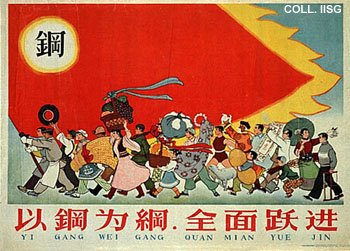
A nice post over at Danwei on the discovery of some old "backyard furnaces" from the Great Leap Forward. The furnaces (pictured above) were an attempt, as a part of the disastrous Great Leap Forward, to produce steel in a radically decentralized, localized manner. It was a terrible failure.
The Danwei post links to and translates an article by Wu Zhaolai, "Ruins of Great Leap Forward smelters should be preserved." I agree with him completely when he writes:
The memory of the Great Leap Forward, and its millions and millions of innocent victims killed by failed Maoist policies, must be kept alive. Wu must be circumspect in discussing the Leap – government censors do not like too much consideration of those bad days – but this is a nice paragraph:
The past has become a memory and a historical lesson. But has the mentality of the Great Leap Forward been entirely eradicated? Faced with this massive cluster of iron smelters, we have much to reflect upon. Public, scientific, and democratic decision making must not be merely empty words but must be put into practice in every project.
And there is a nice allusion to Mencius:
There are natural laws that govern nature: you can't pull on shoots to help them grow. Similarly, social and economic development has its own set of laws: all-out effort won't bring accelerated economic growth overnight. In those days, iron was the "supreme commander," iron was everything. That was the extreme mentality of the Great Leap Forward. Society no longer meant unified economic development. It was forced to make immense, unconditional sacrifices for the cause of increasing a particular type of output, and spiritual victories were won by realizing a particular target. As a result, the views of those who opposed rash advances were criticized, and they were sidelined as obstacles to rapid development. Radical speech, thinking, and officials became the mainstream and its guiding forces.
The "can't pull on shoots to help them grow" phrase alludes to this passage from Mencius (3.2) about the man from Sung:
In all beneath Heaven, there are few who can resist helping the rice shoots grow. Some thing nothing they do will help, so they ignore them. They are the ones who don't even bother to weed. Some try to help them grow: they are the ones who pull at them. It isn't just that they aren't making things better – they're actually making things worse!
And this raises a question, perhaps on that Wu cannot raise directly and not get into political trouble: in the case of the PRC's Great Leap Forward, who played the role of the man from Sung? The Mencius quote could suggest that it was a generalized human tendency to force things along. But I think we can be more specific. Mao Zedong did the most to push the Great Leap Foward onward to its deadly culmination. He pulled at the rice shoots of the Chinese economy and the Chinese people more violently than anyone else. He deserves the primary blame for the deaths of millions upon millions of Chinese people then. And that is what needs to be remembered, above all else, about the Great Leap Forward.


Leave a Reply