OK, one more thing on the Jackie Chan thing…

There has been some debate about what, exactly, he was implying when he said: "我们中国人是需要管的."   More specifically, the meaning of that last word – guan – has prompted some debate, leading to alternative translations.  Did he say something like "We Chinese people need to be controlled" or something like "We Chinese people need to be managed."  For some, the first sounds rather more dire than the latter – though personally I don't see that much of a difference here.

But even if "manage" is the better translation of guan, what does "manage" imply in contemporary Chinese politics?   Here is a usage that has rough and violent connotations: 城管, chengguan.  Literally, it suggests "city managers," and could, to a Western ear, call forth the image of a small town technocrat, dutifully and efficiently doing the good public service in town hall.  In China now it has a different meaning, more like "city enforcement squads," gangs of ruffiians who are called in to beat up and chase out street vendors or petitioners or farmers trying to resist corrupt officials from taking their land or, even, political protestors.  Danwei considers translations possibilities hereRoland, too, picked up on the recent book instructing chengguan in how to use violence without leaving too many traces.   And here are some other thoughts on the term.

ChinaSmack has a funny post on "city managers."

And perhaps the most famous image of 城管 is this:
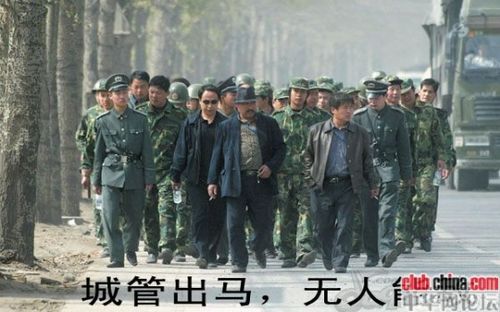
Chengguan

So, here's the question for Jackie Chan: is this the kind of "management" you were referring to?  Do Chinese people need to be subjected to gang-style violence to keep them in line?

Sam Crane Avatar

Published by

Categories:

15 responses to “The Resonance of a Chinese Euphemism, Jackie Chan edition”

  1. Peony Avatar

    You’ve gotta be kidding me. Did Chan actually ever say he was aiming for a 城管 style management or did you pull that straight out of your *ss? 管 is also used for writing “tubes” too… Do you think that’s what he meant? Or perhaps he wanted Chinese controlled be librarians…
    Does 管= 城管 in ordinary Chinese? Is that the argument?????
    Putting the political emotion aside (of which I have feel zero), just linguistically, to administer by goverenment 管 (not 城管)… to minister, to manage… During Hurricane Katrina, that was a comment heard around here: why isn’t the US gov’t 管 the people? (which means protecting in this case). Unless Chan went on to say more, this is less a call to for China controlled by violent gangs as it is a call for continued big government, no?
    I am with Isha on this.

    Like

  2. Sam Avatar

    管 has a range of meanings. Most contemporaneously 城管 has been added to that range of meanings. Whether you believe it or not, that is one of the possible connotations, especially in political terms, especially when speaking, as Chan was, about “freedom,” 自由, or the lack of it.
    I will agree that he may not have been thinking of the 城管 connotation when he spoke, but the 城管 connotation was activated by his speech, whether he meant it or not. I think he was thinking of a form of political “control” more severe than that in Japan or the US, and that he believes that “Chinese people,” whatever that might mean, cannot be trusted with freedom. Which is, whether he or you or Isha care to admit it, a way of thinking that brings us the men of 城管.
    More to the point, I was poking some fun here at Chan’s defenders, who are making quite a bit out of the distinction between “control” and “management”. That is the euphemism to which the title of the post refers….

    Like

  3. Peony Avatar

    Does 管 have 城管 as a range of meaning?? Or does it just incorporate the character into the word? Like I said, that character is used to write many, many words, from electrical tubing to librarians. So, that is my first question. If Chan dislikes chaos, why would he be invoking “violent gangs”?? Does that make much sense, really?
    And yes, he was questioning freedom, in terms of “too much freedom” as something leading to chaos. Whether he is right or wrong, that position is arguable (that is, it has a logic which can be argued and is not a call to totalitarianism). Why not take him on within the argument instead of all this other rhetoric….
    Finally to your last point regarding the difference between control and manage, I think you are wrong and that “control” is written using different characters. It is not a euphemism but is a valid WORD. That does not mean that “control” could never be used as a transaltion for 管—what it means is that the word is 管 and has to be understood in its semantic context.

    Like

  4. Sam Avatar

    “control” is a standard constituent of the semantic context of 管. Oxford dictionary has it as such, too. “Control” can be rendered variously, but one form is: 管制.

    Like

  5. Rhan Avatar
    Rhan

    The above phrase show the attitude of the author.
    Jackie Chan is a movie star, read some of his interview and you know his level of education. What he mean is similar to when we says we have to manage our kid. Don’t use all the political or philosophy jargon to confuse us.

    Like

  6. Sam Avatar

    城管 is not philosophy jargon. It is a euphemism, as is, it seems to me in this case, “manage.”

    Like

  7. Rhan Avatar
    Rhan

    “Don’t use all the political or philosophy jargon to confuse us” is kind of euphemism. “Seem to me” is a more acceptable view.

    Like

  8. Bill Avatar
    Bill

    What is important is what he said after “管”: or else we will do what we want to do. Therefore, being “管” is the opposite of “do what we want to do”. That means “管” is doing what someone else wants us to do. Whether it is “manage” or “control”, it is “do what someone else want”.
    The issue is who is that “someone else” ? For me personally, it is OK if it is me. But you may feel differently.

    Like

  9. Peony Avatar

    Actually, I think a brief glance at Chan’s words will show that he is setting up something more like this:
    “being regulated” versus “too much freedom”
    As to who is doing the regulating, it could only be the government given the context, no? Sam, again, I feel you are missing the point. “Control” is a perfectly valid translation in certain circumstances, but in this case, it is a debatable translation to say the least.
    Hence, people are debating it. There is no mystery really.
    The interesting question, to my mind, is what does this mean: “too much freedom” (ie as something leading to chaos)
    Is freedom like love– that is, there is never too much of it?
    Or is it like sex, something that if “too freely” acted upon could lead to less the ideal consequences. Hence the need for regulation or management– or control if that is what you prefer. This is perhaps where the tension lies…perhaps?
    Yawn.
    Who knows. All I know is, I stand with Isha.

    Like

  10. Kai Avatar

    Sam, er…interesting mental connection there. My response is at CNR.
    Heads up: Nothing personal, just being emphatic. As a blogger yourself, I trust you understand. Cheers.

    Like

  11. chriswaugh_bj Avatar

    支持 Peony. Sorry, Sam, but your blowing this way, way out of proportion.

    Like

  12. Sam Avatar

    Thanks for the comments, everyone.
    All I was going for here was an ironic, satirical, snarky riposte to 管 as “management.” I did not mean this to be taken literally.
    As I said in one of my other posts, to my mind this is, ultimately, not about linguistics but politics. So, I think Peony’s redirection of the conversation is most useful. It is all about an assertion of “too much freedom” v. “being regulated.” If “Chinese people” (and I think we need to interrogate what this term implies in this context, who is in and who is out? Would a decline in “chaos” in Taiwan mean that “Chinese people” are capable of handling more freedom, or does it make them culturally something other than “Chinese people”?) are given “too much freedom,” as in Hong Kong and Taiwan, they will become “chaotic.” And it is that, seemingly natural, tendency of “Chinese people” that requires a certain amount of “regulation,” which, concretely means that it is justifiable to jail people like Hu Jia and Chen Guangcheng -that is what “regulation” or “control” or “management” means in practice.
    Thus if you side with Chan you are essentially saying that Hong Kong and Taiwan are “chaotic” to a degree that justifies the full range political repression now deployed in the PRC. Peony, I’m not sure if that is like love or sex; but it is obviously being scripted as dangerous.
    In the end, I disagree. I do not think HK and Taiwan are unusually “chaotic” and I do not think they should be used to rationalize authoritarianism in the PRC. And I do not believe that “Chinese people” have some sort of natural tendency toward “chaos.”

    Like

  13. isha Avatar
    isha

    And I do not believe that “Chinese people” have some sort of natural tendency toward “chaos.”

    Neither do I, Neither do I. It is universal. I guess Chen would agree with me, but since his audience was the ones he considered as Chinese, he address them as “we Chinese.”( I guess for a lot of not over-educated Chinese common folks, including Chen, they regard themselves as a moral community …)
    If Fianciers are not regulated and have too much freedom, they will just do what they want ( most of the times, it means, free to loot…) How about regulators become looters? anyone knows the final answer, please let me know how to control the central bankers from looting anyone in their sights ( and out of their sights )!!!???…) Didn’t Madoff used to be regulator himself?
    http://en.wikipedia.org/wiki/Bernard_Madoff
    When police have ” too much freedom” …
    http://video.google.com/videoplay?docid=-7554865090799900529
    Police Acquitted Of Shooting Black Man In NY…
    http://www.evtv1.com/player.aspx?itemnum=11647
    http://www.msnbc.msn.com/id/15918902/

    Like

  14. Peony Avatar

    Again, no one said– not even Chan– that the Chinese people have a natural propensity for chaos. It is about “cultural” preferences concerning regulation versus freedom. And that is the only logical place to address Chan’s words– if you are so inclined, which I am not. Regarding the jailing example– again you are logically running amok in the context of Jackie Chan’s utterance. Give me a break.

    Like

  15. Peony Avatar

    PS
    I think freedom is like sex. But, I think people who feel it is like love are praise worthy.

    Like

Leave a comment