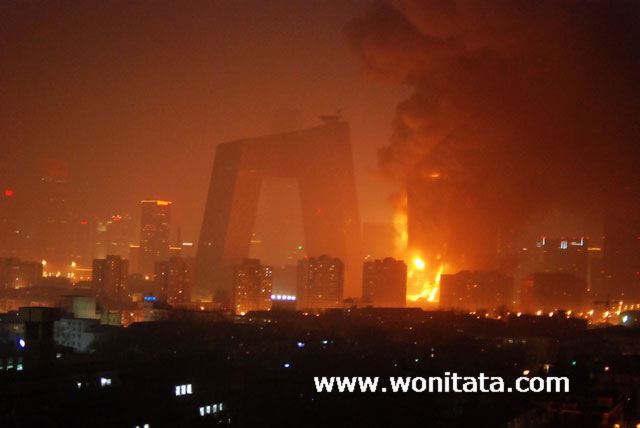
Roland translates a Chinese blog post, "Is the CCTV fire an act of God?" (I would quibble here, preferring a translation: "Is the CCTV fire an act of Heaven" – original Chinese here). The post speaks to the horrible fire that engulfed one of the buildings at the CCTV site in Beijing on Monday (and thank goodness the building was empty at the time, or the human toll would have been much worse…). The blogger raises several issues, including the worries of some Chinese people that the fire is an inauspicious beginning to the new year as well as some subtle criticism of the PRC's political system:
…There are many possible explanations about any
emergency disaster, each with its own reasons. For example, different
people have different explanations about the CCTV fire. Some people
say that it was negligence in safety management, some say that the
fengshui of the place was bad, and some say that CCTV has aroused too
much anger. These explanations are each reasonable in their own way,
but ultimately I believe that this fire was an act of of the Heavens.
Why do I think that this was not a man made error in which safety rules were
broken and the advice from the Public Security Bureau was ignored? Why
do I say that this is an act of the Heavens?
When a person, or a group, or a political party, or a
people arrives at a stage that nobody can warn or stop them, the only thing
left is for the Heavens to punish them. That would be an act of the
Heavens. CCTV is such a group. For certain artificial reasons,
the position of this group was elevated above others because it can help the
survival of a certain political party. As a result, CCTV can have or
do anything that it wants. Nobody can restrain it. Many people
know this for a fact, including former CCTV employees who know what goes on
inside.
The idea of punishment from Heaven is an old one in Chinese philosophy. Mo Zi (I am in a Mohist state of mind this week) is especially focused on this idea. This is from the internet encyclopedia of philosophy's entry on Mo Zi:
Within the core chapters, the Mohists consistently portray Heaven as if
it possesses personal characteristics and exists separately from human
beings, though intervening in their affairs. In particular, they
present Heaven if it is an entity having will and desire, and concerned
about the welfare of the people of the world, even a providential agent
that rewards the just and punishes the wicked through its control of
natural phenomena or by means of its superhuman intermediaries, the
spirits (guishen). Finally, Heaven and the spirits are also
portrayed as the objects of reverence, sacrificial offerings and
supplication ("Heaven's Will" B).
This notion of Heaven is not the same as the Christian idea of Heaven: there need not be a singular God figure who is the ruler or orchestrator of Heaven. Rather, Heaven can be a rather more diffuse sense of fate and destiny, though in the Mohist view a more specific will of Heaven (something more concrete or particular than the "Mandate of Heaven"?) is certainly in play.
The blogger, then, is giving modern expression to an ancient Chinese sensibility of Heaven as a regulator or legitimizing director of the human world. And he (or she?) goes further by incorporating a yin-yang notion of balance, something that I associate most closely with the I Ching but which is infused throughout just about all pre-Qin thinking:
A sign from the Heavens or an act of the Heavens conveys a
message. The message may not be understood unless one is respectful
and humble. Although I don't fully understand it, I have figured out
that one of the aspects is "balance." This is the minimum demand by
the Heavens for humans: balance. This may sound profound, but it is
actually very easy to explain.
The existence of everything is premised upon a certain
balance that exists from the smallest atoms to the microbes to the solar
system to the galaxy to the universe. In humans, the balance is for
the yin-yang, the bones, the muscles, the brains and the limbs. In a
society, the balance is for equality of wealth and political fairness.
In economics, the balance is between income and expenses and also asset
structures. There is no need to say more about the balance in nature.
CCTV, and the CCP that stands behind it, has gone too far in amassing and controlling power. The political system is out of balance, and the fire is a act of Heaven that is pointing to that imbalance. Interestingly, my friend Allan all but anticipated something like this in a post from February 7th, "Ominous Signs from Heaven?".
It seems that Heaven is trying to tell us something. It may be something more than China and CCTV and the CCP. It might be a message to all of us, everywhere, to think about how we might be out of balance with one another and with the environment that surrounds us. I think it may be time to consult the I Ching…


 The Useless Tree
Leave a reply to isha Cancel reply