Sorry for the blog silence: a whole week without a post. That is unusual for me, even when I travel. What kept me away was work, for the most part. I had to grade 67 five page papers in under a week and that stole away my time. There is a benefit, however. My students wrote on nationalism after WWII in two of the three countries we are studying this semester: China, Japan and India. Many chose China and analyzed the rise of Maoist revolutionary socialism and its horrendous failures, The Great Leap Forward and the Cultural Revolution. And this got me to thinking about the Great Leap Forward, which was unfolding fifty years ago.
Indeed, exactly half a century ago the transition to communes was just about complete. Popular enthusiasm for the Leap was at its height. No one had starved to death yet. Ultimately, though, by 1961, somewhere in the neighborhood of 30 million people had perished from starvation. It was an unmitigated disaster, the deaths were mostly man-made, and the man most responsible for most of those deaths was Mao Zedong. Here's a depressing chart that shows the plunge in the birth rate and the horrible rise in the death rate and the absolute decline in population caused by the Great Leap Forward:
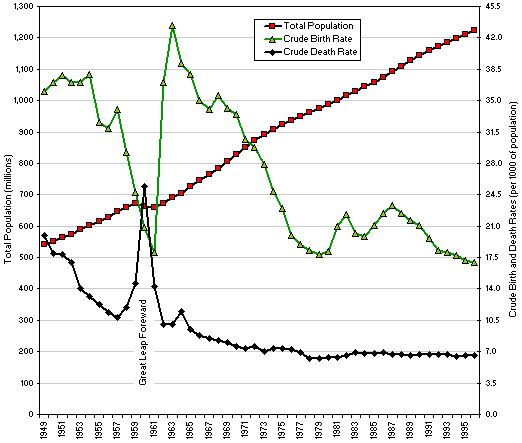
That's what 30 million deaths looks like.
Anyway, my student's papers got me to thinking. There's a way in which we (analysts of Chinese politics) might view the Leap as something exceptional. It obviously grew out of Maoist ideology and Leninist practice, but it might be seen as a distortion or corruption of those original sources. Mao had been placed in a difficult political position by the Hundred Flowers Campaign, which had brought forth more fundamental political criticism than he had expected, and he lurched back toward Party Leninists (who had always been skeptical of Mao's desire to open the Party to intellectual critique) and launched the Anti-Rightist Campaign. The atmosphere of intimidation and fear created by the Anti-Rightist Campaign shaped the political context of the Great Leap. When the utopian ideals and goals of the Leap were announced, no one dared to criticize or resist because to do so could lead to a "Rightist" designation and a term on a work farm. And when Defense Minister Peng Dehuai, the only real hero of the story, stood up and tried to challenge Mao in 1959 and was purged, it sealed the deal: the Leap went forward and millions died.
That's pretty much the conventional story. And there is a way in which it could be read as a distortion of Maoism or a sidetracking of a more pragmatic expression of Chinese nationalism. But my students' papers, some of them, have me thinking, no, the Great Leap was not an exception, it was not a political mutation of what might have been a more subdued nationalism. It was, rather, an organic development of the national project that emerged in 1949. It was completely in keeping with Mao's vision (he had not been compromised by Party bureaucrats, as he himself would argue in the Cultural Revolution). He had merely continued along a path established upon the founding of the PRC.
To see this we need to consider Ernst Renan's definition of the nation (this was the assignment I gave to my students). Here's a passage from his 1882, "What is a Nation?":
A nation is a soul, a spiritual principle.
Two things, which in truth are but one, constitute this soul or spiritual
principle. One lies in the past, one in the present. One is the possession
in common of a rich legacy of memories; the other is present-day consent,
the desire to live together, the will to perpetuate the value of the heritage
that one has received in an undivided form. Man, Gentlemen, does not improvise.
The nation, like the individual, is the culmination of a long past of endeavours,
sacrifice, and devotion. Of all cults, that of the ancestors is the most legitimate,
for the ancestors have made us what we are. A heroic past, great men, glory
(by which I understand genuine glory), this is the social capital upon which
one bases a national idea. To have common glories in the past and to have
a common will in the present; to have performed great deeds together, to wish
to perform still more – these are the essential conditions for being a people.
One loves in proportion to the sacrifices to which one has consented, and
in proportion to the ills that one has suffered.
I think this has resonances with Maoism. Obviously, Renan is not a Marxist. But the voluntarism that he puts forth in his understanding of nationalism (consent, will) is similar to an element of Maoism that my old teacher, Maurice Meisner, is famous for emphasizing: "… an extreme voluntarist belief that human consciousness is the decisive factor in determining the course of social development." Mao and Renan both believed that national identity is constructed by human activity, by action that creates solidarity, by performing great deeds together.
Of course, Mao, unlike Renan, defined the "great deeds" that would bring China together in terms of socialist construction. And once he had taken on that perspective, he would have to devise an expression of socialist construction that was unique, that did not merely mimic the experience of the Soviet Union, in order to claim historical greatness for himself and China. He had to push further than the mere "socialism" proclaimed by the Eighth Party Congress in 1956. He had to make a bigger, grander statement.
Part of that reach for a peerless expression of communist national greatness was the other half of Renan's formulation: the need to redeem the nation's past struggles. The revolutionary victory of 1949 had already liberated China from the "century of humiliation." But to achieve something like the Great Leap Forward would elevate that initial revolutionary victory even more. The national past and present are fused in Renan's understanding, and national solidarity is a reflection of the scale of both past sufferings and present (and future) accomplishments.
In these terms, the grandiosity, and attendant brutality, of the Leap makes a certain, albeit depressing, sense. Mao was reaching for a greatness that would elevate the nation above any of its global competitors. His cultural iconoclasm might suggest a rejection of the past (he certainly attacked Confucianism outwardly). But he could not escape history; perhaps he did not want to escape history but fundamentally overthrow it. We commonly hear that China has "too much history." How better to get out from under it than achieve something so audacious in the present that the past would have to be redefined in the face of it. He could recapture not the glory of Confucius, but the glory of Qin.
So the Leap was an extension of Mao's voluntarist socialist nationalism. The impulse for destructive creationism (to turn Schumpeter around) was a culmination not a distortion.
And to bring a bit of ancient Chinese thought into the conversation here, the tragedy of the Leap lies in Mao's misplaced historical perspective. He was measuring himself against Qin and Marx. Had he followed Mencius, he might have listened when Peng Dehuai remonstrated in 1959 with a poem:
The millet is scattered over the ground.
The leaves of the sweet potato are withered.
The young and old have gone to smelt iron.
To harvest the grain there are only
children and old women.
How shall we get through the next year?
Peng was a Mencian at heart; Mao was not.


 The Useless Tree
Leave a reply to isha Cancel reply