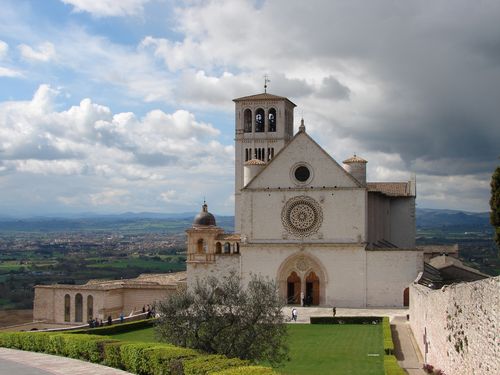
Just back from a brief trip to Rome. My first time there. What a fantastic city. We took a day trip as well to Assisi, the birthplace and resting place of St. Francis. And while there I had a riveting experience that made my think of China and Confucianism.
We were in the lower basilica of the Basilica of St. Francis, having just emerged from the crypt of the saint himself, when suddenly the air filled with singing. A clear and wonderful four part harmony curled through the stone arches and walls. We walked toward the heavenly sound, turned a corner and saw a chorus of thirty or so young East Asian students, their gray-haired conductor swaying and waving before them. Their voices lifted up and out and all around the sacred space. We were transfixed by the ethereal melody. It is impossible to capture in words the transcendent quality of the music. When they finished, silence settled upon the small crowd that had gathered. And then clapping, which came hesitatingly at first (were we supposed to clap in church?) but then heartily. We were then treated to three more songs.
It turned out that these were high school students from Japan, pupils at a special institute for choral training. They were truly extraordinary.
Afterward, as I strolled through the church and out into the hillside town, I started thinking about that performance. These young Japanese people had just authentically [see comment below for why I am retracting this term] enacted an element of "Western" culture: Christian hymns sung in Latin in four part harmony. I don't know if they were Christians themselves. But it doesn't really matter if they were or not. They had learned how to perform the culture and did so with flawless accuracy (hence my willingness to suggest that this was an "authentic" enactment of the culture [which I now am less willing to invoke]). And this got me thinking more generally about culture and cultural diffusion.
Various different cultures have elements that are meant to be transferred to other contexts. They are universalizable. For "Western" culture (I don't like the meta-geographical generalization, "Western", but will use if for now…), Christianity fits this bill. Indeed, that's what "catholic" has always meant to Catholics: "universal in extent." And that is also true for other religious traditions. Islam is open to all who care to convert, as is Buddhism and Hinduism (though will less demand for a specific "conversion" process). Religion is not the only source of transferable culture but it is a notable one. These traditions provide a system of beliefs and practices which, when they are taken up by any person anywhere at any time, produce a cultural identity grounded in both thought and behavior. Again, one's religious identity may not be the totality of ones cultural identity, but it can be an important part.
It is that openness to diffusion that I want to focus on here. Because that kind of openness also facilitates the movement of cultural practices free from a full acceptance of religious belief. Again, those Japanese high school students may or may not have been Christians, but they could perform those hymns and their performance was welcomed by the other people in the church, many of whom were "Western" and some of whom were Christian, as an authentic enactment of an aspect of "their" culture. The Japanese students were being "Western" at that moment. And the "Westerners" in the room recognized them as part of that cultural formation.
This kind of openness to diffusion is by no means peculiar to "Western" culture. Think of the expansion of yoga in the US today, a practice originally rooted in South Asian religion but now widespread around the world. Other examples can be adduced…
To become universalized in these ways, a culture has to be seen and accepted as universalizable. In religious traditions, this is often all for the good. Converting or encouraging people into a set of beliefs and practices is what many religious thinkers and practitioners want to accomplish. They want to universalize their culture.
And here is where I see a limitation in some of the current thinking about Confucianism. On the one hand, some Chinese intellectuals see Confucianism as the basis of a new strand of universal culture. They believe Confucianism can and should be universalized and diffused to other parts of the world. For them, something like an "American Confucian" makes sense. I ran into this kind of thinking way back in 2006 at a conference in Beijing on Confucianism and post-modernism. And it reflects a very old way of conceiving of "Confucianism" as a civilized cultural practice that can and should move across political and social boundaries.
But we know there is another perspective, one that sees Confucianism now as particularly "Chinese" and looks forward to using Confucianism as a part of a broader cultural-nationalist project. This is how I understand Jiang Qing. From this point of view, it makes little sense to think of Confucianism as universal nor that it should be universalized. There can be no Confucian equivalent of those Japanese high school kids singing Christian hymns. I don't agree with this position, but we have to recognize it as having a certain traction in China.
Of course, no one person or group can control the fate of cultural beliefs and practices. Whether or not Jiang Qing thinks Confucianism is exclusively Chinese or not will not determine its global standing and prospects. But cultural conservatives (here understood to be those people who try to hold on to nationalist-exclusivist understandings of "culture") are, in a way, undermining their own desires. They want "Chinese culture" to have more prominence in the world and they believe the rising economic power of China will bring some sort of enhanced global presence. But, at the same time, they obstruct the diffusion of aspects of "Chinese culture" because of their narrow nationalist aims.
It seems that the bottom line is: if you want to see "your" culture gain greater global influence, you have to stop understanding it as "your" culture and let it open up to the world. And if you facilitate that, beautiful and unexpected reanactments of "your" culture, in forms and places you might never have imagined, are possible.


 The Useless Tree
Leave a comment