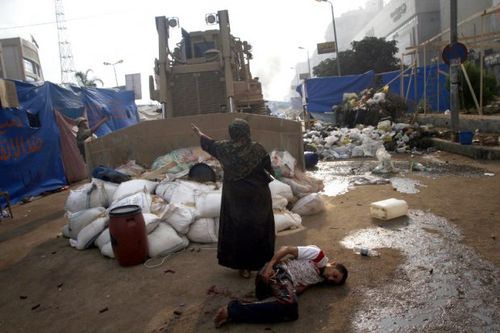
Following up on the post below, I notice that others have commented on the differences between the horrendous violence in Egypt in the past few days and the "Beijing Massacre" of 1989. Matt Schiavenza, over at The Atlantic, adds some additional historical contextual points (Egypt is embedded in a regional dynamic quite unlike China's situation 24 years ago). CDT had a good round-up of stories and links. Both help to diffuse overly simplisitc comparisons.
A post at China Matters, however, misreads my argument. The author there writes:
concerning the CCP’s iron grip on power in 1989 (which, in his view, apparently
makes the Tiananmen Massacre worse than the events in Egypt):
They are: the example of the Cultural Revolution…rampant
inflation…widespread student and worker strikes…millions of demonstrators…leadership split…army units disobeying
orders…worldwide collapse of Communism.
I am in no way suggesting that the Beijing Massacre (let's refrain from calling it the "Tiananmen Massacre") was "worse than the events in Egypt." I make no general evaluative statement of that kind. The rather simple point is that the PRC state is more coherent, more institutionalized, more durable, and more powerful than the state in Egypt. And that structural contrast makes for a very different political context. The China Matters writer can belittle this observation as much as he (she?) wants, but without a substantial counterargument (does he/she believe the state in Egypt is more powerful than that in the PRC?) it is simply empty snark.
I agree with the China Matters writer: all such massacres of demonstrators should be condemned. What the Egyptian government has done is unconscionable; what the PRC state did in 1989 was also unconscionable. The consequentialist logic that might be employed to relieve the CCP of its responsibility for killing some hundreds, perhaps more than a thousand, unarmed Beijing citizens, is ethically insufficient. But it's not clear to me what the China Matters writer believes: should we cheer Li Peng for his nerve to do "what was necessary" to carry on with deepening China's ties to the world economy, widening economic inequality, and preserving growth? I'll leave that to him/her.
In his/her zeal to overstate and ridicule my post, he/she suggests that I would characterize the current PRC regime as "totalitarian." I have never used this term to describe the post-Mao PRC state (the Maoist era is another matter…). It is a fraught term, rather vague in its empirical referents (though Hannah Arendt's analysis may still be the best). To reject its relevance for today's PRC, however, does not mean that we cannot still point out that the state there is stronger (more institutionalized, capable, autonomous) than the state in Egypt. We can and it is.
What we might be able to say at this point is that the crisis in Egypt appears to be more extensive than what happened in China in 1989. While it is true that the Chinese demonstrations were national in scope, they were not accompanied by armed assaults on police stations as is happening in Sinai. It will likely be much more difficult in Egypt now to reconstitute centralized government authority than was the case in China in 1989.
Finally, a friend emailed me to argue that I was underestimating the extent to which the CCP did in fact face an existential threat in 1989. He argues that the nation-wide protest was such a threat and, therefore, had to be "ruthlessly repressed." I disagree. I believe that the regime could have found a way of getting the students off the square and diffusing the situation without mass violence. The terrible tragedy of June 4th was that violence was not necessary; it was a choice made by spiteful and rigid conservative leaders. The military did not have to open fire as it did.
If there is a basic similarity with Egypt now, it is this: explosions of state repression are usually the result of a longer series of prior political decisions, any of which might have been taken differently, averting catastrophe. The ultimate responsibility lies with power-holders who make strategic decisions that close off avenues for peaceful resolution of political tensions.


 The Useless Tree
Leave a comment