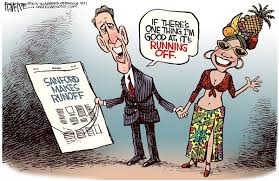
Infamous philanderer Mark Sanford is poised to win the open South Carolina seat in the US House of Representatives. He seems precisely the kind of person Confucius would reject for any such position of public authority.
Sanford's notorious transcontinental affair, during which he not only lied to his wife but also to his staff and his entire constituency of South Carolina citizens, was an enormous breech of trust. Whether he has really atoned for those misdeeds is, in the first instance, a matter between him and his wife. Voters, however, seem willing to forgive and, to some extent, forget, and that appears to be a sign of wilful hypocrisy in support of political ideology: "conservatives" in South Carolina would rather have a Representative who symbolizes unfaithfulness in his family commitments than suffer a Democrat in that position. So much for "family values."
We know that electoral processes do not always yield ethically satisfactory leaders. (Though the authoritarian alernative is generally worse). But we can demand that those who would stand for office must match their words with their deeds. That, at base, is how Sanford failed. He said he was a loyal husband, a family man; he said he was trustworthy. But he did not act that way. He cheated and lied and dissembled.
That matters for Confucius, because, to him, public leaders set examples for the rest of society. Indeed, the key to Confucian leadership is exemplary behavior: the good should rule, by this understanding, not only because their experience in cultivating goodness creates in them a capacity for judgment, but also because society at large needs, and benefits from, the morally charismatic power of that goodness. Here is his advice for how to govern effectively in Analects 12.19:
“Just
set your heart on what is virtuous and benevolent. The noble-minded have the integrity of wind,
and little people the integrity of grass.
When the wind sweeps over the grass, it bends.” (Hinton)
The effect of morally excellent action by noble-minded people is like a natural force, the wind, and it will sweep along those in need of instruction. Conversely, as Mencius suggests, if people who act badly are installed in leadership positions, society at large suffers:
Therefore
only the humane should be in high positions.
When one lacking in humaneness occupies a high position, his wickedness
spreads to everyone. (Bloom, 4A1)
Now, I don't want to make too much of Sanford's indiscretions. He is not "wicked" or inhumane. He is simply a jerk, a rather grandiose and obnoxious jerk. But the Confucian standard is still relevant here: the good should rule, not the jerks. Perhaps he is tyring to make up for his mistakes; maybe he is an honest and honorable man down inside. That's all fine. He just should not be a representative, for if he is, he will be a constant reminder of dishonesty and unfaithfulness. And that is not what we need in our public officials.

 The Useless Tree
Leave a comment