For the Record: one of the commenters on this post has, on another blog, accused me of "banning" him. That is not true. I suspect he ran into a bit of trouble with the Captcha system in Typepad Comments, and jumped to the conclusion that I was a hypocritical imperialist hell bent on suppressing speech. As of this posting – 2/26/13 2:35PM - the error has gone uncorrected, even though I tried to send an email to the person involved. Just to be clear: I have not banned anyone from this post, and have never banned any individual in a systematic manner (In the past, I have taken down some specific comments I felt were inappropriate personal attacks)
I knew this was going to happen. Was it George Bernard Shaw who said: "Never wrestle with pigs. You both get dirty and the pigs like it"? That is where I find myself now. In my previous post, I criticized Great Leap Famine denialists, knowing full well that this would likely spark an attack against me personally. And, lo and behold, like clockwork, it has. I will not belabor this exchange, for there is really no prospect of any sort of meaningful outcome when dealing with staunch ideologists incapable of anything but stark binary oppositions, and I will not link to the site (don't feed the trolls…), but I will make a couple of clarifying comments.
First, the question of precisely how many people died during the Great Leap Famine is not settled. It will likely never be, as I suggested in the original post. There is certainly room for serious intellectual investigation into the issue of how many people died. I do not believe that all such critical questioning of the death toll is motivated by denialism. But it is rather obvious that a particular subset of that criticism is denialist. This is difficult for ideologically- and politically-motivated people to grasp, because they think only in black and white terms. So let me be painfully clear: not all critics are denialists, but all denialists are rooted in a political agenda that keeps them from maintaining an open and, ultimately, critical attitude. They are apologists.
Thus, I do not view Amartya Sen as a GLF denialist, as is implied by my critics. Sen is obviously a serious intellect. I am a bit amused, however, that he would be invoked in this manner, since he is famous for arguing that famines do not occur in democratic regimes. Although that argument has opened into a wide-ranging debate about the politics of famine, and there are ways in which Sen's analysis has run into problems (Zimbabwe, for example, turned out not to be as democratic as he first thought), his basic point is crucial to keep in mind when thinking of the Great Leap Famine: the causes of that terrible tragedy are rooted in the nature of the political regime, whether we call it "authoritarian" as Sen does or "totalitarian" as Yang Jisheng does. The PRC political system, dominated by the CCP, is chiefly responsible. I am happy to include Sen's perspective into the conversation.
Selective use of sources is characteristic of the denialists' approach. In their most recent invective they continue to focus on demographic estimates, focusing specifically on possible problems with the 1953 census, in an attempt to discredit some of the larger calculations of GLF deaths. On this narrow question, I accept the possibility that the 1953 census could be flawed, just as so many other statistical products of the Maoist era PRC are flawed. But debates among demographers do not settle the larger question of how many actually died. Especially when we have a growing body of archival documentation – not simply demographic estimates, but internal bureaucratic reports from the time of the starvation itself – to bolster our understanding. The denialists assiduously avoid these sources, obviously because they point inexorably to the worst sorts outcomes.
When will they deal directly with the work of Yang Jisheng and Zhou Xun? Until they do, they cannot be taken seriously.
The denialists also ask why I would make the comparison between the death toll of the GLF and the horrible effects of Japanese imperialism in China. It is precisely because I see the latter as terrible, and yet, the Mao-led CCP killed more Chinese people than even that scathing inhumanity. Serious scholars of the GLF cannot avoid that sad comparison. Yang Jisheng writes (Tombstone, p. 13): "The Great Famine even outstripped the ravages of World War II; the war caused 40 to 50 million deaths throughout Europe, Asia, and Africa over the course of seven or eight years, but the Great Famine's 36 million victims died within three or four years, with most deaths concentrated in a six-month period."
It is precisely because the value of every Chinese life – whether victims of Japanese imperialism or Maoist radicalism – is significant, that such comparisons must be made.
But denialists cannot stand this. They must defend Mao; they must resist the terrible truth in order to preserve the memory of the Chairman. And those of us who would question Mao's culpability, must be totally negated. Thus, they call me "morally degenerate". This is Cultural Revolution language. The language of ideological motivation, intended to inspire repression and violence and elimination. That is the preferred idiom of the denialist: threaten in order to silence.
It must be rather frustrating for them, because they are losing this battle. Yang Jisheng's book was first published in Hong Kong, in Chinese. It is banned still on the mainland, but it went through eight printings in two years. It circulates widely in the PRC, in spite of the ban, and has become "…a legendary book in China." Thus, Chinese people are gaining access to the truth that the denialists work to repress. And Yang shows us that Mao bore significant responsibility for the mass death:
Those who deny that the famine happened, as an executive at the
state-run newspaper People’s Daily recently did, enjoy freedom of
speech, despite their fatuous claims about “three years of natural
disasters.” But no plague, flood or earthquake ever wrought such horror
during those years. One might wonder why the Chinese government won’t
allow the true tale to be told, since Mao’s economic policies were
abandoned in the late 1970s in favor of liberalization, and food has
been plentiful ever since.
The reason is political: a full exposure of the Great Famine could
undermine the legitimacy of a ruling party that clings to the political
legacy of Mao, even though that legacy, a totalitarian Communist system,
was the root cause of the famine. As the economist Amartya Sen has
observed, no major famine has ever occurred in a democracy.
In Mao’s China, the coercive power of the state penetrated every corner
of national life. The rural population was brought under control by a
thorough collectivization of agriculture. The state could then manage
grain production, requisitioning and distributing it by decree. Those
who tilled the earth were locked in place by a nationwide system of
household registration, and food coupons issued to city dwellers
supplanted the market. The peasants survived at the pleasure of the
state.
The Great Leap Forward that Mao began in 1958 set ambitious goals
without the means to meet them. A vicious cycle ensued; exaggerated
production reports from below emboldened the higher-ups to set even
loftier targets. Newspaper headlines boasted of rice farms yielding
800,000 pounds per acre. When the reported abundance could not actually
be delivered, the government accused peasants of hoarding grain.
House-to-house searches followed, and any resistance was put down with
violence.
That is undeniable.
UPDATE: a bit of further evidence that denialists are being thwarted by the historial understanding of people in China: this story about a People's Daily editor having to backtrack on a denialist claim when confronted by angry netizens on weibo.

 The Useless Tree
67 responses to “Reply to my Diaspora Fenqing Nationalist Critics”
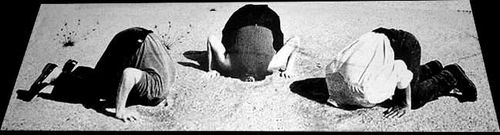
For a person who claims other people calling alot of names, you seem to do alot of it here, several references of “Fenqing,” “apologists” and of course “denialist.” Yeah, that picture with people with their heads in the sand is very ‘constructive.’ If you want to stop ‘trolls’ from coming here, you should stop offending people who don’t agree with you.
LikeLike
Great post, not much use in discussing with narrow minded and ignorant chinese nationalists. They are ideological, blind to reality and their extreme actions are actually against Chinas real national interests.
LikeLike
China’s first emperor probably ordered more death as a proportion of the total population than anyone else. He conquered the warring states and unified China, killing hundreds of thousands and sending other hundreds of thousands to build the Great Wall and dying in the process. yet despite the maligning of Confucian scholars in the 2 millennium since he’s still widely admired by poets, leaders, and people in general. And despite your condemnation Mao will also be admired by Chinese people. As a historian versed in Chinese history I am surprised by your blindness in not seeing why. From the Spring and Autumn period through the Warring States millions died because of the constant warfare and resulting upheaval. The First Emperor did kill many, but compare the casualties from the previous 400 years it’s a travail amount. He wanted his dynasty to last 10,000 years, yet it was overthrown in less than 20 years after his death. Yet he also succeeded beyond his imagining. For the next 2,000 years China essentially followed his model, legalism with a Confucian patina. You have to understand that since Opium Wars, more millions died from various causes until the formation of People’s Republic of China. To you GLF is everything; for China it’s just a bump on the road to modernity, a price being paid for the present and future success.
LikeLike
But a crucial distinction, at least for those who might care about reasons for killing, is that Qin did most of his killing in warfare before unifying China. Mao, on the other hand, did most of his killing after the CCP had won the civil war v. the GMD, another “unification of China” of sorts. Now, that apparently does not matter to you. But I believe that the GLF was not necessary. It was not a matter of national survival (quite the contrary it was a national disaster). It obviously was not necessary for Chinese “modernization” – we will notice that modernization happens in Taiwan and South Korea and Japan without the mass starvation of millions of innocent people. Had Chen Yun’s policies been followed from 1955 onward, a very different, less violent and deadly, Chinese modernization would likely have transpired.
And I suspect that many, many Chinese people would not agree with you when you trivialize the suffering of so many as a “bump on the road to modernity.” Again, it was in no way necessary to modernization. And the many, many victims of that horrible time would most certainly want to mourn and remember their dead with dignity, something that has been subverted by the state’s repression of that history.
Can you really look into the eyes of people who lost their parents or grandparents or other relatives at the hand of Maoist insanity and say to them that their personal losses are mere “bumps on the road to modernity”?
What a pathetic and inhumane rationalization….
LikeLike
What a pathetic and inhuman rationalization….
When I mentioned slavery and genocide of native Americans you dismissed it as a blob on the founding fathers. Do the industrialization of West has to proceed as it was described in Communist Manifesto or A Tale of Two Cities? On the backs and conquest of the colonies? We can always be revisionists and imagine Shangri-La. Where do you think your self congratulatory democracy come from? It was built on the backs of those suffering dying people in the third world. You may think you are guilt free advocate of democracy and transparency, as if society is isolated and free from past and history. You may have protested against Vietnam and Iraq, but still 3 million Vietnamese and 1 million Iraqis died and to their relatives the blood is still flowing. Most Americans couldn’t care less about them. Sure, we have free internet and democracy, but we couldn’t care less about a wedding party hit by the drone in Afghanistan, not to mention evolution or climate warming.
LikeLike
Mao ordered peasants to melt down their farm tools and along came three years of poor weather – the kind of bad luck that could strike any despot and his victims.
LikeLike
The thing about the GLF famine is, it isn’t even unique. Before the GLF we have the example of the Ukrainian famine under Stalin, and after the GLF we have the famines in Cambodia and North Korea, all the result of crazed utopianism under totalitarian dictatorship.
Mao at the very least should have been aware what the consequences of his policies might be given the events in the USSR. Anyone seeking to deny the GLF famine has to explain why exactly this case is different. Denialists therefore find themselves having to either deny all the famines that resulted from attempts to impose Marxist ideology on agricultural production, or deflect blame onto other countries.
It is no surprise, therefore, to see HH pushing the line that China was under strict ‘blockade’ during the Mao period. In reality, just as with North Korea during its famine, one has to ask why the country was so isolated and whether the government had an culpability for this isolation. In the case of Mao’s government, it was isolated not just from the ‘imperialist powers’ (with the exception, of course, of the UK) but even from its co-ideologists in the USSR and North Korea, and this was a direct result of Mao’s crazed policies. Just as importantly, the refusal to acknowledge that anything might be wrong with these policies prevented any request for help even from the few countries with which Mao continued to maintain relations.
On the subject of ‘feeding the trolls’, however, I think you’ve taken the wrong tack. HH may be trolls, but simultaneously refusing to acknowledge their existance whilst writing an entire essay dedicated to them is somewhat bizarre. Either ignore them entirely, or address them directly, but don’t try to do both simultaneously.
LikeLike
Ngok, You are distorting my words. Here is what I wrote:
“…slavery in the United States was a horrible abomination that killed and maimed many, many, many people. As was the extermination of native Americans. And, yes, the “founding fathers” of the US are responsible for those things, and their historical legacies must always include those facts.”
I am not dismissing these historical facts. As you well know, these horrors of American history are well-documented. They are known and remembered and mourned and commemorated. There are deniers of this history, just as there are GLF deniers and Holocaust deniers. I am not one of them. The good news is that these deniers are marginalized by open debate.
But the topic of conversation here is the Great Leap Famine.
Here is another historical fact: Mao was significantly responsible for the unnecessary death by starvation of millions and millions of Chinese people. Why is is so hard to accept that fact?
I guess I shouldn’t really pose this as a question, because I do not expect an answer. All that I get – and have gotten from GLF denialists in the past two days – is obfuscation, distortion and personal attacks. That, in itself tells us something about denialist ideology.
LikeLike
FOARP,
You may be right. I may have taken the wrong tack. But given the response, which I expected, I am not now going to reverse course. I am, after all, “morally degenerate.”
It is, in any event, time to go back to ignoring them.
LikeLike
There are many people on both “sides” of this debate who are genuinely intelligent and certainly earnest in their positions, but I think with the past two public posts on each site, this has devolved into identity politics.
There’s less and less discussion about the actual issues and points being made, and more and more characterizations of the “other side”. Or at least there’s more and more attention and indignation given to such characterizations.
It’s understandable of course, but I just think it’s a bad direction that both sides could actually agree on if they put their fists down for a moment. This started off somewhat interesting, if only to see how each side articulates their points, but now both sides are just using labels to simultaneously dismiss and provoke each other.
LikeLike
Sam, I want to thank you for your work! As a Chinese born Amercan who enjoys reading your blog, and reading history, it is so clear who cares about China more. It is the intellectuals who seek the truth, like you, and like the investigators of GLF in China.
I think when you tried to answer Mr. Ngok, you really meant that American government and its intellectuals would never, with conscience and right mind, justify slavery and Native American policies as a necessary evil on the road of American nation building. To use Western history as an excuse for the Chinese GLF and other failed national policies is a slap on the face of everyone on the planet of ours, who values open society and the pursuit of truth, in order that we may as global human societies, avoid the tradgies in the future, especially in China.
The fact is a lot of Chinese are not yet mature enough to think independently of racial and national identity.
LikeLike
Mr. Crane,
Let’s get some facts straight. You have accused us as deniers for questioning the numbers you yourself agree aren’t certain, for as you said, we try to excuse Mao for whatever crime you accuse him of. As a historian and American if someone accuse of Washington and Jefferson as slavers and responsible for the holocaust for African-Americans, although the charge maybe literally true, for they did own slaves and the constitution did define the slaves as 3/5 of a person, I am sure you would consider it as slander and fighting words. Yet you think we are brainwashed and not capable of rational discussion, but only for pig fights.
For someone teaching about Chinese philosophy that is really arrogant and lacking insight of China and Chinese. To me you remind me of “The Quiet American” by Graham Greene, full of self righteousness of democracy, condemning others of barbarity yet unaware of your own limitations. Do you think we really that uncivilized that we or Mao does not suffer when other Chinese died of starvation? Why do you think Castro defies America, the number one super power for over 50 years. For you it’s beyond comprehension, for me it’s so obvious, for human dignity! At this age when colonialism died 30 years ago, American still clings to Guantanamo, which legally according U.S. belongs to it, yet to the rest of the world is fiction. Despite your embrace of Arab Spring, I very much doubt your so called democratic value will prevail. For Athens democracy belong to Athenians only, not to their slaves.
You value Confucius, yet during his lifetime he was dismissed by various rulers. He was resurrected later because his philosophy dovetailed with status quo and useful in that sense. He imagined a perfect past and yearns to return to then, maintain the proper rites, everyone in their proper place, and everything will be in harmony, and slaves will remain slaves, and all the rulers will be usurpers in his eyes as only the Chous are the legitimate king. A few years ago archaeologists unearthed a Qin tomb a few hundred years previous to the First Emperor, in it were the bones of the wives and concubines, slaves and tomb builders buried alive, at least the concubines were lucky that they probably took poison before the burial. I am sure the burial follow the proper rites according to the custom of that time. So much for the theory and reality of past and present. At least Qin First Emperor advanced to the Terra Cotta Army rather than live people. I suggest that you read Andre Malraux ands Graham Greene, for they understand why the anger which is beyond you.
LikeLike
@Ngok – You really are incapable of getting this very simple concept: the subject under discussion is whether it is appropriate to deny that Mao’s policies led to the avoidable deaths of millions of Chinese people to no gain.
Sam’s made it very clear that he is not a denier of the wrongs of US slavery or US treatment of Native Americans. You continue to talk about why people are angry at the United States – but what is the relevance of this to the subject of whether it is appropriate to attempt to deny that millions of Chinese people died both unnecessarily and predicatably from Mao’s policies?
Analysis of:
1) Contemporary Chinese statistics
2) Eye-witness accounts
3) Research in the intervening time
All shows that significant numbers of Chinese people starved to death during the Great Leap Forward. The exact figure may be as high as 50 million, or as low as 16 million, but it is not zero, it is not comparable to the figure that might come from local famine induced by crop-failure alone. It is, however, what one would predict from similar instances in history (the Ukrainian famine, the North Korean famine, the Cambodian famine) where totalitarian governments have attempted to adapt food production along ideological lines without reference to what actually works.
In the face of this evidence, it is not appropriate to suggest, as HH did, that no-one starved, or that the number was low enough to make this historical event not worth mentioning. Even those who believe Mao to have been a good leader must explain why he remains so in the face of this evidence. It is not appropriate to censor this information, nor is it appropriate to defend such censorship.
@Kai Pan – It is certainly true that the HH crowd are simply going with the brand they love. One can legitimately ask whether Yang Jisheng is guilty of this.
LikeLike
Ngok,
Here is the difference between us:
I recognize this as a true statement:
“Washington and Jefferson bear significant responsibility for the holocaust against African-Americans because not only did they own slaves and participate in a constitution that defined the slaves as 3/5 of a person, but also because they continuously exercised political power in a manner that perpetuated slavery.”
Furthermore, I absolutely support my colleagues here at my college who teach classes to students that bring the best and most recent research to light that reveals and explains the horrors of slavery and its insidious after effects. We have a vibrant Africana Studies program. We also have a Latino/a Studies program; a Women’s and Genders Studies program, a Jewish Studies program, and an American Studies program (one part of which delves into the historical discrimination against Asian Americans). The brutal extermination of native Americans is covered in early American history classes. We are a small college, but we do all of these things and I support all of them unequivocally.
You cannot recognize this statement as true:
“Mao Zedong bears significant responsibility for the deaths by starvation of millions and millions of Chinese people (not to mention politically inspired killings of Chinese people before and after the GLF) because he actively promoted the policies that produced the famine (against the advice of people like Chen Yun) and stubbornly and knowingly demanded that the failed policies continue even when it was known (most notably, but not exclusively, through the intervention of Peng Dehuai) that they were causing starvation.”
Needless to say, serious study of the GLF in China is actively repressed by the CCP.
Both statements are true. Why can you not accept the latter?
LikeLike
As a Chinese American who grew up in China, who never met his grandfather because of PRC’s economic policies in the late 1950’s, here is my thought after reading the rest of the discussions here:
Mr. Sam is not trying to point finger at China. Mr. Sam is discussing about the conditions and economic policies that led to the Famine of the Great Leap Forward, and GLF being only one of series of economic policies that undermined the PRC since its founding.
To argue along the line of Mr.Ngok, in the context of American economic policies of past century, including the last decade up to present, American intellectuals might as well give up the investigation and research into American’s past economic policies that led to the great depression of the 1930’s, and the economic policies of the past 30 years that have led to serious problems Americans are dealing with today.
Because, if we use the same logics as Mr. Ngok have presented, we would:
A). brush truth finding aside, saying to ourselves that there is nothing to be learned from history of American government’s policy making process;
B). claim that it is just a few mistakes made by a few administrations in the past century. No need to find out systematic conditions in the United States that caused economic problems of our country today, no need to reflect and find out the true cause, as some Americans would rather we bury our own heads in the sand.
If everyone in the US thinks and acts in this manner, how much more similar wrong-headed economic policies will current and future generations of Americans likely endure?
The point is:
A). Truth finding from the past can serve as useful advice to policy makers, political leaders and the public of this and future generations of Americans, Chinese and people of other countries, so that they may void similar mistakes in the future.
B). An open society that allows serious research and discussion to come to light in public is not a contradiction to the values of the more enlightened Chinese societies of past or even the present, regardless of the form of government in China, monarchy or republic.
C). One of the functions of a liberal art institution is to facilitate such open minded discussions and learning, so that students who are to become future leaders can do their own critical thinking and become informed citizens and, hopefully enlightened leaders of any country they serve.
LikeLike
@FOARP,
“In the face of this evidence, it is not appropriate to suggest, as HH did, that no-one starved, or that the number was low enough to make this historical event not worth mentioning.”
Can you point to me where in the HH blog that nobody starved in the HH blog? If you can’t, you’re just lying.
LikeLike
Mr. Crane, It’s certainly very Confucian for you to accept my theoretical accusation against the Founding Fathers. In return I will accept the proposition that Mao made mistakes during the GLF which exacerbated the famines during which millions died. Yet the concession is meaningless, you can teach in an ivory tower in an ivy league university which probably over 95% of Americans would totally reject which I think you would recognize as true, and large majorities in both Congresses will rebuke any such ideas. The policies of U.S. as an empire will continue unabated.
When the Tea Partiers claim in their philosophy of Objectivism, that they earned what they accumulated and resist taxes, the liberals sneer at their naivete, as if society can be isolated to individuals. Yet for the cold war liberals history does breakup to discrete isolated events. They consider GLF or Cultural Revolution as discrete events isolated from history and blames assigned. China does learn from its mistakes. Liu Shao Chi was named president in ’59 and policies and rationing were installed, contracts were signed to import food, the worst of the famines occurred in ’60-’61, but to you instant response is not fast enough and path not taken in retrospect is the critique. For all its censorship I suspect Chinese are much better informed on her history than wide open internet accessed America where knowledge is available and ignored, and certainly lesson unlearned.
LikeLike
Mr. Ngok:
If China has learnt the lessons, she would not have sensored the books on GLF, or any disents. And Mr. Crane is not making a comparison of informedness of ordinary Chinese and American of their own history.
Yes, lots of Chinese are informed of their own history, like wise, lots of Americans are not. We are not comparing who is more stupid or less ignorant. We are trying to understand the conditions that give rise to crazy economic policies that led to mass starvation and uncessariary suffering. This applies to both side of the Pacific.
It is why we need such discussions and investigations, for the good of all humanities.
LikeLike
@Pugster –
Allen, on HH, suggesting that no-one may have died ‘abnormally’ during the GLF, supported by hand-waving analysis that ignores even the most basic tenets of statistics.
The weird thing is that, simultaneous to this denial, Allen tries to pin responsibility on the famine on foreign governments:
This ridiculous assertion (suffering – presumably meaning the starvation and malnutrition was imposed on China by a ‘western’ embargo) does not bear even the mildest degree of scrutiny. Firstly, some ‘western’ governments continued to allow trade (albeit excluding anything of military utility) with China – including the United Kingdom. Secondly, the People’s Republic may have been relatively diplomatically isolated during the 1960’s, but this was a largely self-imposed isolation brought about by Mao’s insane policies (or was the USSR part of ‘the west’? Was India?). Thirdly, the PRC never admitted that there was a problem and so would not have asked for aid from e.g., the United States even if it could have, and did not request aid from the countries it maintained relations with. In reality, this is little more than the normal attempt at subject-changing seen again and again in these discussion – make the discussion about the ‘west’ rather than about Mao.
LikeLike
@Roy
Mark Twain referred Americans as “Innocents Abroad”. Mr. Crane shouts from his ivory tower that J’accuse. I certainly would not use those inflammatory words on HH, but I do want to make clear why I feel he was mistaken. Liberals feel they are morally superior and preach democracy while ignoring history. They embrace Arab Spring and women’s right while ignoring the support for Mubarak for the last 40 years and still continuing support for the Saudi royal family, they condemn the Ayatollahs while ignoring the coup in ’53 by CIA in overthrowing democracy in Iran, they were appalled by genocides on Rwanda and Congo while forgetting the assassination of Lumumba by CIA and the Belgian colonialism in setting up of Tutsi tribal rivalry. For them, they are really innocent of crimes of history.
For Chinese who are aware of history, Qin First Emperor stopped the slow bleeding of previous 400 years even if he had to bury a few hundred Confucian scholars. For Chinese intellectuals, the humiliation since the Opium Wars were stopped by the forming of the People’s Republic. People from the West has the stereotypical view of Chinese as good at math, memorization , while lacking the sense of innovation. We blamed it on Confucius. We did invent compass, paper, and dynamite, while Confucian ideology worship the past, memorization of classics, and suppress science and change. When Mao proclaimed that Chinese people have stood up in October 1, 1949, he had washed away the humiliation of the past 100 years and was like a god to us. To Mr. Crane the GLF probably has more deaths than Japanese invasion, to us it was not just the invasion since 1937, but the constant piracy since the 15th century, the war of 1895 when Japan annexed Taiwan together with the Diayu Islands, for him it’s discrete events, yet for us it’s part of history. Mao certainly made mistakes during his lifetime, even Deng mentioned 70/30 ratio, but history will have its own judgment, certainly not for Mr. Crane to have his self righteous rant.
LikeLike
Ngok,
I see. Mao must be protected from historical truth because…the US overthrew Lumumba. OK. It is clearly impossible to focus on specific issues with you. You seem quite comfortable in ascribing political positions to me, even though I illustrated above how this is inaccurate. For the record: It is possible to accept both a critique of US foreign policy and a critique of the GLF that recognizes Mao’s responsibility. We are discussing the latter here; so, please stop with the non sequiturs.
You would make an excellent US politician as, above, you said that you were accepting my statement about Mao without really accepting it (I didn’t see reference to the “actively promoted” and “knowingly” parts).
Just two things (and then I’m really going to stop engaging on this):
– history cannot have its “own judgment” if history is not freely and fully debated. This is a key problem for the GLF in the PRC. And the resistance to accepting the truths of history, most notably in this case Mao’s central responsibility for the mass starvation, is a substantial obstacle to allowing history to have its “own judgment.”
– Your embrace of Qin’s legalism is instructive. It provides a fuller rationale for the devaluing of the lives of Chinese people, as demonstrated in your statement that the mass starvations of the GLF are “just a bump on the road to modernity, a price being paid for the present and future success.” The cynicism there is disturbing. But that’s your argument, not mine.
LikeLike
Mr. Ngok, I totally understand your point of view. I just feel that Mao should never have been in power after PRC founding. He is good military strategist, just not good at running the country, the economics, that is all.
LikeLike
@FOARP – You seriously didn’t read what he wrote didn’t you? He was arguing there’s no accurate way to measure how many people died as the result of the policies of the GLF. For all we know, it could be zero. Everybody, including the ‘denialists’ know that people died because of a famine.
Sure, keep believing that there’s no economic sanctions against China during 1949-1963. This guy did some research, did you?
https://www.sup.org/ancillary.cgi?isbn=0804739307;gvp=1
LikeLike
Here is a demonstration of the denialist position: “For all we know, it could be zero.” That statement is false. The writer of it knows that it is false because he follows it with a statement that backtracks away from it. Then why utter the false statement in the first place? It is done to minimize the historical effect of the starvation; it is done in an attempt to shield Mao from responsibility. Have you consulted Yang Jisheng’s work? Or Zhou Xun? Have you read the documents from provincial archives. Have you read the memoirs of survivors? How about the one by Yu Dehong, who was a cadre in Xinyang, who wrote:
“…five kilometers from my home, there were dead bodies everywhere, at least 100 corpses lying out in the open with no one burying them. Among the reed ponds along the river embankments I saw another 100 or so corpses. Outside it was said that dogs had eaten so many corpses that their eyes glowed with bloodlust. But this was inconsistent with the facts: people had already eaten all the dogs, so where would there be dogs to eat corpses.” (Yang, p. 40)
Or perhaps Yu is part of some “Western conspiracy.”
We know many, many people starved to death. We know Mao is significantly responsible. These historical truths are simply undeniable.
LikeLike
@Sam,
so you basically won’t be satisfied until all chinese people declare that Mao is a mass murderer monster? The man who finally put a stop the century of humiliation to the chinese people.
And don’t forget that your government, the US government, ordered Soeharto to massacre millions of chinese in Indonesia in the 60s
LikeLike
Dan,
I simply want to refute false statements, like: “For all we know, it could be zero.” And I know that among “all Chinese people” there are many who recognize Mao’s culpability.
As to Indonesia, I believe that the US role in the massacres was horrendous (though I would like to see the evidence that the US “ordered” the killing of Chinese). It is good that serious scholarship has brought that role to light. Thank goodness academic freedom in the US has allowed brave individual scholars to ferret out the truth that the US government would rather hide.
We must recognize historical truths regardless of country or nationality. The US has done many terrible things. That is true. It is also true that Mao bears significant responsibility for the death by starvation of millions and millions of Chinese people.
And why should we define Mao as “the man” who saved China? As if one man did so. I think Mao was right when he said that the Chinese people have stood up. It was a mass movement; it was a large and complex historical era. Could China have “put a stop to the century of humiliation” without Mao? We can’t know, but I believe yes. Why not recognize the other key leaders – men who Mao crushed – Liu Shaoqi, Peng Dehuai, and others? Why not understand China’s ultimate rise as the result of larger historical forces? Mao did not save China; China saved itself.
Slavishly venerating the single leader is not only bad history, it is bad politics.
LikeLike
@Sam – You should really chill out because you have taken what I said out of context. First of all, I was talking how can we correctly measure how many people died as a result of GLF compared to the famine during that time. Second, I said “..it COULD be zero.” and not “..it IS zero.” only because there is no quantitative way to measure this.
LikeLike
Pugster,
Your comments are helpful, developing, as they do, the denialist argument.
First, I quoted you verbatim: “For all we know, it could be zero.” And that is a false statement. For all that we know – and by that I mean all of many sources available to us – the death toll could not be zero. To believe that it could be zero is a willful act of denial.
Second, this phrase is telling: “I was talking [about] how can we correctly measure how many people died as a result of GLF compared to the famine during that time.” It implies that the GLF and the famine are two distinct things, and that the GLF was not the cause of the famine. That, too, is not true. For all that we know, it is clear that the set of policies and actions known as the “Great Leap Forward” directly resulted in millions and millions of people starving to death. More precisely, people died because party cadres took their food away. The party also destroyed the people’s capacity to feed themselves, through the imposition of public mess halls that failed utterly. And the party forcefully prevented people from leaving places that had no food to save themselves. Yang Jisheng describes the general pattern in the op-ed I cite in this post above. Here is the last paragraph that I quoted:
“The Great Leap Forward that Mao began in 1958 set ambitious goals without the means to meet them. A vicious cycle ensued; exaggerated production reports from below emboldened the higher-ups to set even loftier targets. Newspaper headlines boasted of rice farms yielding 800,000 pounds per acre. When the reported abundance could not actually be delivered, the government accused peasants of hoarding grain. House-to-house searches followed, and any resistance was put down with violence.”
This history is well known and well documented. To suggest that the “Great Leap Forward” did not cause millions and millions of deaths by starvation is to deny established historical facts.
LikeLike
“so you basically won’t be satisfied until all chinese people declare that Mao is a mass murderer monster? The man who finally put a stop the century of humiliation to the chinese people”
I read the entire post and didn’t get that at all. I understood what Sam is saying is that people should have whatever facts are available available to make an informed decision freely.
As to your utterance about something unrelated happening in another country, well, I think this says more about you than anything else.
LikeLike
This is just waste of time, you people only want to force your narative, “truth” into chinese peoples throat.
As soon we start to question your “truth” we are called denialist, brainwashed, fenqing
LikeLike
No, it’s when you post denials of indisputable historical events that you are labelled denialist. Last I checked, the only people forcing anything down the throats of the Chinese people on this were the CCP.
LikeLike
@Dan, you’re right. Sam is so hell bent over believing that the famine is caused by the GLF so that he tries to shove his version of the ‘truth’ to everybody and dismiss his naysayers as ‘denialists.’ This is what I thought of him in the first comment.
LikeLike
HH didn’t just deny the link between the GLF and the famine (a link that is uncontroversial given the known facts) but suggested that there was no famine.
LikeLike
@FOARP – Gees, first of all, when someone post in HH, it doesn’t represent the views of everybody else who post in HH. Second, you have not proved that someone in HH had “suggested there was no famine.”
The fact is this. An estimated 60% of agricultural land in northern China had no rain at all in 1960, followed by droughts and floods, which caused millions of deaths. The next thing you guys can blame on is Mao causing this drought by asking the rain gods to rain in south and leaving the north dry.
LikeLike
I know I said that I was going to stop responding here, but I just keep coming back… And, in the end, I feel like a certain progress has been made: we have elicited the crux of the denialist position. And that is: there was no link, no causal connection, between the policies and actions known as the “Great Leap Forward” and the massive number of deaths, most but not all by starvation, in the years 1958-1962 in the PRC. That position is demonstrably untrue. Thus, it is denialist.
Interestingly, the original posts that inspired me to write the first refutation, turn out to be, on denialist grounds, meaningless. Those posts attempted to refute demographic analyses of famine deaths. But even if they conceded that Yang Jisheng’s calculations are correct (and I have yet to see them take his analysis seriously) and approximately 36 million people died, they would continue to hold that those deaths were not the result of the policies and actions known as the “Great Leap Forward.” They are ideologically committed to that position.
Earlier in this thread, Kai Pan, lamented that the exchange had fallen into name-calling. I appreciate his desire for measured debate. But, in the end, I think he posits a false equivalence, by suggesting that both “sides” in the exchange were essentially making the same error (though it was interesting that he put those scare quotes on “sides”…). I have termed the position I am arguing against as “denialist”. I have presented reasons and evidence for that characterization. My sense is that as this thread has unfolded my interlocutors have confirmed that they are, indeed, denying a well documented and well known historical fact: that the policies and actions of the “Great Leap Forward” directly caused millions and millions of deaths of Chinese people, and the Mao bears significant responsibility for that horrible outcome. On the other hand, I have been called “morally degenerate.” that strikes me as a fairly good example of ad hominen attack. Thus, I do accept the suggestion that the two “sides” are in some manner analytically equivalent.
I’m not sure if I will continue to respond here. I need to get back to my day job, which is demonstrating the relevance of ancient Chinese thought to modern American life. So I will leave this for now with a line from Mencius:
“You defy Humanity if you cause the death of a single innocent person, and you defy Duty if you take what is not yours.”
殺一無罪,非仁也;非其有而取之,非義也
LikeLike
If it walks like a fenqing and talks like a fenqing……
LikeLike
. . . then it’s evidence of the anti-China conspiracy!
LikeLike
Just one point: Mr Crane/Sam talks about ideologically- and politically-motivated people.
I think that these people are better described as religiously motivated. Their religion is the Chinese race and state. As Roy said, “A lot of Chinese are not yet mature enough to think independently of racial and national identity.”
It’s useless to discuss anything with religious fanatics. They can only see the world one way and are impervious to any kind of reasoning that might conflict with their beliefs. To attack Mao is to attack their religion and they will twist the facts any this way and that to ward off what disagrees with them.
Like religious freaks these nationalists are also cloaked in self-righteousness. Witness Mr Ngok’s discussions of history where China is always the victim, never the perpetrator of colonialism. If these people have their way, the statues of Bamiyan will be nothing compared with what China does when it sets out to right all the wrongs it has suffered.
LikeLike
Sam Crane: your comparison of the effect of the Japanese invasion and Maoist policies are absurd.
Firstly the Japanese invasion was responsible for far more deaths than simply those directly killed by bullets, bombs, and bayonets.
Imperialism created the conditions that sustained enormous mortality rates —if we are to accuse Mao of murder for every excess death of the late 1950s then surely the impact of imperialism should likewise be measured in exactly the same manner.
And if we do this imperialism, Western and Japanese, is responsible for far more deaths than Mao.
Maoist policies on the balance undoubtedly saved lives. The demographic history of China during his rule is incontrovertible, and is an iron bar upon which the lies of arrogant Westerners like Sam Crane are smashed.
The fact is, the British engineered famines in India, Ireland, the American genocide in the Phillipines, were far worse on a proportionate basis than anything Mao’s worst detractors can even accuse him of.
What is the agenda of people like Sam Crane.
The agenda is this. It is to make the Chinese people feel ashamed of themselves, and their history. Whether one is a communist or anti-communist, as a Chinese I oppose all Western attempts to defame our history and our leaders.
Especially when that leader was perhaps the greatest political figure of the 20th Century. The facts will bear this out.
LikeLike
Western imperialism is responsible for the greatest crimes in history. Those who fought and opposed and defeated Western imperialism are among history’s greatest heroes.
Here is just one example, from around the same time as the GLF.
Algeria’s population in the 1950s and 1960s was around 10 million.
How many Algerians did the French imperialists murder? Around 1.5 to 2 million.
So if Mao is a monster for policies that caused far fewer deaths, proportional to the population (even assuming the worst estimates are true), why does Sam Crane not mention them in the same breath as Hitler –as he does Mao.
I’ll tell you why. Because he is a Westerner. He wants Chinese to think that Westerners love them, and want to help them. He wants the Chinese people to forget the ravages of imperialism, and to submit to Western dominance again.
That is the agenda of his type.
LikeLike
Here is recent research on China’s population under Mao –by Western researchers, from Stanford University:
“Indeed, despite the higher death rates associated with the Great Leap Famine of 1959-1961, China’s growth in life expectancy from 35~40 in 1949 to 65.5 in 1980 ranks as the most rapid sustained increase in documented global history.”
Click to access AHPPwp_29.pdf
Sam Crane. Maoist China, for a developing country, had low rates of mortality. This is a fact verified by every demographer, both Chinese and Western, out there today.
In fact by the time of Mao’s death, China’s life expectancy was higher than what it is in India today
You simply cannot deny this.
You have nowhere. Absolutely nowhere to run Mr Crane.
LikeLike
“The Great Famine even outstripped the ravages of World War II; the war caused 40 to 50 million deaths throughout Europe, Asia, and Africa over the course of seven or eight years, but the Great Famine’s 36 million victims died within three or four years, with most deaths concentrated in a six-month period.”
This comment shows what an absolute idiot Yang Jisheng is.
Look at just one conquered country for one, say Poland.
Out of a population of around 35 million, around 6 million were killed by the Germans. That is the excess death rate alone was almost 30 per thousand per year.
Now lets look at Yang Jisheng’s figure of 36 million over 4 years, and an assumed population of around 650 million in China at the time. That works out at around 14 excess deaths per thousand per year.
So even trusting Yang’s figures, and using widely available figures for just one conquered Eastern European state during WWII, it is clear that the impact of the Nazis was far worse than anything that happened under Mao.
Yang Jisheng is just plain dumb.
LikeLike
note: the above post assumes 6 years of occupied Poland and 4 years for the GLF
LikeLike
Sam Crane:
Come on. I dare you to deny the following:
“Indeed, despite the higher death rates associated with the Great Leap Famine of 1959-1961, China’s growth in life expectancy from 35~40 in 1949 to 65.5 in 1980 ranks as the most rapid sustained increase in documented global history.”
Click to access AHPPwp_29.pdf
What this means of course is that Mao saved perhaps well over 100 million lives (refer Chomsky and Amartya Sen).
LikeLike
Wayne,
For all of your sound and fury, nothing that you have written contradicts or even challenges the central point at stake here, which is:
“Mao Zedong bears significant responsibility for the death by starvation of millions and millions of Chinese, because he promoted and demanded the continuation of the set of policies know as the “Great Leap Forward.”
My assertion is that that is a true statement. You have not addressed it at all.
But let me make two points in response to your diversionary tactics.
1) Nothing in the Stanford paper you cite contradicts or challenges the main assertion here. Interestingly, it may be the case the the data used to calculate the high population growth in the 1950s in China relies upon the estimates in the 1953 census, which found an unexpectedly large population that year. Your nationalist confreres have gone to some lengths to show that the 1953 census is flawed, in their effort to weaken Banister’s analysis (you’ll notice, too, that Banister is thanked in the paper you cite). So, do you agree that the 1953 census is accurate? (you might want to check in with other Mao defenders to learn what their politically correct answer is).
Beyond that issue, I certainly recognize that things were relatively good in China from 1949-1955, unless, of course, you happened to be labeled a class enemy, landlord, etc. Yes, the economy stabilized and grew, population expanded, public health improved. All of these were clearly benefits of the end of invasion and civil war. But these were all things that Mao was unsatisfied with. It was he, and other “Maoists” around him, who pushed for accelerating collectivization in 1955, the first of what would prove to be a string of increasingly bad decisions. He did this against the advice of others in the leadership, most notably Chen Yun, but also other more sober planners. And he pushed, and pushed, and defied reality all through the terrible Great Leap Famine and, to top it all off, instigated the Cultural Revolution in a final fit of destructive self-delusion.
So, yes, I agree, things were good in the early fifties. But Mao had a major role in upending those good times and bringing mass death.
2) I am familiar with the arguments of Cormac O’Grada. I know that he tends to accept the lower range estimates of the death toll. And my sense is that he does not have a very good grasp of the intricacies of the politics of 1950s PRC. Yet even for all of that notice how he ends his critique of Dikotter’s book:
“None of this absolves Mao from responsibility for the policies that caused the greatest famine ever. But reckless miscalculation and culpable ignorance are not quite the same as deliberately or knowingly starving millions (Jin 2009: 152). Few of the countless deaths in 1959–61 were sanctioned or ordained from the center in the sense that deaths in the Soviet Gulag or the Nazi gas chambers were.”
Please notice that first sentence, it seems to be something you have trouble accepting: “…the greatest famine ever”. I disagree with O’Grada’s political analysis. People who have studied Chinese politics in much greater depth than he point to Mao’s “willful” persistence in the face of evidence of failure.
One more time:
“Mao Zedong bears significant responsibility of the death by starvation of millions and millions of Chinese, because he promoted and demanded the continuation of the set of policies know as the “Great Leap Forward.”
I am not going to get into a competition with you about specific data points. I have already granted the point that estimates of deaths from the Great Leap Famine vary and that a precise number will never be established. But, if you are going to cite O’Grada, you should also have a look at these analysts:
Ding Shu: “35 million unnatural deaths from 1958 through 1962”
Jin Hui: “The total number of unnatural deaths in China’s countryside during the three years of the famine then comes to 34.71”
Cao Shuji: “”…the unnatural deaths during the three-year Great Famine totaled 32.458.”
Wang Weizhi: “Wang concluded that unnatural deaths from the three-year Great Famine totaled 33 to 35 million.”
All quotes can be found in Yang Jisheng’s book, Tombstone, pp. 419-428. I recommend you take a look at it.
Oh, right, you have already determined that Yang is an “idiot”. And why is that? Because he draws upon serious Chinese research to try to establish an estimate of Great Leap Famine deaths?
LikeLike
Beyond that issue, I certainly recognize that things were relatively good in China from 1949-1955,
Note that China’s greatest increases in life expectancy came about during the Great Proletarian Cultural Revolution with a year of life expectancy added for each year between 1966 and 1976.
The fact is in spite of one relatively bad period (the GLF), China under Mao was a standout performer among developing countries in improving the well-being of her people.
The GLF had higher mortality rates because of natural disasters, political isolation and embargo, and poor planning and misreporting.
However even though the GLF was bad, it was still better to be a average Chinese in 1960 than a average Chinese at any point before the revolution in 1949, and better to be average Chinese in 1960 than a average African under British colonial rule, and certainly it was no worse for the average Chinese in 1960 than it was for the average person in any other part of the developing world.
So tell me Mr Crane. Instead of just spouting big numbers (which mean nothing in themselves —you have to consider the base population size and the period over which the deaths occurred), compare China before and after the revolution. What society would you rather have lived in?
Face it. Maoist China was a low mortality developing country. Socialist countries ala Cuba, tend to have low mortality and high life expectancies relative to their actual GDP.
LikeLike
Your comment suggests a basic misunderstanding of the GLF. The key dynamic that caused the deaths of millions of people was a political dynamic: Party cadres took food away from people, and those people, with no recourse, died of starvation. That dynamic varied across China; some places were very much worse than others; some places were less affected. This is very well documented. Have you consulted the work of Zhou Xun?
Wang Jisheng states the following:
“The consequences of the Great Famine were harshest where officials fell under Mao Zedong’s influence most strongly.” (p. 397)
So it would seem that it was worse to be a Chinese person in 1958-1961 in those places in the country where the local leadership was most strongly under the influence of Maoism and Mao Zedong.
LikeLike
it was still better to be a average Chinese in 1960 than a average Chinese at any point before the revolution in 1949
With both a foreign invasion and civil war going on, it’s hard to see how it could have been better for the average Chinese before the Revolution.
The Americans defeated the Japanese. The civil war was between the Nationalists and the Communists; the Communists won. With these conflicts out of the way and the return of peace, there was obviously an improvement in people’s lives.
LikeLike
I posted two comments which were obviously deleted by Sam.
Anyway Greg, I do not deny that the cessation of conflict dropped the mortality rate significantly.
You should note that your comment in itself shows that the Japanese had a far more devastating impact on China than Mao –even if Mao was responsible for what Sam accuses him of —-you have to compare apples with apples. Excess deaths from imperialism should be counted against imperialism, not just those killed directly by being shot or bayoneted.
Anyway, my point is China was at least as poor, had a life expectancy at least as low as any other colony or ex-colony of the time.
Yet by 1980 China had achieved a miracle in improving life expectancy, in improving literacy, and in reducing infant mortality compared with other developing countries
Indeed China’s achievements in these areas laid the foundation for her economic takeoff under Deng, according t these Harvard researchers:
“China’s economy has exploded, expanding by 8.1 percent per capita per year on average between 1980 and 2000, while in the same time period India saw a sustained growth rate in income per capita of 3.6 percent–a rate that, while rapid by the standards of most developing economies, is modest compared to China’s.
What accounts for the difference? Part of the answer, the HSPH team suggests, is that dramatic demographic changes in China began decades before those in India. After 1949, China’s Maoist government invested heavily in basic health care, creating communal village and township clinics for its huge rural population. That system produced enormous improvements in health: From 1952 to 1982, infant mortality in China dropped from 200 to 34 deaths per 1,000 live births. Life expectancy rose from 35 years to 68. And under the government’s family planning program, fertility rates dropped by half, from six births per woman in 1970 to three as of 1979.”
LikeLike
I don’t know that Sam is deleting comments. But it’s true that comments often seem to disappear into the ether.
LikeLike