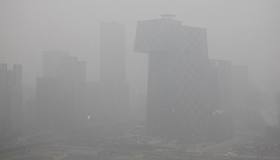
A couple of stories (and a collection of others over at CDT) in recent days begin to link together two big issues in the PRC: concerns for press freedom, stoked by the Southern Weekend affair, and horrendous air pollution, stoked by unrestrained industrial expansion. In the first article, by Edward Wong of the NYT, notices how public disgust over environmental degradation cannot be ignored by the state media:
The Chinese state news media on Monday published aggressive reports on
what they described as the sickening and dangerous air pollution in
Beijing and other parts of northern China,
indicating that popular anger over air quality had reached a level
where Communist Party propaganda officials felt that they had to allow
the officially sanctioned press to address the growing concerns of
ordinary citizens.
As we know, the state works hard to control the media narrative. Two years ago, the Wenzhou train crash demonstrated the growing difficulties for party propagandists in a socially-mediated world. More recently, the Southern Weekend case shows that some editors and reporters and citizens will press back against state intervention and control. Although it is too early to tell what the ultimate outcome will be, the calls for greater press freedom, emanating from Beijing as well as Guangzhou, coupled with events like the "air-pocalypse" enshrouding northern China, could pose a rather serious challenge to the regime.
The problem is that the PRC political system is too rigid to handle the predictable pressures of modernization. The hegemonic party claims responsiblity for all good things, and thus tries to make all that it does to appear good and effective and humane.It must do this because its political legitimacy rests on its capacity to provide public goods. But in its ubiquity it must also be held responsible for all that is bad. There is no alternative authority. There is no other political party. There is only a fragmented and diffusue civil society. There is no real pluralism. And this overcentralization creates an incentive for the Party, when faced with difficult policy problems, to, first, deny that much is wrong and, second, to seek answers from within a realtively narrow base of expertise, one that is dominated by the overriding political imperative of maintaining the Party's power.
Thus, even though air pollution has been a problem in China for many years, it seems that the regime can only respond effectively when its power and prestige interests are involved, as was the case during the 2008 Olympics. Without constant public pressure applied through open, democratic channels, it is unlikely that the regime will take the hard decsions necessary to abate pollution.
But the regime is not allowing more open, democratic channels of public pressure. That, at least, is one lesson that might be drawn from the Southern Weekly incident. Even relatively modest proposals for freedom of expression, as already supposedly guaranteed in the state constitution, must be repressed. The first response in that case was to blame foreigners. Similarly, The Global Times slips into a defensive crouch on the "air-pocalypse," suggesting that China is no worse than the West:
China is still the biggest construction site in the world. At the same
time, it is a veritable global factory. Seventy percent of global iron
and steel, and about half of the world's cement, is produced in China.
Against this background, it is impossible for China to be as clean as
the West.
While it is true that we should not expect China to be "as clean as the West" is now – it is in an early, dirtier phase of economic development - this strikes me as a diversion. It is true that rapid modernization has created environmental problems. This was the experience of the US, the UK, Europe, Japan and elsewhere. The Soviet Union and the Eastern European socialist regimes were also infamous for their environmental degradation. The PRC is now experiencing rapid modernization; thus it is utterly unsurprising that it is also polluting at a relatively high level. The question is: how can that harm be reversed?
The US and the UK – the former notorious for the river that caught fire; the latter for its killer 1952 smog – did curb air and water pollution. And they did so because average citizens who were victimized by that pollution could respond politically and demand action. PRC political institutions do not allow for direct, electoral political pressure to be brought to bear on power-holders. The Global Times offers this exhortation:
The government needs to increase its sense of urgency and ability to
implement its policies. Environmental authorities should enhance their
investigation of enterprises and strengthen the punishment of those that
cause pollution. Businesses that cannot meet environment protection
standards must be eliminated.
But this is precisely the problem in the PRC: institutionally, there is no separation of government and polluting enterprises. The top leadership of the Party benefits materially from the massive state-owned companies that sit atop the "businesses that cannot meet environmental protection." Thus there are powerful disincentives within the structures of political-economic power that impede effective response to the growing environmental crisis. Pollution has been bad in the PRC for a long time. We all know this. But it only gets worse. The reason inheres in the political structure of the regime.
What is needed is political pressure external to the regime, to press and prod for change. But this is exactly what the Party is preventing, as illustrated in the Southern Weekend affair.
At one level, all of this is entirely, and depressingly, typical. All countries, regardless of the type of political regime, experience environmental degradation and attendant public anger when economic development proceeds rapidly and extensively. There is no real advantage here from the "China Model." And that is something to keep in mind when Party propagandists start spouting about the superiority of modernization with "Chinese characteristics." If just ain't so.
The most interesting question is: what will happen in the future as the regime is forced to deal with the problems? It certainly seems like a kind of "rights consciousness" continues to grow in China. People are demanding the right of free expression. They are demanding the right to live in an environment that does not hasten an early death. Events of recent weeks have demonstrated to them that the regime denies them these rights and obstructs them from acting poltiically on their demands.
It would seem the only solution is some sort of political reform, which the Party continues to avoid. Thus, in the medium term, I expect more "crazy bad" pollution days in China. The regime will not effectively respond until the crisis is even worse than it is now. The acid air may eventually corrode the Party's political hegemony, but that will take years. In the meantime, for those of you in Beijing: keep the air filters on high and the surgical masks at the ready….

 The Useless Tree
Leave a comment