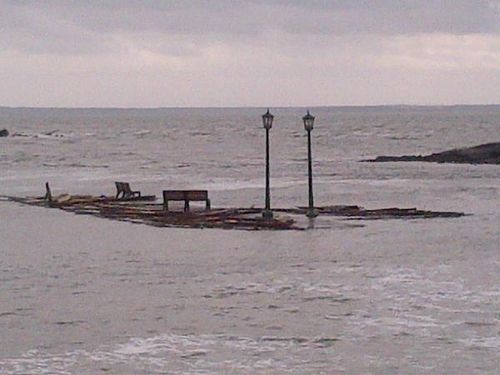
That line from passage 23 of the Daodejing came to mind today, as I saw the terrible damage wrought by Hurricane Sandy. New Jersey seems to have borne the brunt of the destruction. The images of Seaside Heights, devastated and covered in sand, are shocking. My hometown, Rye, New York, lost part of its picturesque boardwalk. But the scenes from New York are most poignant for me. The flooding downtown is simply depressing. It is going to take a long, long time for the Lower East Side to recover. My wife's uncle lives in Breezy Point, flattened by both fire and water. He and his family are safe but such a sad, terrible day….
If I have learned anything about New Yorkers, however, it is that they know how to rebound from tragedy. The City is not defeated, its greatness will endure. "Wild winds never last all morning and fierce rains never last all day" – that is what the Daodejing tells us.
It is all too reminiscent of last year, when Hurricane Irene stormed through my town here, flooding my in-laws out of their house, causing a world of hurt. So, I will paste below a post I wrote then, though now with New York and New Jersey in mind:
***
As I have pondered the disaster, a passage from the Daodejing has come to the fore:
Keeping words spare: occurrence appearing of itself.
Wild
winds never last all morning and fierce winds never last all day. Who
conjures such things if not heaven and earth, and if heaven and earth
can't make things last, why should we humans try?
That's
why masters devote themselves to Way. To master Way is to become Way,
to master gain is to become gain, to master loss is to become loss. And
whatever becomes Way, Way welcomes joyfully, whatever becomes gain,
gain welcomes joyfully, whatever becomes loss, loss welcomes joyfully.
If you don't stand sincere by your words how sincere can the people be? (23)
The
above is David Hinton's translation. I mention that here because as I
consult other translations, I notice some variation. The basic ideas
are the same, but some of the translation choices are different.
For
example, in the first and last lines, the Hinton mentions "words" and
"sincerity." Generally, I see this framing as drawing a parallel
between the impermanence of wind and rain to the instability of language
and any sense of sincerity we may draw from the use of language.
Hinton translates "xin" 信 – as "standing by your words," which I have always liked, since the character is made up of a "person" 人, next to "words" 言. He thus puts forth "sincere" as a key notion here; while other translations (Ivanhoe and Van Norden; Lynn) use "trust" for xin.
I don't see the difference as being that great, and Hinton's approach
allows us to link the last and the first lines in their references to
"words." In any event, that is just the first idea in this multifaceted
passage.
More
important than the implicit critique of language is the observation of
impermanence. Terrible storms come and go. They are beyond our control
in all ways and, as such, they are a reminder of just how much is
beyond human control. In my town, and in my family, we are living that
reality right now. All we could do was watch as the storm rode in and
the water rose. We could not know what the full effect would be, we
still don't know. We can only follow where Way leads.
And
that brings us to another important aspect of the passage, a kind of
"you get out of life what you put into it" message. If we interpret and
experience unexpected circumstances as "gain," we will live "gain;" but
if we interpret and experience those same circumstances as "loss," we
will live loss. There is a kind of agency here. People are not just
mindless automatons in the vastness of Way. We have will and
interpretive capacities. And if we allow that will and those
interpretive capacities to get caught up in transient worldly concerns,
we will experience Way negatively. This is how Wang Bi, a Han dynasty commentator on the classics, understood this passage (thanks to Richard John Lynn's translation, which includes Wang's notes on the text):
Failure … [loss]
results from being entangled in having much… If one is entangled in
having much, he fails, and this is why the text refers to "failure." If
one practices failure, such a one embodies failure. Thus, the text says
that he "becomes one with failure."
In other words, the Dao reacts to one's practices and so responds in kind.
I
don't think this would go so far as to permit a kind of human control
of Dao. Rather, humans have control, not over Dao, but over their own
apprehension of and reaction to Dao. And Dao, then, reacts to our
reactions, and on and on and on…
The
line that leaps out here, for me now, is: "if one practice failure,
such a one embodies failure." Or, as Hinton has it: "to master loss is
to become loss."
If
facing our troubles I will thus not practice failure, I will not master
loss. We have literally lost a home and with that comes a cascading
series of other sorts of apparent losses. But we are not simply victims
of circumstance. We can choose to experience this as loss or as gain.
I choose to become gain…


 The Useless Tree
Leave a comment