Seems like theoretical physicists have worked themselves into futility. Or that, at least, is the sense that emerges from Alan P. Lightman's piece in Harper's Magazine, "The accidental universe: Science's crisis of faith."
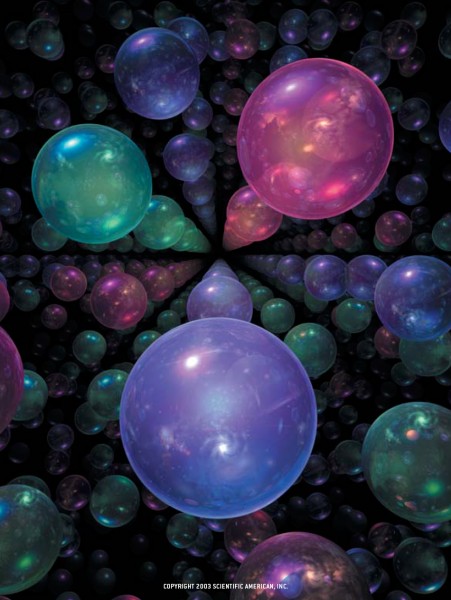
The search for ultimate theoretical explanation of the universe has, essentially, hit a dead end. Actually, it might be better to say it has reached point of infinite, and inexplicable, variation: the multiverse. In short, if I understand this correctly, in order to adequately account for the dynamics and development of the universe, it is now necessary to invoke the existence of an infinite number of other, alternate, universes, each with its own unique and self-consistent set of principles and parameters. The total of all these universes is, then, the multiverse. Lightman highlights the problems this possibility poses for science:
Alan Guth, a pioneer in cosmological thought, says that “the multiple-universe idea severely limits our hopes to understand the world from fundamental principles.” And the philosophical ethos of science is torn from its roots…..
Evidently, the fundamental laws of nature do not pin down a single and unique universe. According to the current thinking of many physicists, we are living in one of a vast number of universes. We are living in an accidental universe. We are living in a universe uncalculable by science.
Science strives for explanation and calculation. When it encounters what appears to be an inexplicable and incalculable problem it has failed in its most fundamental mission. And that seems to be where physics is now.
Of course, none of this is surprising from a Daoist point of view. Daoism tells us that our knowledge, indeed our language, will always be insufficient to capture the fullness and complexity of Dao (Way):
Longing to take hold of all beneath heaven and improve it… I've seen such dreams invariably fail. All beneath heaven is a sacred vessel, something beyond all improvement. Try to improve it and you ruin it. Try to hold it and you lose it…. (DDJ, 29)
As Lightman points out, when science fails at cosmology, a door is open to religious interpretation, in this case "intelligent design."
If such conclusions are correct, the great question, of course, is why these fundamental parameters happen to lie within the range needed for life. Does the universe care about life? Intelligent design is one answer. Indeed, a fair number of theologians, philosophers, and even some scientists have used fine-tuning and the anthropic principle as evidence of the existence of God. For example, at the 2011 Christian Scholars’ Conference at Pepperdine University, Francis Collins, a leading geneticist and director of the National Institutes of Health, said, “To get our universe, with all of its potential for complexities or any kind of potential for any kind of life-form, everything has to be precisely defined on this knife edge of improbability…. [Y]ou have to see the hands of a creator who set the parameters to be just so because the creator was interested in something a little more complicated than random particles.”
This has never made sense to me, from a Daoist perspective. Both the scientists and the theologians seem to believe in an absolute binary here: either there is a singular scientific explanation for the universe or there must be a god-like designer who planned out the minutia that makes our current reality possible. Both abhor the notion of randomness. Why is there so much anxiety about randomness? Yes, the partiuclars of the universe, the very fine margins of the basic forces, are marvelously narrow; a very slight variation would have meant that life as we know it would be impossible. But why shouldn't we believe that what exists now is the result of trillions and trillions of random events and interactions taking place over billions and billions of years?
If we accept randomness we then require neither a multiverse nor a God.
Daoism, I believe, indeed ancient Chinese thought more generally, is much more comfortable with randomness and inexplicability when it comes to cosmology and cosmogony. Here's a quote from Fredrick W. Mote's little book, Intellectual Foundations of China:
The genuine Chinese cosmogony is that of organismic process, meaning that all parts of the entire cosmos belong to one organic whole and that they all interact as participants in on spontaneously self-generating life process… Needham, analyzing that Chinese model, calls it, "an ordered harmony of wills without an ordainer." As he describes the organismic Chinese cosmos, it emerges to our full view as one in striking contrast to all other world conceptions known to human history. It differs from other organismic conceptions, such as classical Greek cosmologies in which a logos or demiurge or otherwise conceived master will external to creation was regarded as necessary for existence. And it contrasts still more starkly with the ancient Semitic traditions that led to subsequent Christian and Islamic conceptions of creation ex nihilo by the hand of God, or through the will of God, and all other such mechanistic, teleological, and theistic cosmologies….(15-16)
"Spontaneous self-generating life process." No "Big Bang," no beginning, no end, just being and non-being, time and timelessness merging one into the other… In a sense, it is a resignation that we will never understand certain aspects of the universe. And, in fact, we do not need to know certain aspects of the universe to live our lives now. Instead of seeking a singular theoretical principle to guide us deductively, we can very well work from the ground up, inductively, in engaging the particulars of our existence. Yes, theoretical physics can be fun (or so I'm told…) but we needn't take it so seriously.
For me, then, the interesting question is: why are people so nervous and afraid of randomness and uncertainty?
While I have no answer for that question, it is amusing that Lightman hits upon a metaphor that brings us back to Zhuangzi. He writes:
If the multiverse idea is correct, then the historic mission of physics to explain all the properties of our universe in terms of fundamental principles—to explain why the properties of our universe must necessarily be what they are—is futile, a beautiful philosophical dream that simply isn’t true. Our universe is what it is because we are here. The situation could be likened to a school of intelligent fish who one day began wondering why their world is completely filled with water. Many of the fish, the theorists, hope to prove that the entire cosmos necessarily has to be filled with water. For years, they put their minds to the task but can never quite seem to prove their assertion. Then, a wizened group of fish postulates that maybe they are fooling themselves. Maybe there are, they suggest, many other worlds, some of them completely dry, and everything in between.
This brings to mind this passage from chapter 17 of Zhuangzi (Watson translation):
Chuang Tzu and Hui Tzu were strolling along the dam of the Hao River when Chuang Tzu said, "See how the minnows come out and dart around where they please! That's what fish really enjoy!"
Hui Tzu said, "You're not a fish – how do you know what fish enjoy?"
Chuang Tzu said, "You're not I, so how do you know I don't know what fish enjoy?"
Hui Tzu said, "I'm not you, so I certainly don't know what you know. On the other hand, you're certianly not a fish – so that still proves you don't know what fish enjoy?"
Chuang Tzu said, "Let's go back to your original question, please. You asked how I know what the fish enjoy – so you already knew it when you asked the question. I know it by standing here beside the Hao."
Hui Tzu, the logician, seeks to prove and disprove. Zhuangzi, the skeptic, understands better the limits of knowledge, even his own. So when challenged, Zhuangzi embraces a kind of perspectivalism: he knows what he knows based on his particular position in a specific context. Writ large, that is what the fish in Lightman's metaphor also suggest. We really can't know much beyond our circumstances, whether that is a universe or the River Hao.


 The Useless Tree
Leave a comment