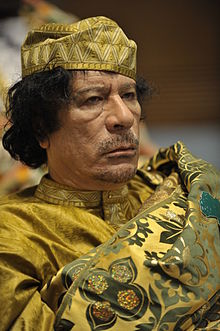
The rather gruesome public death of Muammar el-Qaddafi, dictator of Libya, has caused some upset in more comfortable political quarters. And this was the topic of a historically well-informed op-ed in today's NYT by Simon Sebag Montefiore. He draws comparisons, some fairly grisly, to the fall of other infamous tyrants. And he suggests that the public killing of a despot might yield a productive political catharsis:
Only death can end both the spell to bewitch and the prerogative to dominate — and sometimes, not even death can snuff out power. “The terror inspired by Caligula’s reign,” wrote Suetonius, “could be judged by the sequel.” Romans were so terrified of the emperor that it was not enough to assassinate him. They wanted to see him dead: fearing it was a trick and lacking cellphone footage, they had to be convinced. The mile-long line of Libyans who were keen to see Colonel Qaddafi’s cadaver in its shop-refrigerator-tomb would understand this perfectly.
It seems that the unjust ruler can sometimes (not always, unfortunately) bring about his own demise. The bloodier and more capricious his rule, the more terrible the popular reaction, if the people get a chance to respond. This bring Mencius to mind. When asked if regicide is legitimate, in 1B.8, he answers (Bloom translation):
One who offends against humaneness is called a brigand; one who offends against rightness is called an outlaw. Someone who is a brigand and an outlaw is a mere fellow. I have heard of the punishment of mere fellow Zhou but never the slaying of a ruler.
"Zhou" here is the infamous King Zhou, the final ruler of the Shang dynasty. He is often referred to as "Tyrant Zhou," one of the great villains of Chinese history, righteously overthrown by virtuous King Wu (things get a bit complicated, King Wu was from a state called "Zhou," a different Chinese character than "Zhou" of King Zhou…). Mencius is thus saying that evil King Zhou was so bad – a "brigand and an outlaw" – that he had lost the moral authority of rulership. He was not worthy of any protection from regicide, because he was not a true king. His violent demise, at the hands of King Wu, was justified as a sort of rectification of names. That is, if he was not living up to the norms implied by the title "king" he should not be given that title nor the political status and prerogatives that are associated with the title.
Mencius is generally against killing as a means of government. But in this instance the violent downfall of a tyrant was acceptable. The bad guy brought it on himself for being so bad for so long. The people could no longer tolerate the injustice and they struck out against him.
This does not necessarily imply a generalized "right to rebellion" in Menicus. Nor does it necessarily mean that the "people" are the legitimate agents of this kind of political change. In 5B.9 he tells us that it is ministers from royal families who have the moral standing to remove bad rulers.
But 1B.8 reflects a kind of resignation. If tyrants face the people's wrath and die violent deaths, we should not mourn them as fallen kings. Rather, we should look forward and ask: who will bring humane government to a traumatized land?
Mencius would not feel sorry for Qaddafi.


 The Useless Tree
Leave a comment