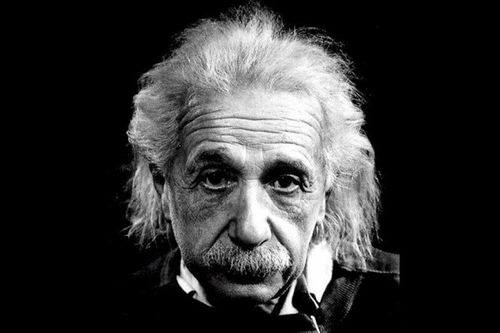
Last week we heard a lot about the experiment in Europe in which a neutrino was measured as traveling faster than the speed of light, a theoretical impossibility according to Einstein. And so now we have a spate of articles asking: "Is Einstein Wrong?" This causes anxiety for some, insofar as Einstein's theories have come to define some pretty basic assumptions about reality and knowledge:
If the OPERA result were correct it would point to some extraordinary things. We’ve all grown up understanding that the only sensible thing for matter to do is to never exceed (or indeed reach) the speed of light. It’s a fundamental piece of Einstein’s special theory of relativity, which is one of the best verified theories in modern physical science. I won’t go into the details here, but for matter with mass to exceed lightspeed there are a large number of headaches, not least of which are the most basic ideas of causality – at both the microscopic and macroscopic scales….
Saswato Das has a nice piece along these lines in yesterday's NYT:
All sorts of strange things could happen if the speed of light can be exceeded. Causality — the relation between cause and effect — would be affected. Anyone traveling faster than the speed of light would be able to see fragments of a broken vase coming together. Faster-than-light travelers could go back in time — say, leave New York for Paris one evening and return the previous day.
Freaky…
But I don't share these anxieties (and I would be happy to arrive in Paris before I left…), and that's because I was reading the Daodejing this week. A philosophical Daoist would not be surprised at all that Einstein might be wrong. Of course he is wrong, at least in the sense that human knowledge, generally speaking, is always less than the fullness and complexity of Way (Dao). Henrick's translation of passage 34 gets at this:
The Way floats and drifts ; it can go left or right.
It accomplishes its tasks and completes its affairs, and yet for this it is not give a name.
The ten thousand things entrust their lives to it, and yet it does not act as their master.
Thus it is constantly without desires.
It can be named with the things that are small.
The ten thousand things entrust their lives to it, and yet it does not act as their master.
It can be named with the things that are great.
Therefore, a Sage's ability to accomplish the great comes from his not playing the role of the great. There he is able to accomplish the great.
Way, the simultaneous expression of all things, being and nonbeing, is larger than the parameters of human language, mathematics included; thus, it is nameless, it cannot be expressed in words or formulae. We do, of course, use words and names to try to characterize and come to know some portion (always partial) of Way. Thus, it can be associated with small or large. But in its vastness, Way can move in ways that are unexpected: it can go left or right, float and drift. Our names, or theories or hypotheses or knowledge, can never capture its totality. And this goes for Einstein as well as anybody else. We shouldn't expect the general theory of relativity to be a knowledge that is all encompassing.
Interestingly, Das makes reference to Karl Popper:
Testing theories through experimentation has always been the basis for scientific progress. The philosopher Karl Popper called this the notion of falsifiability of scientific theories.
Popper is obviously not a Daoist, but he does encourage a certain intellectual humility that a Daoist could appreciate: our knowledge is always unstable, subject to falsification; the best we can do is a kind of conjecture. Or as the Stanford Encyclopedia of Philosophy puts it:
Scientific theories, for him, are not inductively inferred from experience, nor is scientific experimentation carried out with a view to verifying or finally establishing the truth of theories; rather, all knowledge is provisional, conjectural, hypothetical—we can never finally prove our scientific theories, we can merely (provisionally) confirm or (conclusively) refute them; hence at any given time we have to choose between the potentially infinite number of theories which will explain the set of phenomena under investigation.
Our knowledge is never finally established… because Way can float and drift, move left and right.
Should we give up on all science, then? No. I don't think a contemporary Daoist skepticism would reject all science all the time. Rather, it would simply counsel humility. We might reasonably determine how certain facets of Way generally unfold in time. But we should always be open to things that exceed our knowledge. We can never know Way and we can never control it, but we might come to learn how to move through certain aspects of Way, without, alas, arriving in Paris before we left…

 The Useless Tree
Leave a comment