…is that the proper English antonym for filiality? I find the nouns "filiality," as well as "filialness," in my OED. But I don't find antonyms, using either the prefix "un-" or "a-." I do find "unfilial" as an adjective, and not "afilial." So, I guess, if we want to negate "filiality" (which I think sounds better than "filialness"), we should use: "unfiliality." I would prefer "afiliality" but I'll stick with the "un-" form for now…
This comes to mind after reading the piece by Wen Liao in Foreign Policy: "Revenge of the Tiger Children," which gives us this paragraph:
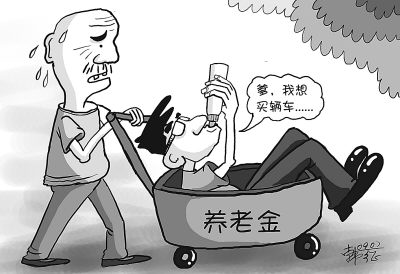
Filial piety has long been a tenet of traditional Chinese culture, and is a core concept of Confucianism. Today, however, many young people nowadays not only shirk this duty, but insist that it is actually the duty of parents to do all they can to care for them, even as adults. Small wonder, then, that a popular insult hurled at the current generation of young Chinese is to call them "ken lao zu" — the generation that sucks the blood of their parents, i.e., the vampire generation.
The story is by now very, very familiar: the combination of China's one-child policy, which has produced spoiled "little Emperors" who are lavished with the attention of the parents and grandparents, together with powerful consumerist-materialist cultural trends have fundamentally undermined the old value of filial piety. Thus, instead of children learning obedience and familial obligation within the family and society, the state now has to legally mandate elder care:
So worrying is the behavior of today's "little emperors" — the products of the country's one- child families — that Beijing is preparing a law to impose a legal duty on young people to visit and care for their aged parents. Indeed, the proposed amendment to the "Law on Protection of the Rights and Interests of the Aged" would allow elderly people to go to court to claim their right to be physically and mentally looked after by their children.
This, of course, is not at all what Confucius had in mind. He was rather down on the idea of a legally enforced morality. If you have to use law and state power to instill respect toward parents, you've pretty much already lost the game:
The Master said: "If you use government to show them teh Way and punishment to keep them true, the people will grow evasive and lose all remorse. But if you use Integrity to show them the Way and Ritual to keep them true, they'll cultivate remorse and always see deeply into things." Analects, 2.3
If China was truly a Confucian society, it would not need laws to compel children to car for their parents and it would not have to worry about a "vampire generation" – ken lao zu – 啃老族 - (which might be better translated as "parasite generation.").
The term ken lao zu has been around for awhile. This Shanghai Daily piece from 2009 suggests a 2005 coinage. It literally means "the generation that bites [or gnaws or nibbles] the old." It usually refers to young people, twentysomethings, who have not been able to find regular work and need to rely on their parents. Rather like the "boomerang generation" in the US and the West. But to the extent that the culture of ken lao zu brings with it a slackening of filial obligation, it poses a larger problem for those in China who want to construct or reconstruct something like a Confucian society under modern/postmodern conditions. The kids are just not doing their filial thing.
Wen Liao's piece mentions the official encouragement of Confucian revival in China, symbolized, for a moment, by the placement of a statue of Confucius near Tiananmen square. And he duly notes how that statue has since been taken down, moved to an interior space not visible to pedestrian and other traffic at Tiananmen. This happened back in April, while I was traveling, and I wasn't then able to comment on it. Let's just say it's not too surprising. Confucius has always had his detractors within the CCP, which was founded on strong anti-Confucian principles. And lately, given tensions in the Middle East and general worries about the loss of "socialist spiritual civilization" (does anyone still really talk like that?), Party leaders may want to invoke Mao, more than Confucius, as the basis of their authoritarian legitimacy. Daniel K. Gardner suggests as much:
Chinese leaders today are in a state of high anxiety. The turmoil in the Mideast has them agitated and overly vigilant. It seems too that there's a tug of war within the leadership itself, between hardliners (like Wu Bangguo) and more reform-minded liberals (like Premier Wen Jiabao), with the hardliners, for the time being, ascendant. In any event, the Beijing government doesn't appear to be in the mood to countenance any threats to its authority — and to the authoritarian principles that undergird Communist Party rule. Confucius' very presence in the square may have been perceived by many as diminishing Mao (e.g., Maoflag.net), the "Great Helmsman" of the Chinese revolution and the continued source of much of the CCP's legitimacy today.
It seems, then, that good old Confucian values, like filial piety, are under siege from below, as spoiled children shirk their family duties, and from above, as Party hard-liners stuff the statue of The Master out of public view.

 The Useless Tree
Leave a comment