This story reports on religious Daoism, which is really not my specialty, but I'm not thrilled by this turn of events:
Over the Lunar New Year weekend Vivian Choi made her annual visit to Wong Tai Sin, one of Hong Kong’s largest Taoist temples, to ask for blessings in the new year. But instead of burning 100 incense sticks in the age-old Taoist tradition, Ms. Choi slipped a written prayer into a small box. An electronic deity statue then lit up and blew artificial smoke, signaling the acceptance of the offering.
As worshippers welcomed the Year of the Rabbit, Wong Tai Sin temple in Kowloon ushered in a new era of its own: high-tech Taoism.
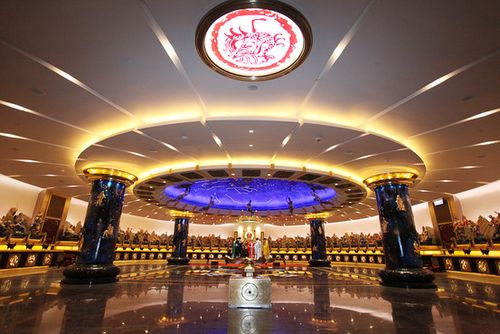
For 100 million Hong Kong dollars (US$13 million), the 90-year-old temple created a underground prayer room — decked with gold and marble and equipped with LED lights and motion detectors — just in time for the Lunar New Year holiday, which started Feb. 3 and is expected to draw more than a million visitors to the temple over two weeks.
The 10,000-square-feet chamber, which took three years to complete, features a vaulted echo-enhancing ceiling emblazoned with a planetarium-like digital replica of the Hong Kong sky that rotates in accordance with the seasons. Two HK$3 million floor-to-ceiling wall hangings, made of marble and rare gemstones, adorn the entranceway. Worshippers enter the hall and deposit a written prayer before one of 60 statues representing the gods of the Chinese zodiac, which responds with flashing lights and bursts of smoke.
Gold, marble, rare gemstones. A philosophic Daoist might ask: why? Is the glitz and technology necessary for the religious practice? On the face of it, it would seem to contradict the general Daoist preference for simplicity and spontaneity and naturalism.
The charitable interpretation, mentioned in the story, is that the glitter will attract more people to the religious practice. Perhaps. But a more cynical possibility is also suggested:
Chan How Ling, 49 years old, has been making Lunar New Year visits to Wong Tai Sin for more than 30 years. She says she will continue to make offerings at the temple’s traditional 90-year-old altar, refusing even to visit the new prayer hall.
“I don’t believe in this electronic stuff, and it’s ridiculous that they ask us to pay a fee to worship,” she says. “I think they probably just want to attract tourists, and they shouldn’t be using so much temple money for this.”
That was my first impression, too. But I'm not a religious Daoist and, thus, cannot really appreciate all that is at work here. Indeed, when we think historically about the more traditional wooden temples, which might have included statues, maybe even painted gold, of various Daoist immortals, we should realize that those structures, which seem so old and quaint now, were technologically advanced for their time. Where else might the average person encounter sparkling gold paint? So maybe this new technological garb is not so radical. Yet, even with that long view, I'm still uncomfortable calling this "Daoist." Passage 12 of the Daodejing keeps coming to mind:
The five colors blind eyes. The five tones deafen ears. The five tastes blue tongues. Fast horses and breathtaking hunts make minds wild and crazy. Things rare and expensive make people lose their way.
That's why a sage tends to the belly, not eye, always ignores this and choses that.
Things rare and expensive make people lose their way – indeed…

 The Useless Tree
Leave a comment