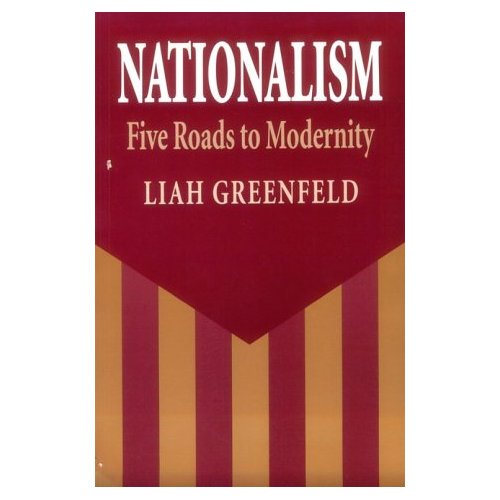
In my class on East Asian nationalism were are reading the introduction and afterword of Liah Greenfeld's book, Nationalism: Five Roads to Modernity. It is quite different from the Gellner book I mentioned in posts below. She is much more subjective in her analysis, as opposed to Gellner's vaunted objectivity.
This passage from Greenfeld jumped out at me:
The cardinal fact of human existence is that humans lack built-in "models for" behavior in groups. Social integration and cooperation are necessary for the preservation of the human species (as well as for its individual members), but there is no innate knowledge of how this should be accomplished. The lack of innate knowledge results in the need for models and blueprints, for an image of order, or created symbolic order, among human beings. (18)
For her, national identity becomes one of those "created symbolic orders," and a particularly powerful one under conditions of modernity. (Quite to the contrary of Gellner, she argues that nationalism produces modernization, not the other way around).
That passage, and that sensibility, brought Mencius immediately to mind:
“Hou
Chi taught the ways of agriculture to the people, taught them how to plant the
five grains. And when the five grains
ripened, the people were well fed. But
once people have plenty of food and warm clothes, they lead idle lives. This is their Way. Then, unless they’re taught, they’re hardly
different from the birds and animals.
The sage-emperor worried about this.
He made Hsieh minister of education so the people would be taught about
the bonds of human community: affection between father and son, Duty between
sovereign and subject, responsibility between husband and wife, proper station
between young and old, sincerity between friend and friend.” (5.4)
后稷教民稼穡。樹藝五穀,五穀熟而民人育。人之有道也,飽食、煖衣、逸居而無教,則近於禽獸。聖人有憂之,使契為司徒,教以人倫:父子有親,君臣有義,夫婦有別,長幼有序,朋友有信.
Mencius, of course, famously asserts that all human beings have an innately good human nature. But that innate goodness must be cultivated and developed. We must be taught, and constantly continue to teach ourselves, how to be good. We require the "created symbolic order" of Ritual and Duty to establish and live through the "bonds of human community."
I suspect Mencius would reject the limitation of this project to nationalism, which is too parochial in its vision. Rather, he would see this as a more universal, transnational endeavor….

 The Useless Tree
Leave a comment