Just saw this brief item in the Global Times. Let me re-post it in full and respond below:
Confucius in court
A descendant of Confucius has threatened to take the producers of a
biopic of the ancient sage to court, saying the film ruins Confucius'
reputation.Kong Jian, who claims to be a 75th-generation direct descendant of Confucius, has sent a letter to producers of the film asking them to delete the parts that are "obviously against history," according to Sohu.com.
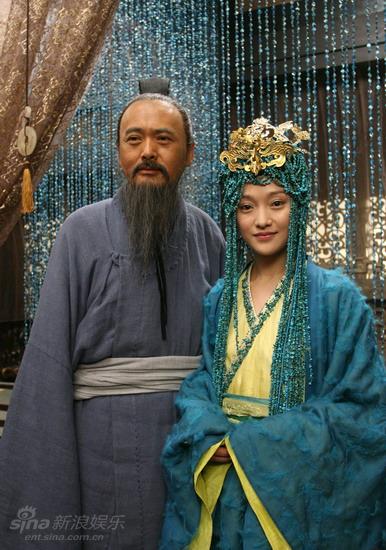
In a recently released film trailer, Confucius, played by
Hong Kong superstar Chow Yun-Fat, speaks in modern languages. The
trailer also highlights a conversation between Confucius and famous
concubine Nan-zi.Kong believes the conversation misleads the audiences that Confucius was romantically attracted to Nan-zi.
"Your recent trailer contains scenes that are obviously against
history and ruin Confucius' image as a sage," Kong wrote in his letter.
"Your film should respect history, not sacrifice Confucius' reputation
for your commercial pursuit."Kong asked the film's producers to delete the modern languages and use words from The Analects.
Kong also wants to see fewer scenes of Confucius with Nan-zi in the film. He threatened to take the production to court if his demands were not met.An unnamed representative of the film told Sohu.com that no changes would be made.
The film is slated to open in cinemas next month.
Several things here. First, should the fellow really be threatening court action over a trailer? How can he know how many scenes there are with Nanzi (an infamous concubine) when he has only seen the trailer? And how can he determine what the full import of the Confucius-Nanzi relationship is? This report suggests that the movie is spinning the meeting (noted in Analects 2.28) as a perfectly innocent discussion of poetry. Edward Slingerland suggests that Confucius may have visited Nanzi out of a sense of ritual propriety (established protocol required that he pay his respects to the wife of the person he intended to see) or in search of some political advantage.
In any event, it seems defensive in the extreme to simply ignore the Confucius-Nanzi meet up. And, given Nanzi's reputation, the episode has inspired literally centuries of speculation about just what went on when the door was closed. So why not let movie goers consider the whole range of possibilities?
Second, does the contemporary Kong think that The Analects is somehow a verbatim record of Confucius's own speech? The book itself was produced after his death by his disciples and has undergone untold editorial changes and adaptations. A movie that had a characterless Confucius simply mouthing sayings from The Analects would be further from the historical "truth" (if such can ever be known) than whatever the new movie comes up with.
Third, as I have argued before, the real life Confucius may not have lived up to the ideals of Confucianism. This point might best be explored through The Sage's relationship with his wife. He left her – some say he divorced her – when he went on his long journey with his buddies. On the face of it, that would seem to be shirking a publicly recognized duty, though perhaps the historical practices of his time tolerated husbands simply walking away from their immediate familial obligations. Whatever one thinks, the movie should engage with the issue of Confucius and his wife, but I suspect it won't. We should contemplate how Confucius himself attended to his duties to understand the difficulties and complexities of being "Confucian."
Finally, the idea of suing the makers of the movie is, in itself, un-Confucian. As Analects 2.3 reads:
子曰:“道之以政,齊之以刑,民免而無恥;道之以德,齊之以禮,有恥且格。”
Ames and Rosemont translate this as:
The Master said: "Lead people with administrative injunctions (zheng 政) and keep them orderly with penal law (xing 刑), and they will avoid punishments but will be without a sense of same. Lead them with excellence (de 德) and keep them orderly through observing ritual propriety (li 禮) and they will develop as sense of shame, and moreover, will order themselves.
The contemporary Kong, if he wanted to live up to his ancestor's principles, would thus simply make his points in writing and resist the temptation of the lawsuit.
Indeed, it is precisely that subltey of Confucian thinking – avoid the false precision of the law and lead through a more fluid and complex use of ritual and virtue – that led to the imfamous rendez-vous with Nanzi….

 The Useless Tree
Leave a comment