I've been distracted of late, as the drop off in posting here suggests. A college reunion (first one I have been to in thirty years! Yes, thirty years) took me away this weekend. And work is getting busier, with end of the semester papers coming in. So let me just quickly provide a couple of links here to a couple of posts on Mencius at other blogs. I'm thinking of Mencius now because my class recently finished reading the text and many of my students are handing in papers on it…
First up Chris Panza, over at A Ku Indeed. He has two Mencius posts. In "High Bar for Sons" he asks:
transform his father/mother? Are the virtues that embody “being a son”
incomplete if they are not mirrored by the virtues involved in being a
dad? (I presume this holds in the reverse direction for sons, too).”
The short answer: yes, Mencius is serious. He is tell us that our duties toward our parents extend beyond mere obedience, which is usually what "filial piety" implies. Indeed, one of the greatest aspects of the story of Shun, at least in Mencius' telling, is how he came to understand that sometimes (not very often, but sometimes) filiality might require a certain disobedience of parents. There are various possibilities of what this larger filiality, which justifies disobedience of parents, might be: having a heir (Shun disobeyed his parents and got married against their wishes in order to produce an heir); creating a new context of enacting Humanity in his relationship with his wife; and/or "realizing his parents." This latter – which Chris's translation renders as "transforming his father/mother" – is obviously linked to the other two: the parents' Humanity is more fully realized, thus opening transformative possibilities for their less humane personal characteristics, in Shun's actions of getting married and producing an heir. But we might be able to think of other ways in which our own performances of Humanity might similarly uplift out parents. And that is what Mencius wants us to do: think about how all of our actions might relate back and contribute to the Humantiy of our parents. It's not just about obedience.
Chris also has a longer post, "Mencius on Moral Effect," which raises questions about the power of exemplary moral leadership. Good reading….
I also want to mention a post, "Bad Sons," by Alan Baumler over at Frog in a Well, which places the story of Shun in a broader historical context (i.e. considering how bad sons and wicked fathers figured in myths that precede Mencius):
piety, but rather trying to explain away the unfilial behavior in a
story that is not really about filiality and moral influence, but
rather is about the extremes of human possibility and the need to impose hierarchy on the family. Mencius is struggling
to put a “modern” reading on a much older story with different concerns.
I'm not sure I buy this completely, not as it is expressed here. Mencius may well be a "modernizer" of sorts, especially in pressing for a moral meritocracy of sorts over and against mere hereditary legitimacy, but he is using Shun to describe filial piety.
In any event, it's always good to have more Mencius on the web…
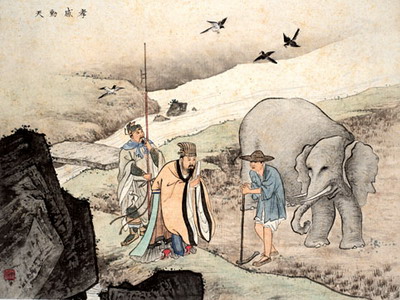
(Painting below is of the sage-king Yao discovering the modestly attired Shun plowing the fields. I didn't realize that elephants helped Shun plow…):


 The Useless Tree
Leave a comment